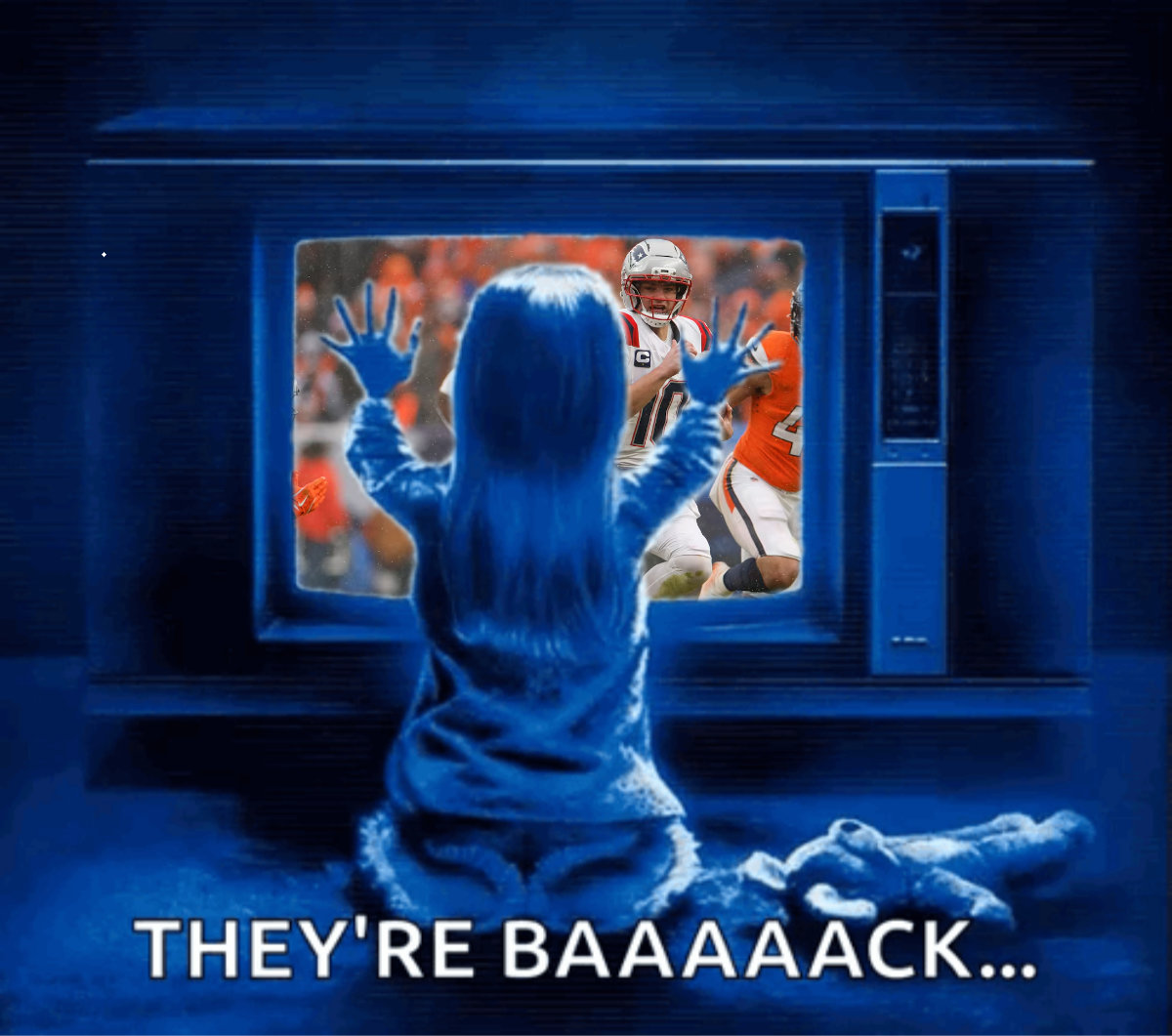
Go Pats!
[Props to my brother who made this. Thanx, JT!]
The US is suddenly very bad at a lot of good things: caring for the unfortunate, uplifting the oppressed, promoting a healthy environment, and protecting future generations, for instance. We’re making up for that by being really good at bad things: terrorizing minorities, killing innocent civilians, and invading friendly countries come immediately to mind but there are loads of others.
One more example of the latter occurred to me of late, reinforced by the commercials that have bombarded my senses as I watched football playoff games. It appears as if we are world leaders at manufacturing gamblers.
It used to be that, if you wanted to gamble, you went to Las Vegas (a.k.a. Lost Wages) and blew the nest egg. Other alternatives were the dog and horse tracks, for those drawn to such diversions. For the truly desperate, there has always been the option of tracking down some lowlife bookie and throwing away money at him. (Not to be sexist, but were there female bookies?)
Over time, short-sighted local governments got into the game with lotteries, i.e. voluntary taxes on people who are bad at math. All the aforementioned activities catered to a limited population or at least were small potatoes, it seems to me.
Things have changed.
You can literally gamble anywhere, anytime, if you have a phone and a connection to the Internet. It’s safe to assume that’s pretty much everyone in the US. If the proliferation of sports gambling commercials is any indication, all sports above youth level exist for the sole purpose of gambling, while sports “news” is all about odds, overs and unders, and other such profligate falderal.
For football, you have the ability to not only bet on game outcomes but countless other possibilities. Who will win MVP? Who will kick the first field goal? What color Gatorade will be dumped on the winning coach? (Seriously, that’s a thing!) I can only assume the same goes for baseball. Will the next pitch be a strike? How many innings will the starting pitcher go? What will be the “launch angle” of the next home run? With baseball, the number of trivial stats and possibilities is virtually endless. Any baseball fan knows that. A veritable gambler’s gold mine, paying off almost solely to “the house”, whoever that might be.
Punch in, folks! They aren’t paying for all these big names and expensive advertising minutes on money they’re giving away. They’re getting it from suckers who think they’re going to win in spite of the fact that the odds are stacked heavily against them. The saying is trustworthy and deserving of full acceptance: “Someone has to win. It just won’t be you.”
My point is that there were only so many outlets for gambling back in the day. Today, there are more than anyone could count. Plus, it’s encouraged by the new bookies: everyone from your governor to your favorite entertainers, be they artists or athletes. To keep that voracious beast fed requires churning out new gamblers. They have to come from somewhere and they don’t grow on trees. We’re manufacturing them. It’s likely they were gamblers all along but didn’t partake, not unlike an alcoholic who doesn’t drink. ‘Cept these folks have fallen, or perhaps been thrown, off the wagon. To quote another wise man, “If you think you may have a gambling problem, stop thinking.”
That’s bad.
And America is good at it.
Are we great yet?
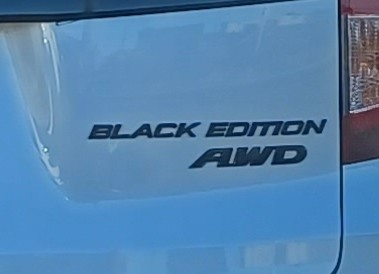
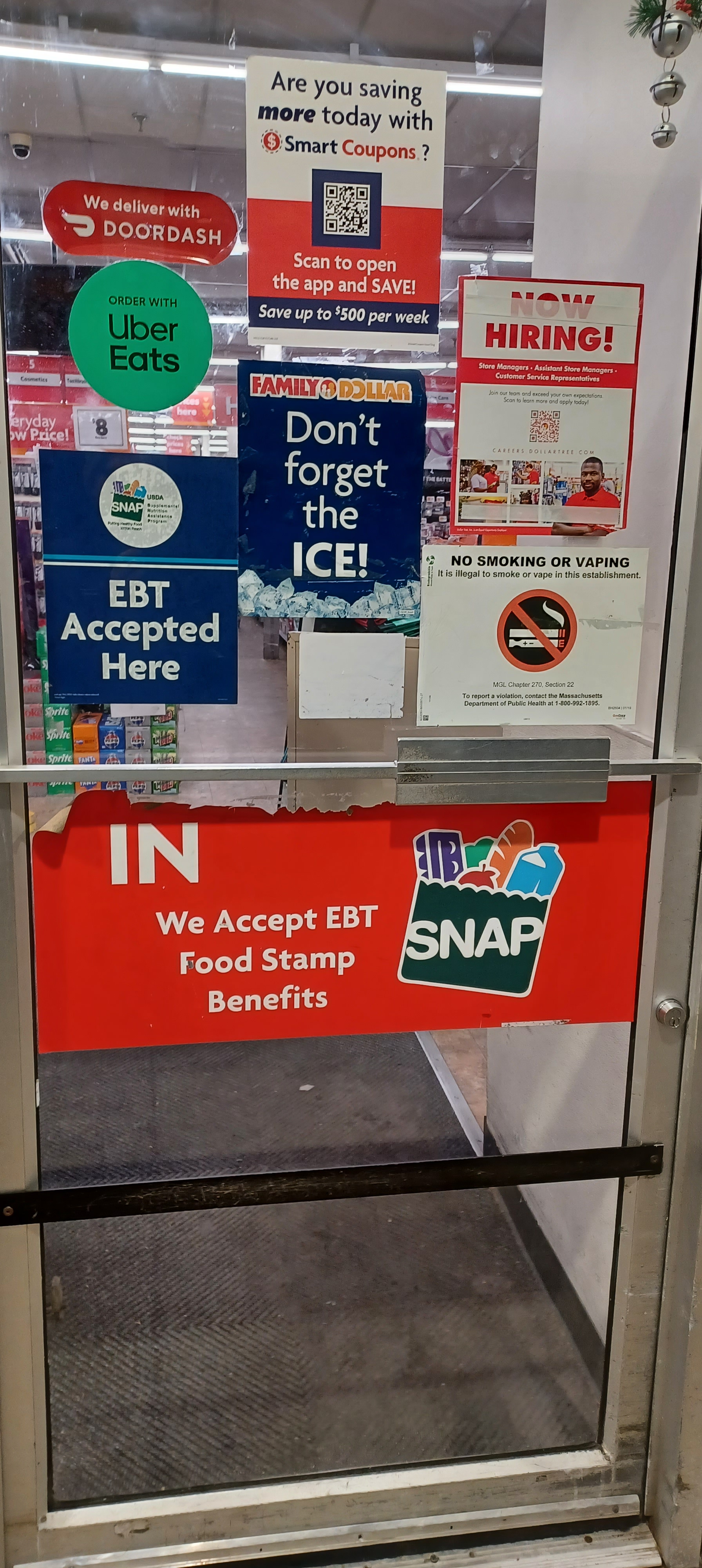
Having a camera in my phone is great for capturing strange, unexpected sights. Here are two examples taken just a few days apart recently in the same town, within two miles of each other.


Second example. This is the door to a local store that, as you can probably tell from some of the signs, serves a lot of low income customers, some of whom are bound to be immigrants in this immigrant-rich community. Or they could be mistaken for illegal immigrants and arrested by small-minded MAGA bigots.
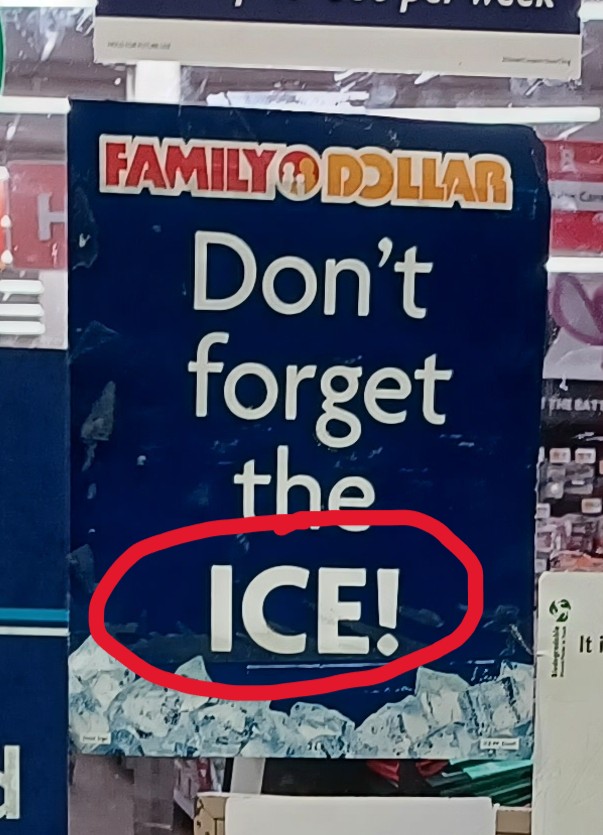
Now for the blow-up…
Could someone be sending a covert warning because of the dangerous, toxic government that now rules this nation? I hope so but it’s probably just a coincidence.
A sad, ironic coincidence.
* Reference to the movie “Blow-Up”, directed by Michelangelo Antonioni, about a photo that’s blown up to reveal clues to a crime.
We all have our days of reckoning when it comes to Christmas. Remember that fateful moment when you came to the realization that Santa Claus was fabricated by parents (as a scapegoat for their gift-giving failures) and toy manufacturers (as a profit-making ploy)? This year I had a similarly painful epiphany, this one regarding what Linus says “Christmas is all about.”
I learned that there’s a very good chance that Jesus was not shut out of an inn by a hostile innkeeper and forced to give birth in some Godforsaken cave. (Another spurious artifact, the “stable” motif, long ago bought the farm, pun intended.) No, it’s most likely that the young parents, Mary and Joseph, were hosted by family back there in Bethlehem and delivered the Christ Child within the confines of their home, which might still have been a cave. Given that setting, they were likely assisted by family and/or a midwife, a far cry from the lonely birth witnessed only by animals.
The manger remains—it’s there in scripture. The Magi are still part of the picture, although they probably arrived on the scene closer to Jesus’s first birthday than on the night of His birth as depicted in the classic creche. So also those those scruffy n’er-do-well shepherds. (Note well: Pariahs (shepherds) and pagans (the Magi) were the first to know of the Incarnation, long before the religious elite or royal powers-that-be. That’s like God revealing himself to illegal immigrants and irreligious idolators before presidents and preachers. Think about it.)
All these minor details are just that and shouldn’t be allowed to distract us from the “the true meaning of Christmas.” This is not, contrary to what lame Hallmark Christmas movies tell us it is, a renewed romance with your old high school flame in your home town. It’s not spruces or snow or Santa, gifts or Grinches or gewgaws. No, it’s the ultimate drop-in, Immanuel, God with us. That part will not be shaken.
Merry Christmas.
It’s a tried and true cliché: Writing is a solitary affair. A writer and his or her computer, typewriter, pencil, tablet, pen, marker, crayon, or other writing implement of choice are isolated for hours, days, weeks, or months on end staring out a window, at a wall, or at the blank page. Locked away in an office, attic, basement, or studio with no people, no interactions, and no interruptions (hopefully). The writer alone with his/her thoughts. (And, when working on a computer, with the endless distractions of the Internet.)
I’m an extroverted, community-oriented, people-energized kind of guy. How did I end up in this world?
Well, there’s another cliché, just as true, that while writing is solitary, a book is a communal undertaking. I can scribble all day for my own entertainment and edification but unless I have others to assist in getting it from the page to an accessible form, it’s merely an exercise of the imagination. That has its own value, to be sure, but it’s generally not the writer’s ultimate aim. Furthermore, if no one reads what I scrawl, it’s vanity of vanities, as the Preacher tells us. The written word needs to be read to be complete.
Take my case, for example. Each of my 12 (so far) books lists me as sole author. (My picture book also has an illustrator.) That’s misleading because I hardly worked alone. There were editors, designers, consultants, inspire-ers, and (maybe most important of all) encouragers, to name a few. And, as I said above, the folks who read those books are as important as any contributor. To paraphrase the age-old question, “If a book is published and no one is there to read it, does it matter?”
Change is in the wind. For the first time, my writing is part of a group project. The local writers’ group I’m part of has published a collection of writings. I had the privilege of contributing three pieces: two short stories and an essay. “Somewhere Stories” can be found on Amazon by clicking on the image below.
As the flyer above indicates, a book launch will be held next week, on Thursday 12/18/25 at the “somewhere” where we meet, the Chelmsford (MA) Center for the Arts. Feel free to drop by, have some cookies, and check it out.
(In case you were worried that I’ve given up writing long form books on my own (admit it, you were worried, weren’t you), fret not! I have a new book in the works, a family-friendly comic tome based on another of my unproduced (as yet 🙂 ) screenplays. God willing, it will be out in plenty of time for better weather reading.)
Apropos to the day, and in keeping with a tradition I’ve maintained for the past few years, I herewith present my annual cryptic list of a small sampling of items I’m thankful for on this Thanksgiving week and always.

God and family are implied, as always.
On the subject of gratitude, here are two of my favorite quotes on the topic from one of the most quotable people of all time, G. K. Chesterton:
Now a couple of thoughts from a lesser voice, me:
I hope and pray you have the most Grateful Thanksgiving ever. And that you have Someone to thank.
I’ve written before about how the world changes but language seems to lag behind. Thus we still use phrases like “through the wringer” long after wringers have ceased to be. For a full discourse on the topic, see this previous post.
A couple of idioms just keep on living, like a pair of linguistic zombies, more than a century after their original usage has, for most intents and purposes, passed into history.*
Those expressions relate to blacksmiths, for Pete’s sake! (Whoever Pete is.) But their usage has continued unabated—possibly even increased—long after the profession has faded from most memories, if it was ever there in the first place. How are these beasts hanging on? Maybe I’ll dig out my slide rule in case it makes a comeback.
* Yes, the craft still exists, mostly as an artistic form, but, c’mon, blacksmithing? Really?
Most people can rattle off a few of the classic “seven deadly sins”, although few can name them all. According to Wikipedia, that Font of All Imperfect Knowledge (or FAIK), they were codified by Pope Gregory I in 590 AD. They are:
It’s been said that envy is the only one in the list that has no upside. The others can be kind of fun to wallow in, for a little while anyway. That’s one problem with the list. The other, more troubling one, is that it no longer resembles a list of faults or transgressions. Rather, it reads like a job description for POTUS. (Seriously, look at that list and make the comparison yourself. It’s one thing to perpetrate those transgressions. It’s a whole ‘nother to brag about them.)
For a very long time, I’ve believed the list to be incomplete. There’s one I fall victim to as do most people I know, to our and society’s detriment.
Yup, I think fear might be the deadliest sin. For those who, like me, take their standards from the Christian Bible, you’ll find the pages there replete with exhortations to overcome fear or avoid it altogether. Here are a few:
And the grandaddy of them all, Psalm 23:
In fact, I once did an audit of the entire Bible in order to determine what the most common command in Scripture is. I can’t remember the exact order, but “fear not”, or some variation thereof, was first or second.*
Here are a few more excellent quotes that affirm the truth of the above:
Avoid this deadly sin, probably your elected leader’s greatest one, and the rest of the list becomes a whole lot easier. And less frightening.
Fear not…
* For the curious among you, the other charge was some form of “Go.” Combine those and you have something to think about. And do.
A BlogSnax© post
(I’ve been doing a lot of these easy, photo-based posts lately. Perhaps I’m lazy. Or maybe I’ve lately come across an abundance of bizarre stuff worthy of further exposure. Or maybe it’s a little of both. More likely, it’s a lot of both. Here’s today’s slothful submission.)
A friend of mine recently returned from a trip to Austria. Gentleman that he is, he brought me back a souvenir in the form of a bar of Austrian chocolate. As a big fan of the dark brown delicacy, I was immensely grateful.
Until I looked closely at the wrapper, reproduced below, at which point my appetite disappeared. What do you think?
Which caused me to ask myself, “Who thought that photo was a good idea?”