Defusing the bombs

fbombSomeone wiser than me (that’s covers pretty much everyone) once observed that no one ever left a movie theater saying, “Yeah, it was a good movie. I just wish there had been more swearing.” Plenty of audience members yearn for more violence or lurid sexual content, but swearing is not really in that great demand.

I guess the market is saturated.

This topic came to mind recently when I read an online discussion among screenwriters wondering whether the whole F-bomb thing had gotten out of hand. The discussion was initiated by someone who questioned whether movies rely too much on that popular profanity to convince viewers of the film’s edginess.

Funny thing about that. F-bombs have been defused merely by their ubiquity. They aren’t spoken only by nasty thugs in edgy movies or shady characters in bleak noir films. They’re in goofy comedies, historical epics, and science fiction. They’re in everything! We’ve been carpet F-bombed. As a result, the very effect they supposedly serve is gone. It’s just another cliché. A cliché no one questions.

Let’s think about it. If a character in a movie said any other word as often as Robert De Niro or Chris Rock use The Big One in an average movie, no one would take them seriously. The argument is that this is the way people talk. Which people? I don’t know them, and I’ve been in some pretty rough environments. In my experience, the number of times a person uses that word is inversely proportional to the IQ of the speaker.

Besides, film characters aren’t written to speak the way people really speak. The “um”s, “uh”s, and “er”s are generally banished because they’re boring, just as excessive swearing has become boring. Suppose, for example, a character said the word “like” as often as many people do today, say, like this. That dialog would be unlistenable. It would never pass development muster.

So we’re on our way to completely declawing another obscenity. We’ve seen it before. When I was growing up, there were still older people who remembered where the word “screw” came from. If we innocent children referred to something as “screwed up”, we were shushed or, if we were unlucky, went on a soap diet. We had no idea why. Today no one bats an eyelash at screw, which means essentially the same thing as… well, you know.

For better or worse, our culture is in the midst of the dilution of another cuss word: suck. No one said this when I was young. It was a “swear word”. Like the other no-say-ems, it referred to a sexual act. Now it means… well, it means nothing. And everyone says it with impunity, from children to parents to ministers to teachers. It’s just another word.

Crap, heck, darn, shoot, screw. The euphemism backlog is growing as the “real” swears fade into impotence. I’m not sure if all this is good news or bad. Are we lowering the standards of the language or are we gradually removing the words that hurt?

I don’t friggin’ know.


Addendum: OK, just so you know it’s not only narrow-minded bloggers like me who think this way, here’s a quote from a recent newsletter from Richard Walter, chairman of the UCLA screenwriting program:

“The downside to writers having the freedom to write whatever they want is that it allows us also to write as badly as we want. The relentless exploitation of vulgarity is supposed to foster a sense of authenticity. In fact, however, it usually achieves precisely the opposite: heavy-handedness, thudding self consciousness, and a tone that is overbearingly shrill.”

To which I say, “Amen, Professor Walter.”

Born to be broken

IMG_20150330_200252587The old adage says rules are meant to be broken. There’s no shortage of “rules” for writing. Those commandments are intended to aid in the writing process. They might be helpful if only they weren’t moving targets. I’ve written before about the difficulty of writing. Trying to remain upright on the shifting sands of unstable standards doesn’t make it any easier.

Go ahead. Try to get a group of authors to agree on the tenets that are most useful to guide the writing process. You’re likely to get a protracted religious argument for your trouble.

Here are a few of the most well-known non-negotiables that are constantly being negotiated:

  • Write every day.
  • Write what you know.
  • The road to hell is paved with adverbs.
  • Use sparse language, i.e. “less is more”.
  • To write well, you must read a lot.

For every writer who subscribes to one of these statutes, there’s probably one or more who eschew it. For example, I was at a book reading by a highly regarded, best-selling author who, when asked what other authors he read, claimed not to read other authors in order to avoid being unduly influenced by them. So much for reading to become a good writer.

With all due respect to adverb-phobic Stephen King, who deserves a great deal of respect indeed, I don’t have any problem with adverbs as a reader. In fact, I kinda like them. So why avoid them? If you’re writing a book for Mr. King, I guess. But why leave any tool in the toolbox unused? They’re there for a reason.

Fundamentalism is generally condemned in other spheres, but it’s alive and well in the writing world.

And the “write what you know” dictum would be better expressed as “write what you care about.” You can always gain knowledge about a topic. It’s no easy task to develop enough passion to write well about something about which you are otherwise indifferent.

John Fox, manacled hand and foot by his pirate captorsIf you’ve read enough about writers writing, you’ve undoubtedly come across the ones who claim they don’t know where their characters are going to take the story. Those lifeless entities are independent actors with wills of their own. I guess that’s possible, but is it mandated somewhere? Some would have you believe that it is or that at least it’s a hallmark of a higher level of fiction. I don’t think so. No less an authority than Vladimir Nabokov says he has no use for that tactic when he says, “My characters are galley slaves.” No surprises for Mr. Nabokov, thank you.

This confusion first confronted me when I was trying to master screenwriting. The rules to screenwriting are many, absolute, and quite specific. The only problem is, accomplished screenwriters break them as a matter of course. One decree beyond discussion is: Don’t describe what can’t be shown on the screen. For example, a script can’t say in its descriptive text, “Joe was nervous about the interview.” Fine. At a lecture at the Austin Film Festival (the screenwriter’s Mecca), a man who is arguably the most successful screenwriter of this generation, told all of us rapt listeners that he does it all the time.

AFF produced a nice little book of excerpts from various talks given at the festival over the years. “On Story” has lots of advice for writing the next great movie. Unfortunately, much of the advice is conflicting.

This is one of the reasons I question a prime directive of screenwriting education: Read scripts. A problem with that advice is that screenwriters don’t follow “the rules” we’re supposed to learn, so we’re likely to learn the wrong way. Also, most scripts we have access to are “shooting scripts” filled with camera angles and other technical directions that don’t belong in submitted scripts.

What’s a struggling writer to do? Obey the rules (“Do as I say, don’t do as I do.”) until you break in. Then you can do anything you want. Another way of saying it is, “Write something great and you have permission to write whatever you want.” I think of it as learning a secret handshake. Based on what I’ve seen and read, once you’re in the club, the rules no longer apply.

Fair enough. If I want to play their game, I’ll do my best to play by their rules.

Mr. Burdick’s Burden

Hello, my name is Rick C and I’m a bookaholic.

It’s true. There is always at least one book I’m making my way through, sometimes a few at a time. My backlog of to-be-read books is out of control. I’ll read pretty much any genre, but there’s one I miss terribly. Children’s picture books are among my favorite reading matter.

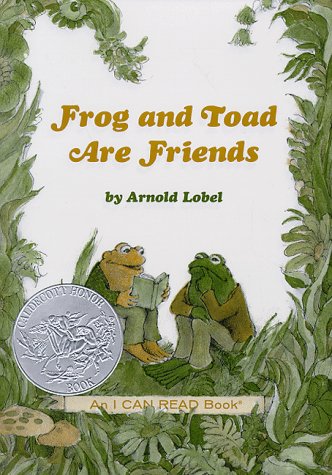
FrogToadArnold Lobel, Don and Audrey Wood, Rosemary Wells, Peter Spier, James Stevenson, as well as old reliables like Dr. Seuss and Maurice Sendak. They’re my Tolstoy, Hemingway, and Faulkner. I miss having little children around to read to and it runs contrary to the societal norm for a man to read “Frog and Toad Are Friends” in public. Not that I haven’t done it anyway.

burdickNo list of children’s author/illustrators would be complete without the remarkable Chris van Allsburg, best known for his “The Polar Express”, as well as other great books that were made into mediocre movies. One of his books was an enigmatic masterpiece called, “The Mysteries of Harris Burdick”. Each page of the book consists of a magical (and sometimes downright creepy) illustration. On each facing page was written a single line from the book from which the picture was supposedly drawn (pun intended).

According to the book’s introduction, the collection of drawings and accompanying texts were dropped off at a publisher by a mysterious author named Harris Burdick, who never returned to pick them up.

All that verbiage was simply to lead up to an idea I’ve come up with for some blog posts. Since the extent of my backlog of writing ideas outstrips even that of my reading list, what better model to follow than Mr. Burdick’s? I can’t draw to save my life – hope to God I never have to – so I’ll write short snippets from stories that don’t exist, that I have ideas for but have no hope of ever pursuing. Consider them writing prompts on steroids. Maybe they are.

Confused as much as distressed, he watched the ship disappear beneath the waves, foam and oil bubbling to the surface, marking its interment. No one could possibly have survived the explosion that ended the vessel’s journey long before it reached its destination.

He still clung to the life preserver he’d carried with him when he leapt into the water just moments before the blast. The old man he’d dived in to save had certainly looked like he might drown out here, miles from any known shore. The prospect of playing the hero in front of the crowd of onlookers standing on the deck, some of whom were attractive young women, had triggered a shot of adrenaline that made him perform an act that was as uncharacteristic of him as the peaceful, beckoning look was on the face of the old man.

Now the ship was gone, the sea slowly settling from turbulent to placid. What had happened to that man?

Writing is hard

hardwritingThe truth of this title is self-evident to those for whom writing is an important part of life, whether as vocation or avocation. They know. Others might accuse me of hyperbole. Everyone gripes about how difficult their work is for them. How hard can it be to sit on your duff all day and string together a bunch of words that make sense?

Harder than you’d think.

Writing a quality book, play, screenplay, short story, poem, article, or other piece of literature is, as we say in Boston, wicked hahd. Legendary sports columnist Red Smith, when asked whether churning out a daily column was hard work, replied, “Why, no. You simply sit down at the typewriter, open your veins, and bleed.”

Garbage, on the other hand, spews forth with a lot less resistance and little or no shedding of the crimson.

Writing blog posts can be the easiest writing task or the hardest. It’s easy if all the writer is interested in is dumping random thoughts with no focus on accuracy or the quality of the prose. If you’ve read many blogs, you know exactly what I mean. No disrespect intended, but those are the literary equivalent of the old SNL Colon Blow cereal. As long as there’s mountains of output (words), that’s good enough.

The hard part is the unrelenting self-imposed “deadlines”. I’m committed to putting out a post every Tuesday for this blog and every Saturday for Limping in the Light.

In spite of those deadlines, I always want to put my most literate foot forward. (I think it’s the left.) One thoughtless typo and I look like a moron. Cranking these posts out twice a week, I don’t have a lot of time to obsess over editing. (I do have a life.) Anyway, self-editing is usually a futile effort. Because my schedule might warrant it on any particular week, I confess to have pushed out posts prematurely. As a result… mistakes were made.

These factors provoke all sorts of qualms at every stage of the post creation process. The blank screen, the self-doubt, the self-critique, the hesitance to expose my work (and by inference, myself) to the world all conspire to make the process more agonizing than it should be.

Hopefully readers will show some grace as they read these hastily scribbled sentiments, especially those readers who are interested in purchasing any of my writing. This shouldn’t be cause for concern. There are enough poorly written books and movies that it’s clear (1) there are a lot of poor writers out there, and (2) the vetting process is imperfect. I’d rather not rely on that state of affairs, but until I have nothing to do except write a couple of blogs – nice work if you can get it – I’ll simply slog along as well as possible given the circumstances. Posts might be short and they might be of varying quality.

Thank you for your understanding.

What do you mean?

ambiguousWords are the tools of the writer as much as a hammer is for a carpenter, a brush is for a painter, or a combover is for a CEO. As such, I should be able to make myself understood. And I want others to express themselves clearly, unambiguously. It doesn’t always happen. We either shy away from saying something directly or we slip into vague expressions that can cause serious misunderstandings.

The most prominent example in my life, and the one that makes me most crazy, is the question that begins, “Do you want to…” then continues with an obvious command, such as, “wash the dishes?” How can I honestly answer yes? There’s no way I want to wash the dishes (or run to the store or pick up after myself or do anything for that matter). The person posing that pseudo-question is trying to tell me to do something without telling me to do it. It’s politely passive-aggressive.

Another useful one for the subtle-controller crowd: You’re on the phone with someone and the conversation has worn out its welcome; you’re ready to move on. The direct, “I don’t want to talk to you any longer”, is probably not going to win you any style points, etiquette-wise. The one I hear all the time is, “I’m gonna let you go.” Huh? What happened? Did I express a desire to be “let go”? The truth is, you wanted to go but didn’t want to hurt my feelings. That would work… if I was stupid.

What that statement really meant was, “Let me go.” If it was an appropriate way to express that sentiment, I figure Moses would have used it on Pharoah a few thousand years ago.

moses

I’m going to let you go!

Moses: Well, Pharoah, it’s been real, slaving under you for the last 400 years, with you making our lives bitter with harsh labor and all. But now I’m gonna let you go.

Pharoah: You’re gonna…? How did…? I thought…?

Moses: See you at the Red Sea. Bye now.

It could have been that simple. No plagues required.

(As an aside, the easiest way to end a protracted phone call is to hang up while you are speaking. Hanging up on the other party would be rude. No one expects you to hang up on yourself. This is purely hypothetical. I would never do this, of course.)

The problem with those approaches is all the room for misunderstanding.

Mother: Billy, do you want to take out the trash now?

Billy: Not really. Instead I think I’ll just blockade myself in my room and play video games until puberty’s over. But thanks for the offer, Mom!

Mother: I sincerely appreciate your honesty, Billy.

The above approaches should be avoided because ambiguity is an enemy to peace in relationships. That’s why it’s so important to be clear. A friend told me about an argument she had with her husband when he asked her where to find a certain item in the kitchen:

cabinetHusband: Honey, where’s a certain item in the kitchen?

Wife: In the cabinet next to the dishes.

(Rummage, rummage)

Husband (simmering with anger): It’s not there.

Wife: Yes, it is. Are you sure you looked in the cabinet next to the dishes?

Husband (smouldering with anger): Yes! I’m sure I looked in the cabinet next to the dishes!

Wife: Then you should have found it.

Husband (boiling over with anger): I’m looking there right now and it’s not there!

This went on for ten minutes or so before they realized what she said was not what he heard. She was referring to the dish cabinet, next to said dishes. He heard the cabinet next to the cabinet where the dishes were. I suppose verbal punctuation would have helped: “In the cabinet comma next to the dishes,” but that makes for pretty clumsy communication.

That’s my communication lesson for today: You can’t be too specific when you speak. (Figure out what that means.)

Why?

flip

We miss you, Flip.

In this post, I want to answer the question, “Why do I write this blog?” To do so, I feel compelled to borrow (a.k.a. steal) a brilliant technique once used by the brilliant, sadly departed, comedian, Flip Wilson.

Remember Flip? He, in the guise of his most popular character, Geraldine, invented the phrases, “The devil made me do it,” and, “What you see is what you get.” Quite a legacy.

So here goes:

“Why do I write this blog?”

I see that as a two part question. First: “Why?”

“Why?” is a question that has plagued mankind since time immemorial. Every philosopher, theologian, statesman, and all who have confronted their own mortality have been confronted with and tried to satisfactorily answer the profound question, “Why?” It’s been debated, sermonized, and written about extensively since man was able to reason, yet no one has ever been able to find a resolution to the eternal “Why?” Given all that has gone before, none of which has borne meaningful fruit, it seems both presumptuous and pointless for this humble writer to add what would amount to a comparatively insignificant contribution to the discourse. Thus, I defer.

The second part: “Do I write this blog?” Yes.


That’s a flippant (pun intended) answer to a serious question. Why does anyone write a blog? Many do it for purely mercenary reasons. They desire to build up sufficient following in order to attract advertising dollars and thus, write for a living.

Closely related to those are the dilettantes who want to have their 15 minutes of fame and, when it doesn’t come in the first 15 posts, chuck the whole business.

It’s pure therapy for many. Disgorging whatever thoughts come to mind gives them the healing they need to assuage the frustration daily life dumps on all of us. It doesn’t matter one bit whether anyone reads it.

My two-part answer to that one-part question is, all of the above and none of the above. There’s at least a modicum of truth to each of those for me.

It is sometimes therapeutic, but I do care if people read it.

I am trying to earn a living as a writer, but not by selling advertising. In fact, that’s the last thing on my mind. Building a “platform” is an important step in creating a demand for writers trying to ply their trade. This is how I’m doing it for now.

I’m not looking for fame, but I do want readers and I do want to sell some of my writing. Am I lying to myself?

Besides those schizophrenic answers, there’s the hope that writing on a regular basis will improve my skills at the craft. I have no right (believe it or not, on the first pass, I spelled that “write”) foisting poor or even mediocre writing on an unsuspecting public. That doesn’t seem to be a problem for some very successful writers. I don’t know how they’ve done it, but I applaud their ability to do so and I wouldn’t mind being let in on their secret(s).

Believe it or not, writing just one of these posts can take a few hours. That’s just long enough to develop a thought, but not really long enough to do it justice. I could be using the time to work on one of my other projects – I always have a few on the front burners – or just to relax.

In spite of the fact that, between this and my other blog, Limping in the Light, I’ve written well over 300 posts, I’m constantly questioning my efforts in this quixotic quest. Will something ever come of it? Is it worth it? Is anyone reading this? Should I deep six the whole thing and do something that pays some more tangible benefit to society… in my lifetime? Ultimately, why am I writing this blog?

The questioning continues as I suspect it will as long as I continue. Writing is a lonely calling. Especially if no one’s reading.

Entitled

snoopytypeI love to write or I wouldn’t be doing this. Even if no one read my scribblings, I suppose I’d scribble them anyway. That’s a recurring theme from writers. We write because we have no other choice. It’s not like we don’t have any other skills, we simply have the overwhelming need, passion, desire, yearning – call it what you will – to write.

Still, it’s gratifying to have others read what I write. Getting my words to an audience beyond immediate family and friends takes a lot of self-promotion, networking, schmoozing, and building of a platform. None of that comes easily to the average writer. They tend to be introverts. I have the advantage of being an extrovert, but promoting myself remains a chore. To improve my lot, I’ve decided I need to take a drastic next step:

I need a title.

Adding a title to a name immediately increases its credibility. Where would “Cedric the Entertainer” be without “the Entertainer”? Many of us wouldn’t know what to make of him absent the built-in endorsement; at least we know what he’s supposed to be. Which would get more press, King Richard I or “Richard the Lionheart”? No contest. Numbers get confused or forgotten. Lionheart will live on forever.

So a title would be a big boost, but the choice is a dilemma. It should be influential without being obnoxious, positive without being presumptuous. You can’t undersell yourself. Seriously, would you remember a ruler called Alexander the Adequate?

weegeeThere’s no guarantee that adopting such an appellation will work, however. Photographer Arthur Fellig was more commonly known as Weegee. Somewhere along the line, he gave himself the title “Weegee the Famous”. He even marked all his photos with a stamp bearing his title as shown on the right. Have you heard of him? I rest my case.

Some titles could be misunderstood. I fancy myself a relatively humorous person. “Rick the Humorous” is too understated, but “Rick the Hysterical” could get me in trouble.

It’s also a good defensive move to assign a title to yourself. Otherwise, you could end up with something less desirable than you might like. Jack the Ripper, Ivan the Terrible, and Mack the Knife probably didn’t choose those labels. If they’d been more proactive, who knows? Maybe we could look back fondly on Jack the Repairer, Ivan the Tender, and Mack the Spoon.

I’ve yet to home in on just the right title. As of now, I have only this list of unsuitable candidates:

Rick the …

  • …Writer (trite)
  • …Blogger (too on-the-nose)
  • …Wicked Awesome (too pompous)
  • …Storyteller (I kinda like that one – hey, I can dream)
  • …Ridiculous (a quality alliteration, but nothing I want to advertise)

So the jury is still out. If anything strikes me soon, I’ll have to give it serious consideration. Too much is at stake.

Suggestions are welcome… within reason.

Creative communities

communityI’m all about community. I crave being part of a community, I flourish in the context of community, and I love building communities. It doesn’t matter what the little society is built around – church, MS, philanthropy, sports, the arts, or pure recreation. Where two or more are gathered, there I want to be in the midst of them. That’s why I speak and write so often (like here and here and a lot of places in between) about the value of support groups for those with MS.

So today I felt like writing about communities. This blog being centered on writing and film, it’s creative/artistic communities that are on my mind.

If I can break it down a bit, I see two flavors of such communities. The first would include temporary gatherings for specific purposes: individual plays, films, concerts, and recordings, for example. My experience participating in such efforts has invariably proven to be fun, exhilarating, and inspiring… for a while. There’s a sort of “postpartum” depression that often sets in when they end, as they always must.

No matter how brief, I wouldn’t want to miss those opportunities for the world. Whether singing in a choir or acting with a troupe, there’s nothing like being part of a collective creative consciousness all aimed in the same artistic direction. To get a glimpse into that world, read the book I wrote about in this post.

As you might have guessed, the second type of creative community is a long term one. They last for years, lifetimes, or generations. Members of these collectives pour their creative energies and encouragement into one another thus enhancing their work and their lives. Some are formal, others more a matter of proximity.

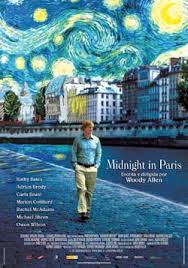
laurelcanyonThe folkies of 50’s Greenwich village were a hotbed of creative (and cultural and political) growth. In the 60’s, the Motown area gave rise to R&B and Haight-Ashbury nurtured the roots of modern rock’n’roll. Those communities were responsible for seismic shifts in culture. Though not considered MIPartistic, Silicon Valley was for a time as creative a community as the world has seen. Gertrude Stein’s Paris salon, portrayed so effectively in Woody Allen’s “Midnight in Paris”, was an intentional community that hosted some of the century’s most celebrated artists and writers.

After all, what is a band, an orchestra, or an architectural firm but a community of creatives? These gatherings are so much more creative and productive than the individuals involved could ever be. I feel confident in asserting that the community known as The Beatles was far greater than the sum of its parts.

Those kinds of groups always seem to eventually fall victim to bloated egos, tempestuous personalities, and conflicting agendas. That’s part of the baggage of the stereotypical artistic personality. Which is probably why artists of all stripes tend toward isolation.

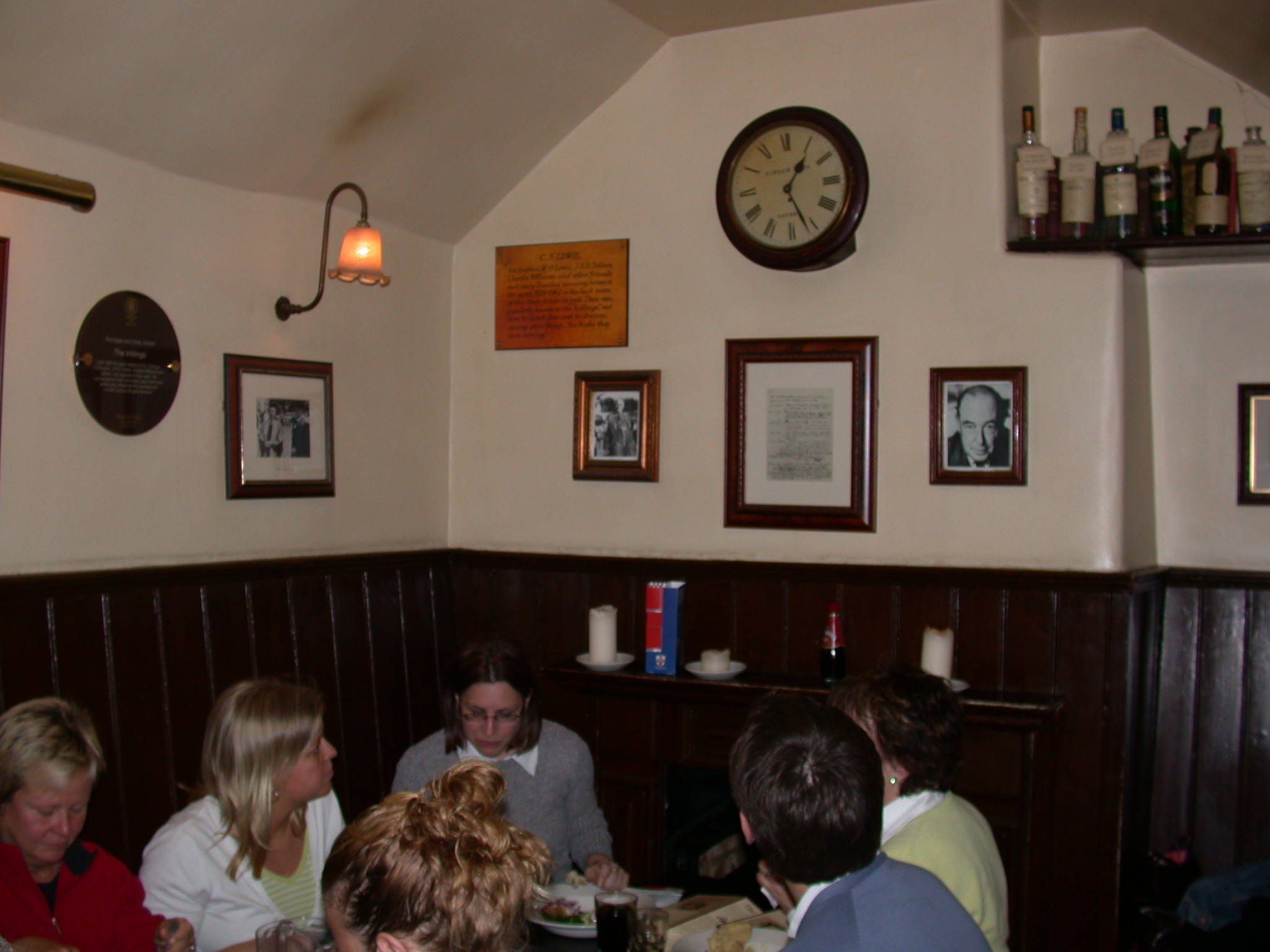
inklingsMy personal icon of a literary community is the Inklings of Oxford, UK. The most prominent members of this discussion group were J. R. R. Tolkien and C. S. Lewis – not sure if using one’s initials was a prerequisite to membership. What I would give to hang around at the Eagle and Child Pub with these guys discussing their latest work and ideas. I’d be lost, of course, but humiliation is a price I’d gladly pay.

Inklings meeting room, Eagle and Child Pub, OxfordSeveral years ago, I had the privilege of visiting Oxford, dining at the Bird and Baby, as its customers often called it, and also hearing a lecture on Tolkien in the adjoining building. I was staying in a house on the same street in Headington where Tolkien once lived, driven to the talk by a gentleman who had been a friend of the Tolkien family, accompanied by the caretaker of the Kilns, Lewis’s home. I’ve never had a more fulfilling, if thoroughly vicarious, literary experience.

I’m not sure why this was on my mind. I can’t say I’ve ever been involved in one of those long-term artistic communities, although the prospect is appealing. The funny thing is that writers are notorious loners and introverts, which would fight against any impulse to be part of a larger group. For many, the value must win out over the personal reticence.

Gotta go. I’m running late for a meeting of one of my collection of communities.

Relaxing in Lewis's study. Where's Jack?

Relaxing in Lewis’s study.
Where’s Jack?

Kill the cat

(Don’t worry, cat-lovers. This isn’t the mad ravings of a felinocidal maniac. There are cat people in my family I’d have to answer to, including the one who trained his cat to turn on the lights.)

Have you ever had the feeling that something wasn’t right but you lacked the confidence to mention it to others because you thought it was just you? I had that sense about movies. They’re running together, each one hard to distinguish from another. The only differentiators are the kinds of superpowers the protagonist has, the planet (or dimension) the aliens are from, or the evil-empire-of-the-month whence arise the powers that are going to wipe out the free world as we know it.

It’s deja vu all over again. Same story, different characters. Is it just me?

As a screenwriter, I had a theory. There are dozens of different philosophies out there about structuring screen stories. As the brilliant screenwriter William Goldman (“Princess Bride”, “Butch Cassidy and the Sundance Kid”, etc.) succinctly puts it: “Screenplays are structure.” In his “Poetics”, Aristotle started it all with the simple three-act structure. Some version of that structure has since been applied to stories of all forms: books, plays, movies, fireside ghost tales, and everything in between.

savethecatIn the screenwriting world, there have been dozens, perhaps hundreds, of refinements suggested to that basic structure. I’ve studied many of them – McKee, Vogler, Truby, Field, Hunter, and more. They range from flexible to downright Draconian. The most rigid of all was laid out in a book called “Save the Cat”, by the late screenwriting guru, Blake Snyder. My theory was that too many modern screenwriters had bought his formula down to the last beat.

I was right. At least, I have some agreement out there.

prefabA couple of days ago, I stumbled on this article from Slate. The author confirms my worst suspicions and fears. (Unfortunately, because the article is over a year old, some of the links in it are dead-ends.) According to this article, in complete agreement with my personal experience (and probably yours), many modern movies are actually prefab creations, like 60’s tract houses. The STC philosophy breaks a film into 15 “beats” that must be hit. That’s one predetermined action that will occur every six minutes in a 90 minute movie. There isn’t a lot of flexibility there. You can read the article to get a better understanding and at the same time seal your cynicism.

For this reason, I’ve pretty much stopped viewing Hollywood blockbusters. They’re all as bankrupt as their namesake video chain. The funny thing is that I’m not missing anything. By seeking out smaller, character-driven films rather than tentpole behemoths that measure their budgets in the hundreds of millions, I’m seeing better films.

bynumbersAs someone trying to sell screenplays, it would behoove me to sell my creative soul and buy into this paint-by-numbers philosophy. While I agree that the structure of a screenplay is critical, I’d rather not write at all than churn out plug’n’play, cookie cutter, straight-off-the-assembly-line widgets that will be gone and forgotten in a month anyway. I might be cutting my own throat commercially, but I’ll retain as much of my dignity as any screenwriting hopeful can.

What’s *your* story?

storyI love Jesus. Not just because He loves me and died for me, although that’s pretty cool and would be enough. I also love the fact that He’s a master storyteller. When people ask Him profound theological questions, He usually tells a story. It’s almost as if He’s trying to evade the question. Rather, I think, He’s getting to the heart of it.

Ask a theologian to tell you what the Kingdom of God is and you’re bound to get a tedious multi-volume treatise on the ins and outs of Jewish culture, a summary of a couple millennia of church history, and a detailed exegesis of Greek New Testament passages. Ask Jesus and you get a story about one of the following:

  • Some sad old woman who spends the whole night looking for her spare change in the sofa.
  • A farmer who’s having mixed success with his crops.
  • A sleazy middle manager who makes good by cheating his old boss.

legoparableThe parables (fancy theological word for stories) of the Prodigal Son and the Good Samaritan are more than tales that have become part of the nerve fiber of our culture. They’re great stories.

Why does He tell stories? Because people listen to stories. Sermons? Not so much. Even those of us who listen to sermons don’t always listen. If you know someone who’s heard a sermon recently, ask her what it was about. You’re more likely to hear about the joke the preacher told or the simple family anecdote that illustrated a forgotten moral lesson.

We’re wired to listen to stories. No matter what the era or the dominant philosophy thereof, people love and crave stories. They used to be told around campfires and now they’re seen on a phone or in a cineplex. No difference. It’s the story, the people, the ups and downs of fortune, the clawing after the goal, the battle of good vs. evil, the boy-meets-girl, the life-and-death struggle.

cleaversOne reason I believe stories resonate so well with us all is that we somehow, without even thinking about it, realize we’re in our own story. You might not be a writer, but you’re writing your life story. You’re the lead, the hero. That doesn’t mean you have to be Indiana Jones or Aragorn. It might be enough to be June or Ward Cleaver.

Most of our stories are pretty boring. They’d make lousy movies. Hitchcock was quoted as saying, “Movies are real life with the boring parts cut out.” By that criteria, most lives would make brief movies indeed, more like music videos or even commercials.

It doesn’t have to be that way.

What if your life was interesting enough to be made into a miniseries? Or a sitcom that runs 20 (or more) seasons? What’s to stop it? You’re the writer. You might have no pen, pencil, laptop, or vintage Underwood, but every day you’re writing the story of your life with your words, your loves, your priorities. Some day this volume of that story will end. (Lord willing, there will be a sequel.) Meanwhile, make it interesting, something worth telling. Something people want to hear.

Including you.