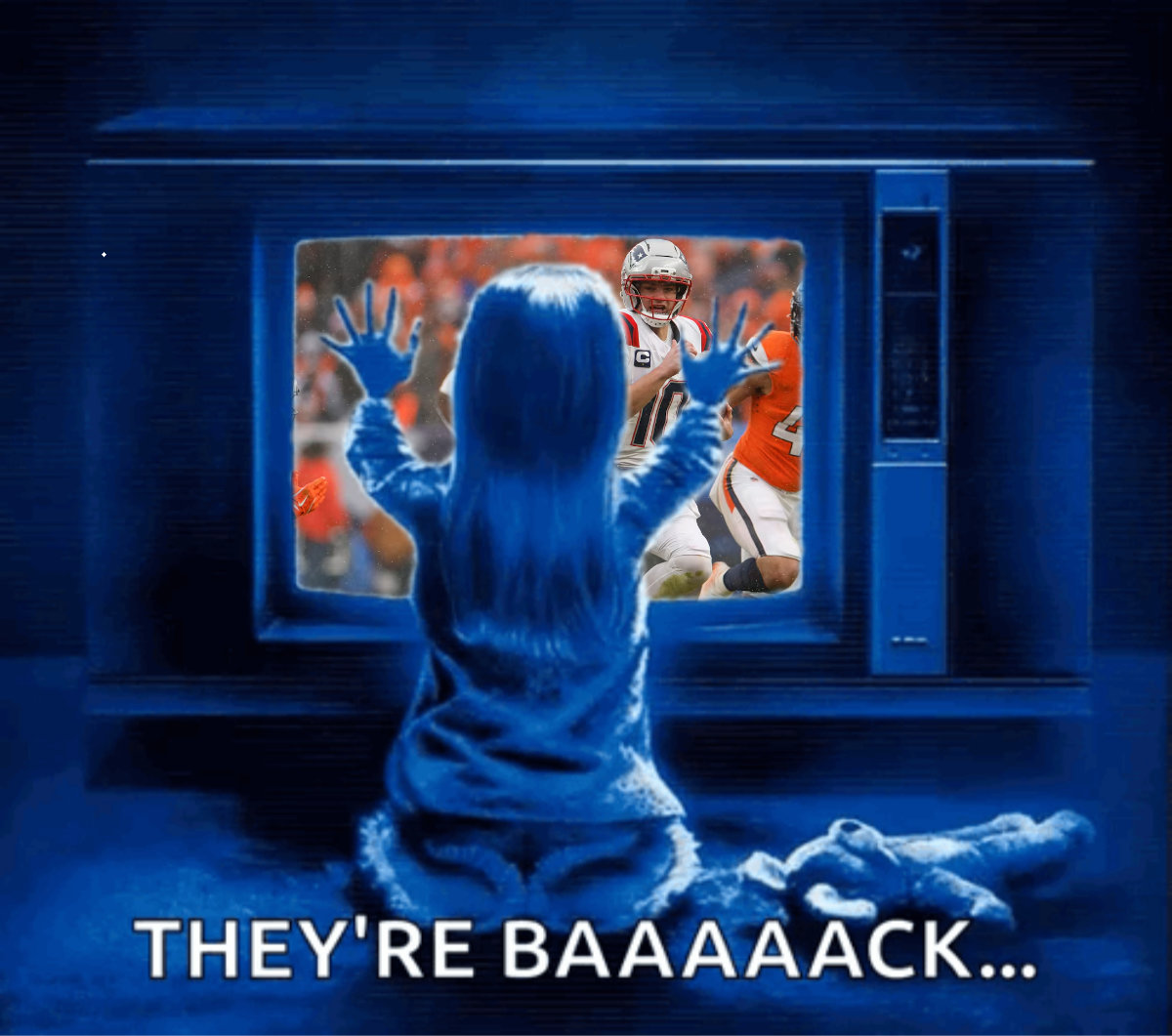
Go Pats!
[Props to my brother who made this. Thanx, JT!]
[Props to my brother who made this. Thanx, JT!]
The US is suddenly very bad at a lot of good things: caring for the unfortunate, uplifting the oppressed, promoting a healthy environment, and protecting future generations, for instance. We’re making up for that by being really good at bad things: terrorizing minorities, killing innocent civilians, and invading friendly countries come immediately to mind but there are loads of others.
One more example of the latter occurred to me of late, reinforced by the commercials that have bombarded my senses as I watched football playoff games. It appears as if we are world leaders at manufacturing gamblers.
It used to be that, if you wanted to gamble, you went to Las Vegas (a.k.a. Lost Wages) and blew the nest egg. Other alternatives were the dog and horse tracks, for those drawn to such diversions. For the truly desperate, there has always been the option of tracking down some lowlife bookie and throwing away money at him. (Not to be sexist, but were there female bookies?)
Over time, short-sighted local governments got into the game with lotteries, i.e. voluntary taxes on people who are bad at math. All the aforementioned activities catered to a limited population or at least were small potatoes, it seems to me.
Things have changed.
You can literally gamble anywhere, anytime, if you have a phone and a connection to the Internet. It’s safe to assume that’s pretty much everyone in the US. If the proliferation of sports gambling commercials is any indication, all sports above youth level exist for the sole purpose of gambling, while sports “news” is all about odds, overs and unders, and other such profligate falderal.
For football, you have the ability to not only bet on game outcomes but countless other possibilities. Who will win MVP? Who will kick the first field goal? What color Gatorade will be dumped on the winning coach? (Seriously, that’s a thing!) I can only assume the same goes for baseball. Will the next pitch be a strike? How many innings will the starting pitcher go? What will be the “launch angle” of the next home run? With baseball, the number of trivial stats and possibilities is virtually endless. Any baseball fan knows that. A veritable gambler’s gold mine, paying off almost solely to “the house”, whoever that might be.
Punch in, folks! They aren’t paying for all these big names and expensive advertising minutes on money they’re giving away. They’re getting it from suckers who think they’re going to win in spite of the fact that the odds are stacked heavily against them. The saying is trustworthy and deserving of full acceptance: “Someone has to win. It just won’t be you.”
My point is that there were only so many outlets for gambling back in the day. Today, there are more than anyone could count. Plus, it’s encouraged by the new bookies: everyone from your governor to your favorite entertainers, be they artists or athletes. To keep that voracious beast fed requires churning out new gamblers. They have to come from somewhere and they don’t grow on trees. We’re manufacturing them. It’s likely they were gamblers all along but didn’t partake, not unlike an alcoholic who doesn’t drink. ‘Cept these folks have fallen, or perhaps been thrown, off the wagon. To quote another wise man, “If you think you may have a gambling problem, stop thinking.”
That’s bad.
And America is good at it.
Are we great yet?
A BlogSnax© post
It’s football playoff time. Like a lot of guys, I spend (too) much of my weekends watching overpaid, overhyped, often overweight men pound each other into the artificial turf in pursuit of their big dream: dating Taylor Swift. No, not really. Well, yes, really, but the other dream: a Super Bowl©® championship, which entitles them to wear an immense, cumbersome, ostentatious ring causing their knuckles to drag on the ground for the rest of their lives. But at least they can flash them when making commercials for Subway©®.
One football scene that always amuses me is when there is movement at the line of scrimmage before the ball is hiked. The flags are thrown and action stops while referees confer about whether the offensive line had a false start or the D-line was offsides. Meanwhile, the players on the field blame each other. Seriously, it’s hysterical to watch mountainous men wagging their fingers at each other. “It’s not my fault, Mommy! He made me do it!”
Case in point (pun intended) is this screenshot from the Ravens/Texans game on 1/20/24:

No doubt the refs counted the number of fingers and made their decision based on that. Or maybe they responded as any frustrated parent of juveniles would, yelling, “Kids, stop arguing or we’re going home right this minute!”
By the way, on an only tangentially related note: Football was made for watching on TV.* At the stadium, it’s cold, it’s crazy, and you can’t really see the game. Unless you like to be surrounded by drunks painting their faces and chests and wearing pirate, S&M, animal, or other insane attire like rejects from a junior high costume party, stay home where you can eat anything you want anytime you want and at reasonable prices, see endless replays from every possible vantage point (including that of a slug crawling along the goal line), and you can easily get to the bathroom whenever you want. (Never underestimate the value of an easily accessible bathroom.)
[*On the other hand, baseball was made for viewing live. There’s nothing like sitting in the sun in a non-obstructed view seat, hot dog and favorite beverage in hand, while the greatest sport ever leisurely unfolds before you.]
With the advent of new NFL season upon us, it’s time to prepare. The players and coaches prepare, why should we fans not do so? It’s a grueling season. If we slack off now, we might be unable to make it to the end.
 Of course, as a native of Massachusetts, my job is easier. I’m rooting for the greatest team in the history of the sport, the New England Patriots. If you favor a different team and hate the Pats, I fully understand. I’d hate them, too, if I were from, say, Philadelphia or Oakland. Or Denver. Or Indy. Or… well, you get it. Sour grapes is an unappetizing but necessary part of the diet of the football fans of those cities, just as it has been for baseball fans from Boston. Until recently. 🙂
Below you will find an important new tool in your appreciation of the sport. Post-game news conferences are about the least enlightening 10 minutes of our lives, filled with platitudes, generalities, and more evasiveness than a Dion Lewis run. Especially if the speaker is the inimitable Bill Belichick. He’s the best coach in the history of the game, but he’s the least forthcoming. Listening to him in a post-game news conference gives one the distinct impression he’d rather have his gums scraped than stand in front of a room full of reporters trying to trip him up. Probably because he would.
To help you pass that painful time, I’ve created the following game: Belichick Bingo. Print the card out and, as you and your family and friends listen to the coach respond to the inane questions reporters throw at him, mark off the phrases you hear. The first to get a vertical, horizontal, or diagonal row of five filled in wins!
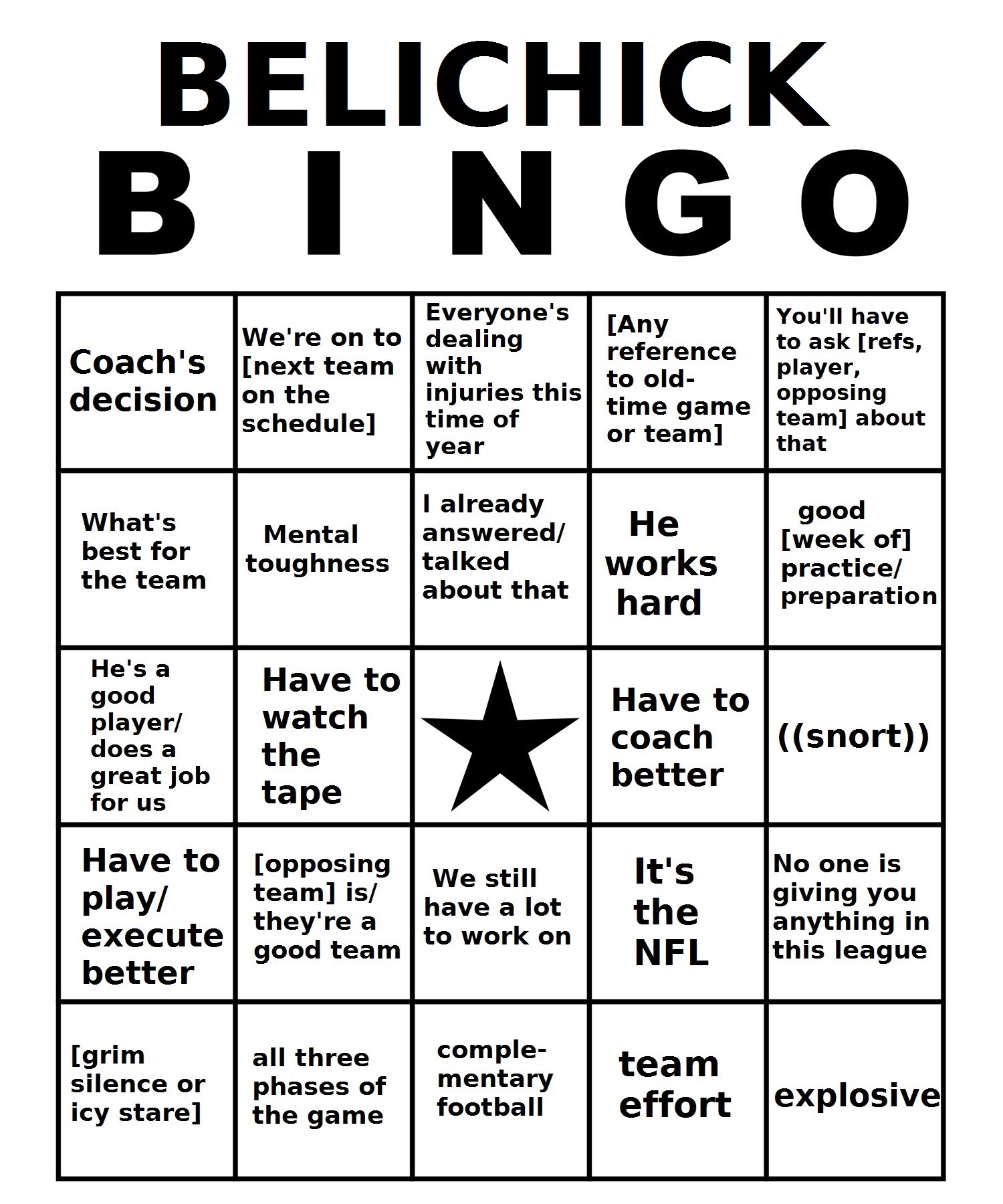
You can even make your own cards with different common phrases from the Belichick post-game lexicon. Here’s a list of more possibilities to get you started:
There you go! The most fun you can have in the NFL without developing chronic traumatic encephalopathy!
These are not good days for reality. They haven’t been for some time, but the old boy’s decline seems to be hastening. From all indications, people don’t have a lot of use for reality.
As an entity, reality has been, as we were wont to say in the software world, deprecated. That means it’s still out there somewhere, but you’re discouraged from using it. It’s just as well. It’s getting as hard to recognize as it is scarce.
The reality (there’s that word again) of the situation has been driven home for me most recently with the suddenly huge and profitable enterprise known as fantasy football. Fantasy sports have been around for a while, mostly played out among friends and co-workers. The lunatic fringe started getting involved. That was bad enough. Then it became Big Business, giving us all the gift of legalized gambling in all 50 states.
 The fantasy versions of sports have surpassed their reality counterparts in importance to many people. At least it’s called “fantasy” because it isn’t “real”. (Would that TV showed the same discretion, q.v. below.) Unfortunately, some people take it to extremes and trade reality in for fantasy. They forget the actual sport – or worse, interfere with the actual sport! – in favor of the fantasy version. Read “Fantasyland” by Sam Walker for a glimpse at the insanity of it all in baseball.
Worse is when we slap the word “reality” on things that are anything but. It should come as a surprise to exactly no one that I’m talking about so-called reality TV. And by reality I mean fantasy. How did that happen? In this case, reality refers to something that is surreal, absurd, contrived, and a slew of other qualities that are in reality (I mean it this time) descriptive of things such as fiction, fantasy, and general nonsense.
That situation isn’t all that distinct from the average based-on-fact movie today. Maybe in days of yore movies that were about people or things that actually existed were factual. There’s no such pretense these days. Movies simply aren’t telling true stories anymore. In order to squeeze into the save-the-cat mold or whatever other generic screenwriting template is in vogue, films are dramatized often to the point of camouflaging the truth beyond recognition. You see the disclaimers at the end of the ridiculously long credits:
Although this movie is based on actual events that may or may not have happened, none of the characters are real. The settings and dialogue have been fabricated for dramatic effect. Organizations depicted herein are not and have never been and most likely never will be real. The story has been twisted like a Möbius strip in order to maximize income for the producers. However, it is true that there once was a guy.
Movies use a variety of descriptions that, if analyzed correctly, reveal how far they’ve drifted from historical veracity. Here’s a sample:
Reality. 
I miss it.
 Scribbling in the Sand