A profession that keeps on giving…

A BlogSnax© post

I’ve written before about how the world changes but language seems to lag behind. Thus we still use phrases like “through the wringer” long after wringers have ceased to be. For a full discourse on the topic, see this previous post.

A couple of idioms just keep on living, like a pair of linguistic zombies, more than a century after their original usage has, for most intents and purposes, passed into history.*

  • Too many irons in the fire.
  • Strike while the iron is hot.

Those expressions relate to blacksmiths, for Pete’s sake! (Whoever Pete is.) But their usage has continued unabated—possibly even increased—long after the profession has faded from most memories, if it was ever there in the first place. How are these beasts hanging on? Maybe I’ll dig out my slide rule in case it makes a comeback.


* Yes, the craft still exists, mostly as an artistic form, but, c’mon, blacksmithing? Really?

More word weirdness

A BlogSnax© post

A few observations on the vagaries of the English language and our (mis)use thereof.

Why is imply a word but exply, meaning to say something directly, is not?

Giving and taking are opposite actions but caregivers and caretakers do essentially the same things.

And while we’re on the subject of words, let’s just eliminate the word literally, okay? It’s way overused, yet generally used in only two contexts: one when people mean the exact opposite (“It literally blew my mind!”) and one when it’s superfluous (“It’s literally the same thing.”).

Get rid of literally and we’ll have room for exply.

Thank your for you support!

Typos are everywhere. I can’t think of a single book that didn’t have at least one. And I read a lot of books. In fact, a recent novel by one of my favorite authors had at least two. Heck, my books (You know, the ones listed here. 🙂 Ironically, a typo in one of those titles caused Amazon to list it twice! Can you find it?) barely have that many. One of my favorite examples is in the written word in the middle of a movie. You can read about that one in this post.

Sometimes, it’s not clear whether an error is a typo or whether it’s just ignorance of the English language. Here’s a prime example from an article about a local community, which bragged that it…

…is infamous for its support of our local artists, writers, and musicians.

In a world where literally and metaphorically have become synonyms, why not famous and infamous? (I know those two aren’t antonyms or even mutually exclusive, e.g. Trump, but hopefully you get the point. They’re way different.)

The most common typo, however, the grandaddy of them all (and as a grandaddy, I assure you I know what I’m talking about) is the substitution of “you” for “your”. This mistake is virtually (not literally) omnipresent in cyberspace. I swear I don’t read an email, blogpost or even legitimate article that doesn’t have this failure. The most recent I can remember is this comment I saw on an article I read not too long ago:

Thanks for writing you article.

I don’t recall if the article itself had the error. I hope so.

Amaaaaaazing!

In this previous post, I pointed out the absurdity of the overuse of the virtually meaningless word “amazing”. It’s everywhere and serves as a putdown as easily as it does a buildup. Case in point:

In a very bad movie I recently watched (yeah, I watch a lot of bad movies), the following line was delivered by a person who had just learned of a loved one’s acceptance into a prestigious college:

“That’s amazing! I’m not surprised, though.”

She was amazed but not surprised. How does that work? To add to the inanity, another character, upon hearing the same news, says, “That’s incredible!”

The same news is incredible and amazing but not surprising. Furthermore, it’s also a nasty, though thinly disguised insult. If someone is amazed and/or surprised at your success, it means they weren’t expecting it, i.e. you’re a loser.

Who writes, and worse, who approves these scripts???


[As a follower of Jesus, I’m even more disheartened by the devaluation of the word “amazing”. The classic and wonderful hymn “Amazing Grace” loses much of its impact when the adjective is rendered impotent.]

Thot Dump*

From time to time, it becomes necessary to do a Roto-Rooter® job on my brain. Ideas, thoughts, whims, and other random ephemera (to borrow a phrase from the subtitle of my 9th book) clog up my scarred brain and need to be snaked out before they leak all over the place and/or my brain backs up. Either one would not be pretty.

Let me now foist some of these notions on your innocent and unsuspecting mind:

Not long ago I watched (for about the 14th time) the original “Terminator” movie. You know, the one where Ahnold is a bad guy and he says “I’ll be bahk!” As often happens after multiple viewings of the same movie, something new and absurd caught my eye. Sarah Connor and her protector, Kyle, escape from the police station that the Terminator had just gone bahk to and, well, terminated. For the first time, I noticed the vehicle they escaped in. It’s an AMC Gremlin! I love it! Could there be a more incongruous mode of transportation in such a movie? I’ve since learned that there are at least three Gremlins in different scenes in the movie. Can you spot them? (Now we know what happened to the rest of the car, toots.**)

You might see me as just another blogger whose writings captivate you with flights of literary genius, thus bringing you back time and again to reach new heights of reading ecstasy, but I’m a lot more than that. In all humility, I must tell you I’m a worker of miracles. In fact, I perform such miracles almost every day when I make a huge deal out of nothing at all. Ask my wife, she’ll tell you.***

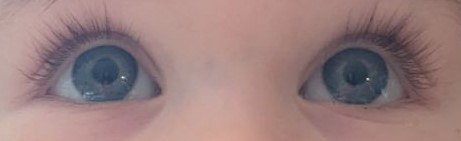
My favorite activity (or at least one of my top three favorites) is something I do every chance I get. Whenever I see babies, the younger the better, I try to catch their eyes. Babies have an incredible ability to lock onto your eyes and never let go until it’s impossible to maintain visual contact because of distance or angle. They stare at me (or you!) as if I’m the most fascinating thing on earth. It’s great for the ego but I always wonder what’s going on in their impressionable, developing minds. I hope it’s not, “Wow, there’s a strange looking dude.” But I don’t care what it is. I just love looking into those beautiful, innocent, inquisitive eyes.

One last question: How is it that saying “something is up” means the same as “something is going down”? Just asking.


* See what I did? I shortened “thoughts” to “thots”, thus saving valuable time and electrons. Of course I’ve blown both by adding this asinine comment but, hey, you can’t have everything.

** Obscure reference to old Gremlin commercial from the 70’s. Yeah, I’m that old. And more. Sadly, I can’t find the commercial anywhere except in the dark recesses of my dark (and getting darker every day) mind.

*** She’ll also tell you that I’m adept at the equally miraculous feat of turning molehills into mountains.

An Amazing Post!

Tears for Fears once sang “Everybody Wants to Rule the World”. A great song and an audacious claim. I believe there’s some truth in it, though. Few would admit it but I believe there’s a little part of everyone that wants to control everything. Maybe it’s the frustration of knowing we actually have very little control over anything in our lives. Controlling something would be a step in the right direction. Or so we think.

I’ll confess that more than a little part of me wants to control more than just a little part of the world. I’ll start right now with my first decree:

The word “amazing” is banished from use forthwith!

Yes, “amazing” is the latest in a long line of words that have been so misused and overused that they’ve ceased to have any meaning. Thus, it must be removed from the lexicon. It has joined the rogues’ gallery of words and phrases that are mutilating our discourse. Others, such as “awesome”, “like”, “literally”, “actually”, “just”, “really”, as well as beginning sentences with “so” for no apparent reason, will be dealt with over time. They must all go and they will when I’m in control.* (In the interest of full disclosure, I’m guilty of leaning heavily on all those verbal crutches.)

Back to “amazing”…

Listen. You hear it everywhere. This movie is amazing. That restaurant is amazing. Some team, book, or blog (!!) is amazing.

Worst of all is when someone calls you amazing. After all, what is being said about you? Nothing. Absolutely nothing. Assuming (and this is a huge stretch) the speaker is truly amazed, it says one of two things. Either they have a low level of amazement (I vote for that one) or something about you is truly amazing, for better or worse. And that’s the key point. There is no value judgment in the word. It’s not saying anything positive about you. Kind of like the doctor in the Seinfeld episode who calls both Elaine and an ugly baby “breathtaking”.

The subprime mortgage debacle was amazing.

“New Coke” was amazing.

Hitler was amazing.

Donald Trump is amazing in his own way. (And it’s not a good way.)

So, I literally think we should just… Ignore that. Let’s dispense with the word altogether.

While we’re at it, how about the current addiction to swearing? When I was in high school, there was a poster on the wall in the guidance counselor’s office. It read, “Profanity is the attempt of a weak mind to express itself forcefully.” That’s the only thing I remember from any guidance counselor, but it’s a maxim worth thinking about. Because they’re so ubiquitous, those words have little or no shock value remaining. There was a time when dropping just one of them in a routine guaranteed a favorable reception for a comedian. (Just ask Albert Brooks about his experience in San Antonio.) Not anymore. They fall with the frequency of snowflakes in a blizzard and with the same effect. One alone simply dissolves into nothingness. Pile on enough and conversation comes to a standstill, buried in inanity.

Rather than be heavy-handed about this whole thing, I propose making it into a game. Everyone in the US will be issued a buzzer from the game Taboo. Just like in that game, anyone will be allowed to buzz anyone else who utters one of those verbal pariahs. Speakers will stammer and struggle to avoid the rejected phrases as they do in the game, beginning every sentence saying, “Um, this is a thing that you might, um, literally…” BZZZZZZ!! How much fun will that be?

No more meaningless words, lots of buzzing. Win, win!

Vote for me.


* The alert reader will note that my list doesn’t include the verbal tics we hear and use constantly: I mean, kind of/sort of, really, y’know, um, uh. Stamping those out would cripple most people conversationally, including me. There’s no need to do that.

Yet.

The Comeuppance Factor

Lately, I’ve been thinking a lot about comeuppance.

First of all, who doesn’t love such a wonderful word? It’s so much fun to say. That’s half of what I want from a word. I have several favorite words. Nefarious, detritus, and capricious—yeah, I know, they all sound like ancient Greek politicians—are among those near and dear to my heart, tongue, and virtual pen. “Ne’er-do-well” is in the running as my favorite word of all.

Sounding good, as important as that is, isn’t enough. To gain my seal of approval, a word must also express major, complex concepts clearly and powerfully all while rolling playfully off the tongue. Comeuppance fills the bill in every way. All you have to say is, “I hope that guy gets his comeuppance,” and people nod their heads in complete understanding.

This is one of the primary ways I judge a film, book, or story in any form. It’s a cardinal rule of mine for action films, especially. The bad guy must get his comeuppance. (Forgive the sexist terminology; it’s just that the best bad guys are in fact guys.) What does a true quality comeuppance entail? Here are a few characteristics:

  1. The bad guy must lose. He can’t ride off into the sunset with the girl, with the booty, or with his head held high. He’s done, finished, end of the line. He’s either dead or demoralized or both. And he can’t come back. Countless terrible sequels have taught us that lesson.
  2. The bad guy must know he lost. At the end of the day, said miscreant has to be saying or thinking, “Curses! Foiled again!” He can’t be allowed to rationalize away his defeat. He blew it and he knew it. While it’s true that he might change his ways in response to his failure—that’s a Good Thing in real life—it’s anticlimactic in a story. Special dispensation is given in the case of Ebenezer Scrooge.
  3. It’s best of all if he knows it’s coming and can’t do a thing about it. This gives the wretched reprobate a chance to beg for mercy or melt down to the lump of evil that he is. (Here the “guy” thing falls apart. It’s the Wicked Witch who literally melts.)

Some examples are in order at this point.

Two of the best comeuppance scenes form the climaxes of two of the best action movies: “RoboCop” and “Die Hard”. In fact, they end the exact same way. The primary antagonists have a long descent from the upper stories of skyscrapers to consider the error of their ways and accept their comeuppance. Do they? We’ll never know because they end up as stains on the sidewalk.

A less violent but just as satisfying comeuppance is that of Prince Humperdinck in “Princess Bride”. Having lost all, he’s left tied to a chair with nothing to do but mull over his ignominious but well-deserved defeat. The comeuppance of Christopher Guest’s six-fingered man, on the other hand, could be the ultimate in cinematic comeuppance. It doesn’t get much more satisfying than watching a sadistic scoundrel beg for his life at the point of his demise.

It could be said that Donald Trump, a stereotypical bad guy of the worst order, got his comeuppance. Sadly, it was far from satisfactory. He lost the popular vote twice, he cost his party the Senate and the House, he never built his cherished wall, he failed to overthrow the government, he lost the White House, and he lost countless business deals because this time he couldn’t sweep his shenanigans under the rug. Failure doesn’t get any more blatant or comprehensive than that. To use his own words against him, the guy is a loser.

The problem, of course, is that his malignant narcissism blinds him to reality. As far as we can tell, he still thinks he won those elections and accomplished all his goals. Mental illness is a sad thing. I wish him healing and recovery.

And comeuppance.


Does anyone else find it frighteningly ironic that, in his attempt to rid the US of foreign terrorists, Trump has bred a crop of domestic terrorists, kind of like Saruman’s senseless Uruk-hai, who will almost certainly wreak more havoc on this country than all those Muslims and Mexicans he likes to rail against?

Or that, in spite of the religious right’s inexcusable devotion to him, he has probably paid for more abortions than he has prevented?

Just sayin’, is all.

Priming the pump

You ain’t a writer if you don’t write

Much to my embarrassment, the last time I wrote a real blog post for this blog–not a shameless advertisement for one of my books–was January 23 of this year. (My other blog is not much better. Last post: August 16, 2019. And that one was preceded by an eight-month hiatus.)

Mea culpa.

Once I completed The Endless Cycle (a four-book series for middle-grade readers (all installments now available on Amazon in paperback and Kindle versions (I couldn’t resist (sorry)))) I decided to take some time off to regroup, relax, recover, rethink… and do some jigsaw puzzles.

Time’s up. I have to put something out here to prime the pump for my next large-scale project, one as yet to be decided. So here goes: A brain dump of random strange thoughts that have been piling up.

Lessons I’ve learned from my grandchildren, Part I: Any truly good book has stickers at the end.

I don’t think, therefore… am I?

I love Maine. It’s a beautiful state. My favorite spots are Bar Harbor and Acadia National Park, or as we say in Boston: Bah Hahbah and Arcadier National Pahk. (Contrary to popular opinion, we don’t discard our “r”s, we recycle them.) I have one problem with the state, however. They need to put a moratorium on the use of the pathetic pun “Mainely” in their advertising and business names. Driving around the state, you’ll encounter “Mainely Lobster”, “Mainely Antiques”, “Mainely Burgers”, “Mainely Brews”, and Mainey more. Enough already.

Speaking of Maine, on my last trip there, I saw this bumper sticker:

I thought it was a souvenir, but then I noticed it was on Donald Trump’s car. Makes perfect sense.

It’s a shame that the common expression is, “sweat like a pig.” Two fun alliterative alternatives exist: “sweat like a swine” and “perspire like a pig.” Just sayin’.

Here’s some word weirdness that makes me say hmmm…

  • Overlook and oversee are opposites. As are “look over” and overlook. Yet an overlook (noun) is something you should look over rather than overlook.
  • Loosen and unloosen mean the same thing.
  • Flammable and inflammable mean the same thing.
  • Valuable and invaluable aren’t quite synonyms but they aren’t the opposites one would expect, given the spelling. Invaluable, in fact, means more valuable. Go figure.
  • A one-way mirror is the same thing as a two-way mirror. Good thing streets aren’t like that.

The English language was obviously created by committee.

Devaluation

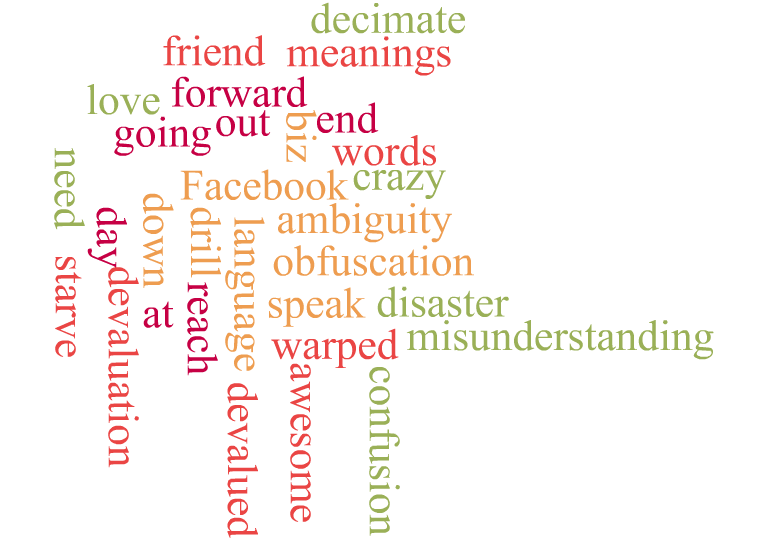
wordcloud1Lately everyone has been worried about the devaluation of the Chinese yuan against the US dollar. It must be important because it’s mentioned in every business report and the front page of the Wall Street Journal. For some reason, it also significantly devalued my IRA.

I don’t understand this. I’ve never spent a yuan. I’ve never held one in my hands. I couldn’t even tell you what one looks like. Yet it cost me all sorts of money because of its devaluation, whatever that is.

To be perfectly blunt, I don’t pay a lot of attention to money. While there are people whose lives revolve around the topic, I find it less interesting than Lithuanian zoning regulations. That’s bad, I know, in our mammon-obsessed culture where money somehow signifies credibility, even for the least credible presidential candidate.

Words are the currency I put the most stock in. The devaluation of words and, on a larger scale, the language is what keeps me up nights when others toss and turn over the latest price of pork bellies on the futures exchange. I’m here to tell you that the news is not good. Words appear to be at their lowest value in ages. The evidence is seen all around us as the meanings of words and phrases change faster than the Standard & Poor’s index.

I blame Facebook for a lot of this. “Friend” is a crucial word in my vocabulary and life. It once indicated a relationship of some intimacy. An old proverb says,

A man of many companions may come to ruin, but there is a friend who sticks closer than a brother.

Another translation puts it this way:

There are friends who pretend to be friends, but there is a friend who sticks closer than a brother.

These aptly sum up a real friend versus a “Facebook friend”. How can you be a friend with someone whose only connection to you is a photo and a few carefully laundered and embellished personal facts? I’ve said it before and I’ll say it again, the number of Facebook friends a person has is usually inversely proportional to the number of that one’s true friends.
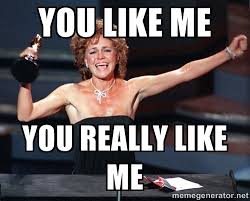
sallymemeFacebook has also turned us into a nation of Sally Fields. Everywhere I turn, people, organizations, and companies are begging me, yea, bribing me, to like them. “Like us and we’ll give you free stuff,” or, “Like me and you’ll be entered in a sweepstakes.” If we step back and acknowledge this for what it’s saying about our culture, it’s pretty pathetic. In truth, it all makes Ms. Field look downright dignified. At the very least, she was ahead of her time.

The most culpable culprit in this ongoing linguicide is corporate America. Look at the gifts they’ve bestowed on us:

  • going forward – “In the future”, “soon”, and “later” weren’t good enough. Everything happens “going forward.”
  • at the end of the day – Other than giving us a good song in Les Mis, this mal mot has added nothing to our lives.

And my personal favorite:

  • Reach out

No one calls, writes, texts, asks, visits, patronizes, drops by, contacts, or tells anymore. We all reach out. We could wipe out the national debt if we put a tax on the use of this banal phrase. It’s bad enough when businesses do it. It has invaded the realm of personal discourse. “Thanks for reaching out to me, Mom. I’ll finish my homework when I’m good and ready.”

Notice one thing about all those biz-speak words. They all increase ambiguity. Thus, an executive may truthfully say, “Bonuses will be distributed going forward,” but might not intend it to happen in your lifetime.

When we say we’re starving, we aren’t. What we say we need, we don’t. Most disasters aren’t. That which we call awesome rarely inspires awe; it barely gets our notice. Great usually isn’t. Important things aren’t. Very-special, can’t-miss episodes of television programs are nothing or less.

Word devaluation doesn’t necessarily hit our wallets, though it could over time. More immediately, it throws our communication – and consequently our relationships – into disarray. We don’t know what we mean anymore. Misunderstanding is on the rise as precision is lost.

Don’t take my word for it. You’ll hear it for yourself going forward.

Old words, bad words

Before I started this blog to concentrate on my writing, I was already writing another blog. It’s called “Limping in the Light” and it’s still limping along out there. Today it focuses on its primary role: dealing with chronic illness while trying to live a life of faith, plus whatever rant comes to mind that week. Until I started this newer blog, however, everything, including the kinds of literary and film stuff you find here, was dumped into that one catch-all.

One such post has come home to haunt me recently. This post on the power of words, especially negative words, would fit nicely into “Scribbling in the Sand”. If I’d read it myself a few weeks ago, I might not have later blurted out what I thought was a clever wisecrack, but was actually a cruel invective cleverly disguised in joke’s clothing.

For a while after I uttered it, I wondered if maybe it was more hurtful than I intended and how the recipient might have taken it. The incident soon faded from my fading memory.

I thought no more about it until a subsequent role reversal. This time someone else made a simple joke at my expense, the kind of quip we often hear and too often make. We babble our little bon mot, not realizing it’s received as a mal mot, containing a slim stiletto of truth that cuts to the heart.

It certainly did in my case. For the next week I was undone. Unbeknownst to the speaker, he’d hit on a simmering volcano in my life and it erupted with a vengeance.

The upside of my injury was that it reminded me of my previous verbal blunder. In trying to make amends, I learned that my idiotic witticism stepped on a personal land mine. Now there’s some serious relational repairs to be undertaken.

wordbombs2That’s a lot of collateral damage for a couple of silly statements meant to entertain or, more likely, meant to flaunt our extraordinary wit. We’d like it if those who deal in weapons of mass destruction would show some discretion in their use. (They don’t, but that’s another sad tale.)

As dealers in words, we writers should be careful how we wield our particular brand of explosive.