Old words, bad words

Before I started this blog to concentrate on my writing, I was already writing another blog. It’s called “Limping in the Light” and it’s still limping along out there. Today it focuses on its primary role: dealing with chronic illness while trying to live a life of faith, plus whatever rant comes to mind that week. Until I started this newer blog, however, everything, including the kinds of literary and film stuff you find here, was dumped into that one catch-all.

One such post has come home to haunt me recently. This post on the power of words, especially negative words, would fit nicely into “Scribbling in the Sand”. If I’d read it myself a few weeks ago, I might not have later blurted out what I thought was a clever wisecrack, but was actually a cruel invective cleverly disguised in joke’s clothing.

For a while after I uttered it, I wondered if maybe it was more hurtful than I intended and how the recipient might have taken it. The incident soon faded from my fading memory.

I thought no more about it until a subsequent role reversal. This time someone else made a simple joke at my expense, the kind of quip we often hear and too often make. We babble our little bon mot, not realizing it’s received as a mal mot, containing a slim stiletto of truth that cuts to the heart.

It certainly did in my case. For the next week I was undone. Unbeknownst to the speaker, he’d hit on a simmering volcano in my life and it erupted with a vengeance.

The upside of my injury was that it reminded me of my previous verbal blunder. In trying to make amends, I learned that my idiotic witticism stepped on a personal land mine. Now there’s some serious relational repairs to be undertaken.
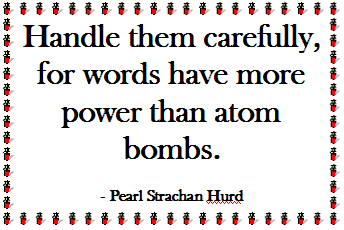
wordbombs2That’s a lot of collateral damage for a couple of silly statements meant to entertain or, more likely, meant to flaunt our extraordinary wit. We’d like it if those who deal in weapons of mass destruction would show some discretion in their use. (They don’t, but that’s another sad tale.)

As dealers in words, we writers should be careful how we wield our particular brand of explosive.

What do you mean?

ambiguousWords are the tools of the writer as much as a hammer is for a carpenter, a brush is for a painter, or a combover is for a CEO. As such, I should be able to make myself understood. And I want others to express themselves clearly, unambiguously. It doesn’t always happen. We either shy away from saying something directly or we slip into vague expressions that can cause serious misunderstandings.

The most prominent example in my life, and the one that makes me most crazy, is the question that begins, “Do you want to…” then continues with an obvious command, such as, “wash the dishes?” How can I honestly answer yes? There’s no way I want to wash the dishes (or run to the store or pick up after myself or do anything for that matter). The person posing that pseudo-question is trying to tell me to do something without telling me to do it. It’s politely passive-aggressive.

Another useful one for the subtle-controller crowd: You’re on the phone with someone and the conversation has worn out its welcome; you’re ready to move on. The direct, “I don’t want to talk to you any longer”, is probably not going to win you any style points, etiquette-wise. The one I hear all the time is, “I’m gonna let you go.” Huh? What happened? Did I express a desire to be “let go”? The truth is, you wanted to go but didn’t want to hurt my feelings. That would work… if I was stupid.

What that statement really meant was, “Let me go.” If it was an appropriate way to express that sentiment, I figure Moses would have used it on Pharoah a few thousand years ago.

moses

I’m going to let you go!

Moses: Well, Pharoah, it’s been real, slaving under you for the last 400 years, with you making our lives bitter with harsh labor and all. But now I’m gonna let you go.

Pharoah: You’re gonna…? How did…? I thought…?

Moses: See you at the Red Sea. Bye now.

It could have been that simple. No plagues required.

(As an aside, the easiest way to end a protracted phone call is to hang up while you are speaking. Hanging up on the other party would be rude. No one expects you to hang up on yourself. This is purely hypothetical. I would never do this, of course.)

The problem with those approaches is all the room for misunderstanding.

Mother: Billy, do you want to take out the trash now?

Billy: Not really. Instead I think I’ll just blockade myself in my room and play video games until puberty’s over. But thanks for the offer, Mom!

Mother: I sincerely appreciate your honesty, Billy.

The above approaches should be avoided because ambiguity is an enemy to peace in relationships. That’s why it’s so important to be clear. A friend told me about an argument she had with her husband when he asked her where to find a certain item in the kitchen:

cabinetHusband: Honey, where’s a certain item in the kitchen?

Wife: In the cabinet next to the dishes.

(Rummage, rummage)

Husband (simmering with anger): It’s not there.

Wife: Yes, it is. Are you sure you looked in the cabinet next to the dishes?

Husband (smouldering with anger): Yes! I’m sure I looked in the cabinet next to the dishes!

Wife: Then you should have found it.

Husband (boiling over with anger): I’m looking there right now and it’s not there!

This went on for ten minutes or so before they realized what she said was not what he heard. She was referring to the dish cabinet, next to said dishes. He heard the cabinet next to the cabinet where the dishes were. I suppose verbal punctuation would have helped: “In the cabinet comma next to the dishes,” but that makes for pretty clumsy communication.

That’s my communication lesson for today: You can’t be too specific when you speak. (Figure out what that means.)