Writing is hard

hardwritingThe truth of this title is self-evident to those for whom writing is an important part of life, whether as vocation or avocation. They know. Others might accuse me of hyperbole. Everyone gripes about how difficult their work is for them. How hard can it be to sit on your duff all day and string together a bunch of words that make sense?

Harder than you’d think.

Writing a quality book, play, screenplay, short story, poem, article, or other piece of literature is, as we say in Boston, wicked hahd. Legendary sports columnist Red Smith, when asked whether churning out a daily column was hard work, replied, “Why, no. You simply sit down at the typewriter, open your veins, and bleed.”

Garbage, on the other hand, spews forth with a lot less resistance and little or no shedding of the crimson.

Writing blog posts can be the easiest writing task or the hardest. It’s easy if all the writer is interested in is dumping random thoughts with no focus on accuracy or the quality of the prose. If you’ve read many blogs, you know exactly what I mean. No disrespect intended, but those are the literary equivalent of the old SNL Colon Blow cereal. As long as there’s mountains of output (words), that’s good enough.

The hard part is the unrelenting self-imposed “deadlines”. I’m committed to putting out a post every Tuesday for this blog and every Saturday for Limping in the Light.

In spite of those deadlines, I always want to put my most literate foot forward. (I think it’s the left.) One thoughtless typo and I look like a moron. Cranking these posts out twice a week, I don’t have a lot of time to obsess over editing. (I do have a life.) Anyway, self-editing is usually a futile effort. Because my schedule might warrant it on any particular week, I confess to have pushed out posts prematurely. As a result… mistakes were made.

These factors provoke all sorts of qualms at every stage of the post creation process. The blank screen, the self-doubt, the self-critique, the hesitance to expose my work (and by inference, myself) to the world all conspire to make the process more agonizing than it should be.

Hopefully readers will show some grace as they read these hastily scribbled sentiments, especially those readers who are interested in purchasing any of my writing. This shouldn’t be cause for concern. There are enough poorly written books and movies that it’s clear (1) there are a lot of poor writers out there, and (2) the vetting process is imperfect. I’d rather not rely on that state of affairs, but until I have nothing to do except write a couple of blogs – nice work if you can get it – I’ll simply slog along as well as possible given the circumstances. Posts might be short and they might be of varying quality.

Thank you for your understanding.

Borehood?

Hitchcock,_AlfredSir Alfred Hitchcock was credited with saying, “Drama is life with the dull bits cut out.”* Hard to argue with that, especially since its source is arguably the least boring filmmaker of them all. Still, I’ve always wondered what happened to those “dull bits.”

This week, I think I found out.

boyhoodThis post could get me into trouble, but I have to get this thought out of my neurons. The Academy Award nominated Best Picture, “Boyhood”, while a laudable piece of logistics, makes for agonizingly boring viewing. You’d think you could find 2¾ hours of material in a 12-year span of a kid’s life that would be gripping enough to keep my attention.

You’d be wrong. Thank goodness for the fast forward button.

There’s a certain hubris required to make a movie that’s almost three hours long. Some directors have (or had) it and pulled it off: Kubrick and Peter Jackson, to name a couple who succeeded. The former because of his genius, the latter because of his rich source material, courtesy of Tolkien who supplied the genius in that case.

Others are less successful. I’ve already noted Mr. Nolan in these virtual pages. I think I can now safely add Mr. Linklater. Both are obviously gifted filmmakers. They’ve proved as much in previous films.

I’m not suggesting that “Boyhood” is a bad film. Who the heck am I to make such a presumptuous claim? I’m just saying it’s dull as dirt. It makes me wonder, who was this movie made for, the creator or the viewer?

The concept is undoubtedly exceptional. Much of the obviously improvised dialog is engaging. But it’s the “dull bits” of life. There’s nothing really new being said. The film’s notoriety seems to be riding on a single gimmick, albeit a brilliant gimmick. If this film had been shot all at the same time with different actors playing the aging youthful roles (the only ones that show marked change), would it have received the acclaim it has? I’m guessing no. It would be just another tired coming-of-age story.

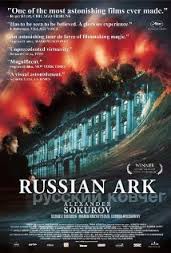
russianarkThere’s another, less well-known film that deserves similar praise for its use of an even more innovative device. “Russian Ark” is a 99-minute movie that was made in one continuous shot. That’s right, no “cut”, no edits, no stopping the camera at all. It’s ingenious, inventive, amazing. It’s also excruciatingly tedious to view. The Mona Lisa is fantastic, but I don’t want to stare at it for 99 minutes, never mind 165.

I’ve seen longer and slower movies that didn’t bore me. The aforementioned Mr. Kubrick’s “2001: A Space Odyssey” is the classic example. (That’s why a clever Mad magazine spoof of it was called “201 Minutes of Space Idiocy”.) It’s long and it’s slow, yet I’m entranced by its entirety.

straightstoryI adore movies that take time to tell their stories. If that story is compelling, if the characters are engaging, they can take all the time they want.

  • The Straight Story
  • The Trip to Bountiful
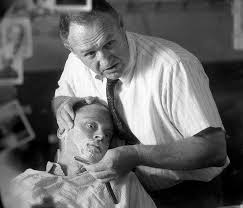
  • The Conversation
  • The Elephant Man
  • Koyaanisqatsi

These are all among my favorite films. They all unfold at a leisurely – some might say plodding – pace but never bore me for a second. Why? Maybe it’s just me.

“Boyhood” feels a lot like life – an admirable accomplishment – but hardly groundbreaking. Every good movie should feel like life in some way or another. The problem is, if I want to view life as it presents itself, I don’t have to go to the theater or watch TV.

It’s happening all around me, with far more interesting people than populate “Boyhood”.


*The great auteur also made the observation that, “The length of a film should be directly related to the endurance of the human bladder.” A lot depends on the bladder of the viewer. In my case, “Boyhood” failed that test as well.

Yes, Virginia, there is a Santa Barbara

??????????

Santa Barbara Point from Shoreline Park

Here I sit in LAX waiting for my red-eye back to Boston. After nearly three weeks in Santa Barbara, CA, I’m hesitant to get on that aircraft. Back home, I’ve missed about seven feet of snow (actually, “I wouldn’t say I’ve been missing it, Bob.“) while relaxing in wall-to-wall days of 70’s and sunshine. They don’t call it the American Riviera for nothing. I’m trading in endless bike paths, ocean surf, and outdoor living for snowbanks, icicles, and a couple more months of cabin fever.

DSCN6184While in SB, I had the opportunity to get a taste of the SB International Film Festival. Film fests are a great experience. I’ve only been to four settings: SB, Austin, Martha’s Vineyard, and Boston. (No Toronto or Sundance yet. Those are the Big Ones. Cannes and Venice are above my pay grade.) The first two are legitimate festivals. Austin is the “writer’s festival” and thus holds a special place in my heart. By comparison, the other two are low key. I can understand MV hosting a smaller event. It tends to serve the local community rather than drawing large crowds from distant locations. You’d think, however, that a world-class city like Boston could pull off something more impressive. You’d be wrong.

Fortunately, Austin and SB make up for it. The two cities have a lot in common besides hosting credible film festivals. They’re both funky, artsy, and warm – things I appreciate in a city. All Austin needs is an ocean built next to it and real estate values increased about 1000% and they’d be identical.

Santa Barbara is the perfect setting for a film festival. First of all, it was Hollywood before Hollywood was Hollywood. Second, it’s home (or home-away-from-home) to many film notables, e.g. Oprah, Jeff Bridges, Kevin Costner, Jennifer Aniston, and a People-magazine-load of others.

luckypennyIn fact, I was having lunch at Lucky Penny last week, when who should sit down at the next table but Christopher Lloyd! I looked at him. He looked at me. Then he says, “Hey, aren’t you the guy who writes that ‘Scribbling in the Sand’ blog?” Wait. That was a dream. (Although someone I know really did see Mr. Lloyd at Lucky Penny. He obviously has great taste in pizza.)

The truth is I’ve never seen a single celeb here, but that’s just fine with me. And even more fine with them, I assume. What I did see are movies, some never before shown in America. Given my lack of time, transportation, and funds, I limited myself to only four of the dozens that filled the 12 day schedule: two Italian films and two Scandinavian. Interesting combination since those two ethnicities make up a significant percentage of my family’s background.

A great thing about film festivals is that you can see movies that might never be seen elsewhere. Many films are showcased at festivals to find distribution. Many – even some good ones – never see the light of day… or DVD or streaming. It was a privilege to see them. Even the duds.

Here’s a brief recap of the movies I saw:

Banana (Italy) was a comic but bittersweet story of a young Italian boy who obsesses about being a great Brazilian (?) soccer star, while wooing the older girl of his dreams. While trying to change his own life, the boy has a positive impact on those around him who have given up hope. I rated it a 3 out of a possible 5 on the film fest scale. It was worth seeing just for a couple of very funny gags.

Mafia and Red Tomatoes (La Nostra Terra, Italy) recounted the true story of an unlikely motley group of volunteers trying to start a farming cooperative on land seized from the Mafia. They face opposition from within and without. With equal parts social commentary, drama, comedy, and romance, the film was a delight. 4 out of 5.

Beatles (Finland), a movie based on a popular novel of the same name, was an engaging coming-of-age story about four Norwegian boys in the 1960’s whose dream is to be like their heroes, the Fab Four. As you might expect, the music was terrific – some straight Beatles songs and some quality covers. It nailed that era and its attitudes with such laser-like accuracy, I had flashbacks. The most astounding aspect to this film was that the four kids who played the leads and were absolutely great, had never acted before. Rated 4. (Note that, for obscure legal reasons, if this ever shows on American screens, it will be called “Yesterday”.)

Eila, Rampe and Baby Girl (Eila, Rampe Ja Likka, Finland) was, I suppose, the Scandinavian idea of a screwball comedy. Unfortunately, it played more like an extended sitcom. There were a few laughs but those were far outnumbered by the many embarrassing moments that had me squirming in my seat. It might have helped to be Finnish, I suppose. Rated 2.


My flight is getting ready to load, so I have to sign off and resign myself to an icy, snowy future, warmed only by memories of Santa Barbara. Oh, yeah, and the love of friends and family who await me. It ain’t all bad.

??????????

Religious arguments

argueWe are an argumentative people. That’s “we” as in my family, Americans, humans. It’s a congenital trait, I’m afraid. Conflict is built into us. It’s not called the human “race” for nothing. We all feel the need to top the other guy, just as the Patriots topped the Seahawks in the Super Bowl this past weekend. But that wasn’t enough. The arguments continue: Are the Patriots only capable of winning because they’re cheaters? (For the record: No.) Are Brady/Belichick the best ever? (Yes.) Is Gronk superhuman? (It sometimes appears to be so.)

The fighting, it seems never ends, even when the fighting ends.

Although David Gates has a good point when he sings, “…an argument can be outta sight, when you love to argue and you know how to fight”, I’m afraid we don’t know how to argue or fight well these days. What start out as discussions invariably degenerate into name-calling spite-fests. That’s a whole ‘nother area of discussion (and perhaps an argument) that I described in some detail in this post from a few years ago.

Even those who would consider themselves above the fray, cultured literati who read, write, and talk about same, have their endless and futile religious arguments. Here are a couple you might overhear in a local coffee shop:

ebooksGood old-fashioned paper books are better than e-books. Now there’s a religious argument if ever there was one. It’s about as pointless as Archie and Meathead’s argument about the order of putting on shoes and socks. There is no right and wrong here. It’s pure opinion. My own personal preference depends on the context. If I’m traveling, I can load more books on my Kindle than I could fit in my luggage. Additionally, most traditional books are impossible to read while both hands are otherwise occupied.

Conversely, some books feel as if they were meant to be held in the hands. My copy of “A Soldier of the Great War” has a heft to it that matches the epic scale of the wonderful novel. It’s also signed. Try that with an e-book.

Finally, there’s something aesthetically pleasing about a shelf or entire wall of books. Scanning the binders can be a joy unmatched by twiddling through the menus of a Nook or Kindle.

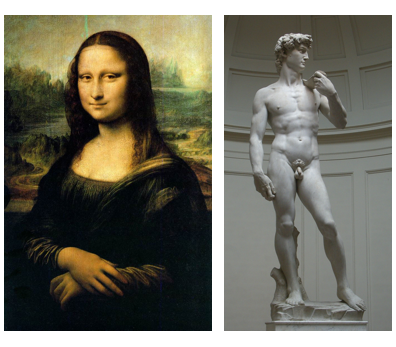
Mona&DavidBooks are always better than the movies made from them. Hopefully no one has such a sweeping opinion. Anyway, it’s a specious argument for the most part. We’re talking about two different mediums: a mental one and a visual one. Your opinion may well depend on the way you process information. You might as well ask which is better, da Vinci’s Mona Lisa or Michelangelo’s David?

Were the “Lord of the Rings” books better than the movies? It’s a moot point. The films were the vision of a small group of artists, Peter Jackson and friends. Who am I to say their vision is wrong or right? I love both creations for what they are. Note: “The Hobbit” films are a different story for reasons I expounded on here.

Some books are rightfully considered unfilmable. Any attempt to do so generally leads to disaster. Cases in point from the not-too-distant past: “Winter’s Tale” and “Cloud Atlas”. Both were monumental critical and box-office failures made from monumentally fine books.

There are a few movies I believe improved on their literary source material. One prime example is “About a Boy”. A good book, a better film, the final third of the story having been changed radically for the better in my estimation. Thus we’re talking about two different stories. Which is better? Again, personal preference. In this case, my preference is the movie’s story. You may disagree.


These two arguments are carried on all over. They can actually be fun to argue about, if it’s done right. When it’s done wrong, we’re missing the point entirely. Needing to be right can kill relationships.

It’s 11:00. Do you know where your priorities are?*

(*Does anyone remember this reference?)

What do you mean?

ambiguousWords are the tools of the writer as much as a hammer is for a carpenter, a brush is for a painter, or a combover is for a CEO. As such, I should be able to make myself understood. And I want others to express themselves clearly, unambiguously. It doesn’t always happen. We either shy away from saying something directly or we slip into vague expressions that can cause serious misunderstandings.

The most prominent example in my life, and the one that makes me most crazy, is the question that begins, “Do you want to…” then continues with an obvious command, such as, “wash the dishes?” How can I honestly answer yes? There’s no way I want to wash the dishes (or run to the store or pick up after myself or do anything for that matter). The person posing that pseudo-question is trying to tell me to do something without telling me to do it. It’s politely passive-aggressive.

Another useful one for the subtle-controller crowd: You’re on the phone with someone and the conversation has worn out its welcome; you’re ready to move on. The direct, “I don’t want to talk to you any longer”, is probably not going to win you any style points, etiquette-wise. The one I hear all the time is, “I’m gonna let you go.” Huh? What happened? Did I express a desire to be “let go”? The truth is, you wanted to go but didn’t want to hurt my feelings. That would work… if I was stupid.

What that statement really meant was, “Let me go.” If it was an appropriate way to express that sentiment, I figure Moses would have used it on Pharoah a few thousand years ago.

moses

I’m going to let you go!

Moses: Well, Pharoah, it’s been real, slaving under you for the last 400 years, with you making our lives bitter with harsh labor and all. But now I’m gonna let you go.

Pharoah: You’re gonna…? How did…? I thought…?

Moses: See you at the Red Sea. Bye now.

It could have been that simple. No plagues required.

(As an aside, the easiest way to end a protracted phone call is to hang up while you are speaking. Hanging up on the other party would be rude. No one expects you to hang up on yourself. This is purely hypothetical. I would never do this, of course.)

The problem with those approaches is all the room for misunderstanding.

Mother: Billy, do you want to take out the trash now?

Billy: Not really. Instead I think I’ll just blockade myself in my room and play video games until puberty’s over. But thanks for the offer, Mom!

Mother: I sincerely appreciate your honesty, Billy.

The above approaches should be avoided because ambiguity is an enemy to peace in relationships. That’s why it’s so important to be clear. A friend told me about an argument she had with her husband when he asked her where to find a certain item in the kitchen:

cabinetHusband: Honey, where’s a certain item in the kitchen?

Wife: In the cabinet next to the dishes.

(Rummage, rummage)

Husband (simmering with anger): It’s not there.

Wife: Yes, it is. Are you sure you looked in the cabinet next to the dishes?

Husband (smouldering with anger): Yes! I’m sure I looked in the cabinet next to the dishes!

Wife: Then you should have found it.

Husband (boiling over with anger): I’m looking there right now and it’s not there!

This went on for ten minutes or so before they realized what she said was not what he heard. She was referring to the dish cabinet, next to said dishes. He heard the cabinet next to the cabinet where the dishes were. I suppose verbal punctuation would have helped: “In the cabinet comma next to the dishes,” but that makes for pretty clumsy communication.

That’s my communication lesson for today: You can’t be too specific when you speak. (Figure out what that means.)

Desolation

smaugeyePurely out of an overdeveloped sense of obligation and closure, I recently watched the final episode of “The Hobbit” trilogy, which I believe was subtitled, “The Last in an Endless Series of Epic Battles and Beheadings Filmed in a Cynical Attempt to Extract Maximum Funds from an Unsuspecting Public by Bloating a Single Book into Three Movies”. If it sounds as if I resented forking over my cash to see the last of these artificially over-inflated flicks, you’d be on the money – my money. I guess that makes me a willing participant in my own mugging.

Let it be known, I’m a huge fan of Peter Jackson’s original “Lord of the Rings” trilogy. Three books, three movies. That makes perfect sense. Trying to cram those three literary masterpieces into a single (watchable in one sitting) film would have been as foolhardy as turning the single Hobbit book into three films was rapacious. Nor am I averse to watching the admittedly protracted extended version, which clocks in at over 11 hours.

It ain’t about the length. It’s about the greed. (More on that later.)

It’s been fittingly suggested that, just as there’s the Extended Director’s version of LOTR, there ought to be an Abbreviated Viewers’ version of Hobbit. Break me off a piece of that.

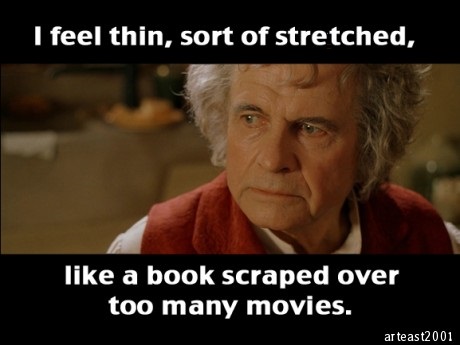
hobbitstretchAs penance for being duped into seeing all those Hobbit installments, I decided to re-read the book. That would not only atone for my sin but give me an idea of how much damage was done to the story.

It goes without saying that the book is terrific. In no way did it require being pumped up with massive amounts of gratuitous battle carnage. Evidently, the producers assumed people were craving more carnage because, let’s face it, there hasn’t been nearly enough war in our world.

Beyond the spectacular tale told by Tolkien and the completely realized world he creates so brilliantly, there are insights into our world that transcend the author’s lifetime. The following passage particularly caught my attention:

smaugDragons steal gold and jewels, you know, from men and elves and dwarves, wherever they can find them; and they guard their plunder as long as they live (which is practically forever, unless they are killed), and never enjoy a brass ring of it. Indeed they hardly know a good bit of work from a bad, though they usually have a good notion of the current market value; and they can’t make a thing for themselves, not even mend a little loose scale of their armour.

Sound like anyone you know?

The most ironic comparison is to the movie producers themselves. It’s all about the gold, artistic integrity be damned. How could they have missed that little parallel?

Closer to the mark, though, are the avaricious denizens of Wall Street whose careers amount to nothing more than collecting other people’s money and hoarding it, Smaug-like, for no particular purpose. They create nothing but profit for themselves. Like those worms of old, these modern day snakes have no use for the cash they collect. They couldn’t spend it all in their lifetimes. (Ask Larry Ellison; he seems to be trying.) The fate of the poor souls barely scraping by outside their luxurious caves, similar to Smaug’s Laketown neighbors, isn’t even on their radar.

It’s inconceivable (does that word mean what I think it means?) to me that Tolkien wasn’t thinking of that class of individuals when he wrote of those who know nothing about what’s good and what’s bad, but “have a good notion of the current market value” of same.

thorinWhile the filthy rich don’t have the longevity of dragons, their caches of cash do. Their children’s children, some of whom will have never worked a day, are destined to sit on that pile of gold “practically forever”. Over time they grow to be like Thorin Oakenshield, who spent long hours in his treasure of gold “and the lust of it was heavy on him.”

I think Thorin was on the old board of directors of Market Basket.

No need to envy the latter-day Smaugs. Those hoarders are as likely to enjoy a brass ring of their fortune as Smaug did. Without the right heart attitude, our possessions come to possess us. We live in so much fear of losing that which we don’t need or deserve, our lives become consumed by what Tolkien called dragon-sickness, an insatiable lust for gold and possessions. Happiness and joy elude us.

Perhaps the “Desolation of Smaug” depicted in Tolkien’s maps doesn’t so much represent physical barrenness caused by the dragon’s destructive presence as it does the devastation dragon-sickness creates in our own hearts.

smaugsketch

Looking in the mirror

mirrorFor some time, I’ve had this intriguing idea for a play. I’m convinced it would be entertaining because I lived through the events I’d be chronicling and they were surreal, hysterical, and more than a little profound. The main reason I’ve hesitated writing it is my fear that it would hurt the real people who were involved. The chances of them seeing or reading any version of the play would be relatively slim, but it’s not a chance I’m willing to take. Today, anyway. There might come a time.

Meanwhile, I wonder how many people out there have felt the sting of seeing themselves in a less than flattering light in the mirror of the media, whether intentional or not. Here are a couple of areas I’ve been contemplating recently where that could easily happen.

One of the most successful TV advertising campaigns of late has been the “alternate” Rob Lowe commercials. The awkward, hairy, paranoid, and other bizarro Rob Lowes are simply hysterical. Although they’re all over-the-top stereotypes, they are types, after all. The world is filled with creepy and painfully awkward people. Do they recognize themselves? At least one group does, according to this Time Magazine article. (Who knew there was a “shy bladder syndrome”, never mind an advocacy group thereof?)

meatheadThe one that really gets me with respect to recognizing oneself, though, is “meathead” Rob Lowe. I know this guy! If you’re honest, you probably do, too. These musclebound no-brain-no-pain dudes are everywhere, but sighted most often in fitness centers picking things up then putting them down. When this commercial plays at “Fitness World” or wherever, as it surely must, how could there not be a meathead revolt of Bolshevik proportions? Huh, Bro?

On a far more serious note, there are the neanderthal racists (excuse the slight at neanderthals – do they have an advocacy group I need to be wary of?) portrayed in disturbingly large numbers in excellent films such as “Selma”, “Glory Road”, “Mississippi Burning”, and “Remember the Titans”, to name just a small sample. Given that the actual events on which those films are based occurred only 50 years ago, give or take a decade, a lot of those bigots are still slithering around. How do they view those portrayals? I can think of a few possible reactions:

  1. People of such low IQ wouldn’t see quality movies. Or any movies.
  2. They wouldn’t understand what they saw, mistaking antagonists for “good guys” and vice versa.
  3. They have, since those dark days, recognized the error of their ways and look with deep regret at the characters who most resemble them.
  4. They grind their brown, crooked teeth as they yearn for the “good old days” when they could carry out their psychotic acts with impunity.

neverending1I get it. The whole point of a good movie is to hold up a mirror so we can see ourselves in a new and unexpected light. Not everyone is up to the task of seeing themselves as they really are. I’m reminded of the quest of Atreyu in “The Neverending Story”. At one point, the “mad scientist” Engywook has this exchange with Falcor, the Luck Dragon:

Engywook: Nonsense! You don’t understand anything! The worst [test] is coming up. Next is the Magic Mirror gate. Atreyu has to face his true self.

Falkor: So what? That won’t be too hard for him.

Engywook: Oh! That’s what everyone thinks. But kind people find that they are cruel, brave men discover that they are really cowards. Confronted with their true selves most men run away screaming!

I’ve run away screaming from many a  mirror – especially in the morning – but wonder how I’d react to seeing my “true self”, i.e. the person I could be under the worst possible circumstances. Having witnessed the depths to which people can sink, I can only hope I’d do better.

May I never find out.

Haiti, Five Years Later


DSC_0677

It was five years ago today that Haiti was hit by an earthquake. The tremors still shake the ground under their feet. Since that day, there has been a lot of hand-wringing and finger-pointing about the fate of Haiti. I’ve done my share.

Lest we forget, we’re talking about people. This special post is just a pointer to another post in my other blog. It’s mere tragic coincidence that I’ve done this twice in a few days.

January 12 will never pass without my remembering, writing, mourning, praying, and acting.

Why?

flip

We miss you, Flip.

In this post, I want to answer the question, “Why do I write this blog?” To do so, I feel compelled to borrow (a.k.a. steal) a brilliant technique once used by the brilliant, sadly departed, comedian, Flip Wilson.

Remember Flip? He, in the guise of his most popular character, Geraldine, invented the phrases, “The devil made me do it,” and, “What you see is what you get.” Quite a legacy.

So here goes:

“Why do I write this blog?”

I see that as a two part question. First: “Why?”

“Why?” is a question that has plagued mankind since time immemorial. Every philosopher, theologian, statesman, and all who have confronted their own mortality have been confronted with and tried to satisfactorily answer the profound question, “Why?” It’s been debated, sermonized, and written about extensively since man was able to reason, yet no one has ever been able to find a resolution to the eternal “Why?” Given all that has gone before, none of which has borne meaningful fruit, it seems both presumptuous and pointless for this humble writer to add what would amount to a comparatively insignificant contribution to the discourse. Thus, I defer.

The second part: “Do I write this blog?” Yes.


That’s a flippant (pun intended) answer to a serious question. Why does anyone write a blog? Many do it for purely mercenary reasons. They desire to build up sufficient following in order to attract advertising dollars and thus, write for a living.

Closely related to those are the dilettantes who want to have their 15 minutes of fame and, when it doesn’t come in the first 15 posts, chuck the whole business.

It’s pure therapy for many. Disgorging whatever thoughts come to mind gives them the healing they need to assuage the frustration daily life dumps on all of us. It doesn’t matter one bit whether anyone reads it.

My two-part answer to that one-part question is, all of the above and none of the above. There’s at least a modicum of truth to each of those for me.

It is sometimes therapeutic, but I do care if people read it.

I am trying to earn a living as a writer, but not by selling advertising. In fact, that’s the last thing on my mind. Building a “platform” is an important step in creating a demand for writers trying to ply their trade. This is how I’m doing it for now.

I’m not looking for fame, but I do want readers and I do want to sell some of my writing. Am I lying to myself?

Besides those schizophrenic answers, there’s the hope that writing on a regular basis will improve my skills at the craft. I have no right (believe it or not, on the first pass, I spelled that “write”) foisting poor or even mediocre writing on an unsuspecting public. That doesn’t seem to be a problem for some very successful writers. I don’t know how they’ve done it, but I applaud their ability to do so and I wouldn’t mind being let in on their secret(s).

Believe it or not, writing just one of these posts can take a few hours. That’s just long enough to develop a thought, but not really long enough to do it justice. I could be using the time to work on one of my other projects – I always have a few on the front burners – or just to relax.

In spite of the fact that, between this and my other blog, Limping in the Light, I’ve written well over 300 posts, I’m constantly questioning my efforts in this quixotic quest. Will something ever come of it? Is it worth it? Is anyone reading this? Should I deep six the whole thing and do something that pays some more tangible benefit to society… in my lifetime? Ultimately, why am I writing this blog?

The questioning continues as I suspect it will as long as I continue. Writing is a lonely calling. Especially if no one’s reading.