World Toilet Day

WTDhurryHere’s a joke that’s not funny:

Q: How can you tell a developing nation from a first world nation?

A: First world nations flush drinking water down their toilets.

Another thing that sounds funny but is deadly serious is World Toilet Day, today November 19. A family member first told me about WTD and I’m glad he did.

Now that you know, too, you can no longer plead ignorance. You must chose: Be part of the solution or part of the problem.

Here’s some great background on the day, courtesy of the Gates Foundation. For more details just Google “World Toilet Day”.

WTD

[I posted this on my other blog (Limping in the Light) too, because it’s that important.]

Creative communities

communityI’m all about community. I crave being part of a community, I flourish in the context of community, and I love building communities. It doesn’t matter what the little society is built around – church, MS, philanthropy, sports, the arts, or pure recreation. Where two or more are gathered, there I want to be in the midst of them. That’s why I speak and write so often (like here and here and a lot of places in between) about the value of support groups for those with MS.

So today I felt like writing about communities. This blog being centered on writing and film, it’s creative/artistic communities that are on my mind.

If I can break it down a bit, I see two flavors of such communities. The first would include temporary gatherings for specific purposes: individual plays, films, concerts, and recordings, for example. My experience participating in such efforts has invariably proven to be fun, exhilarating, and inspiring… for a while. There’s a sort of “postpartum” depression that often sets in when they end, as they always must.

No matter how brief, I wouldn’t want to miss those opportunities for the world. Whether singing in a choir or acting with a troupe, there’s nothing like being part of a collective creative consciousness all aimed in the same artistic direction. To get a glimpse into that world, read the book I wrote about in this post.

As you might have guessed, the second type of creative community is a long term one. They last for years, lifetimes, or generations. Members of these collectives pour their creative energies and encouragement into one another thus enhancing their work and their lives. Some are formal, others more a matter of proximity.

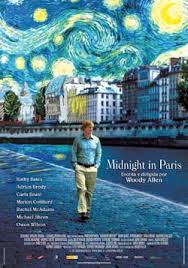
laurelcanyonThe folkies of 50’s Greenwich village were a hotbed of creative (and cultural and political) growth. In the 60’s, the Motown area gave rise to R&B and Haight-Ashbury nurtured the roots of modern rock’n’roll. Those communities were responsible for seismic shifts in culture. Though not considered MIPartistic, Silicon Valley was for a time as creative a community as the world has seen. Gertrude Stein’s Paris salon, portrayed so effectively in Woody Allen’s “Midnight in Paris”, was an intentional community that hosted some of the century’s most celebrated artists and writers.

After all, what is a band, an orchestra, or an architectural firm but a community of creatives? These gatherings are so much more creative and productive than the individuals involved could ever be. I feel confident in asserting that the community known as The Beatles was far greater than the sum of its parts.

Those kinds of groups always seem to eventually fall victim to bloated egos, tempestuous personalities, and conflicting agendas. That’s part of the baggage of the stereotypical artistic personality. Which is probably why artists of all stripes tend toward isolation.

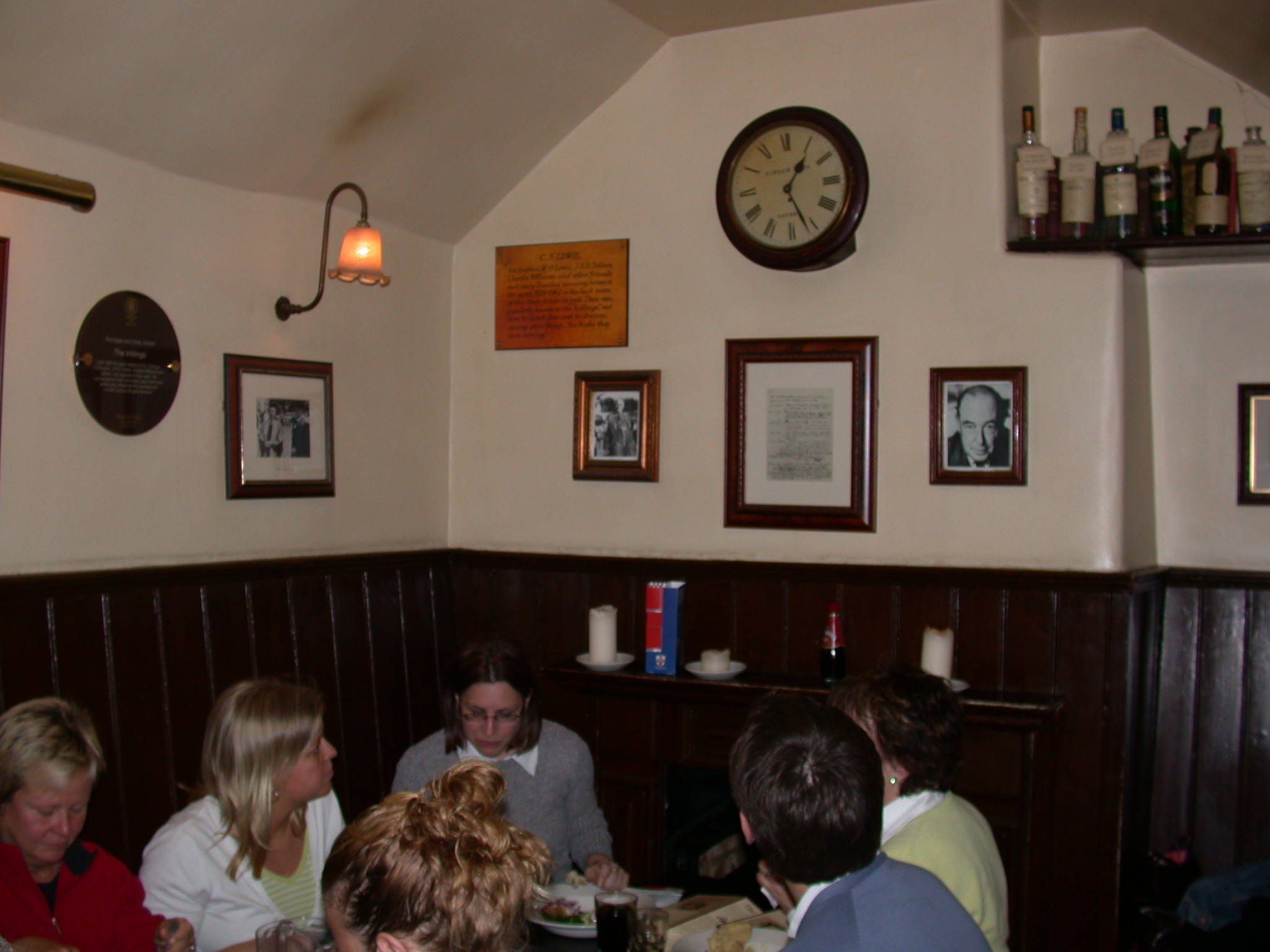
inklingsMy personal icon of a literary community is the Inklings of Oxford, UK. The most prominent members of this discussion group were J. R. R. Tolkien and C. S. Lewis – not sure if using one’s initials was a prerequisite to membership. What I would give to hang around at the Eagle and Child Pub with these guys discussing their latest work and ideas. I’d be lost, of course, but humiliation is a price I’d gladly pay.

Inklings meeting room, Eagle and Child Pub, OxfordSeveral years ago, I had the privilege of visiting Oxford, dining at the Bird and Baby, as its customers often called it, and also hearing a lecture on Tolkien in the adjoining building. I was staying in a house on the same street in Headington where Tolkien once lived, driven to the talk by a gentleman who had been a friend of the Tolkien family, accompanied by the caretaker of the Kilns, Lewis’s home. I’ve never had a more fulfilling, if thoroughly vicarious, literary experience.

I’m not sure why this was on my mind. I can’t say I’ve ever been involved in one of those long-term artistic communities, although the prospect is appealing. The funny thing is that writers are notorious loners and introverts, which would fight against any impulse to be part of a larger group. For many, the value must win out over the personal reticence.

Gotta go. I’m running late for a meeting of one of my collection of communities.

Relaxing in Lewis's study. Where's Jack?

Relaxing in Lewis’s study.
Where’s Jack?

Man of the tombs (rerun)

Two years ago almost to the day, I wrote a little story about a man who had a confrontation with Jesus. We don’t know his real name. He is known by what possessed him. I post it again here for a few reasons. First, life is hectic and I need the break. Second, it’s a bit of original writing that, although it first appeared in my other blog, Limping in the Light, finds its more proper place here. Third, with Black Friday approaching, one message I found behind the story takes on greater urgency. I’ll explain in the “afterword” below.


manofthetombsI was free until he came into my life.

I could come and go as I pleased and no one could prevent me.  Believe me, they tried.  Crowds of men would come and try to hold me down, as many as ten men at once.  They seized my arms and legs, leaped on my chest, locked their arms around my neck, thinking they could choke the life out of me.  I threw them aside as effortlessly as a fisherman tosses his nets out over the nearby Sea of Galilee.  Back then, I had the strength of thirty, forty, fifty men.

Sometimes, just to taunt my assailants, I would let them bind me.  I feigned struggle as they wound the chains around my chest, legs, and arms then clamped my ankles in irons.  When they were done and stood back, finally satisfied that they had subdued me, I stared at them with all the spite that was in my soul and shook off the shackles as if they were made of parchment.  My would-be captors ran off in panic.

They were afraid of me.  My strength frightened them.  My freedom threatened them.  They wanted nothing to do with me and that was the way I wanted it, too.  Their fear simply fueled my hatred for them and their common, contemptible lives.

I didn’t want to be anywhere near the people of the Decapolis – my home! – so I raced up and down the hills with abandon, howling my independence by day and night.  But most of the time I ran free among the tombs.  The dead didn’t bother me; they didn’t try to deny me my freedom.

One day, I found myself trembling.

Rumors of a fresh power sailed across the water before the boats driven by the winds over Galilee.  When they reached me, I was conflicted within.  Gazing over the waters from the top of a distant hill, I saw a man standing in a boat.  He stepped out and stood in the lapping water as if he was waiting for something.

He was waiting for me.

Like never before, I was driven to him.  Nothing and no one had ever compelled me like this man who was still merely a distant image.  Yet there was an opposing force inside me that was tearing at me to hold back.

What was this feeling?  The freedom that defined me now eluded me, replaced by an unnamed conflict within.  I could do nothing; I had no will.  Before I was aware of my own actions, I was at the feet of the stranger.  He spoke something in my direction, but it could not have been meant for me.  I didn’t understand his words.

Someone shouted a response in an acrid voice, or rather a chorus of voices that sounded like a mob all screeching at once.  “What do you want with me, Jesus, Son of the Most High God?  In God’s name don’t torture me!”

The sound came from my mouth.  I felt as if I was standing aside, watching the freakish scene play out before me.  The man the voices called Jesus asked, “What is your name?”  Before I could respond, the voices answered him.  I shuddered as I heard the wretched multitude of tongues growl “My name is Legion, for we are many.”

The voices terrified me, but they were the voices I knew.  It was my voice that spoke next the words that were a betrayal of myself, though I no longer knew who I was.  “Don’t send them away, Jesus.”  Maybe I was trying to convince myself because I repeated it over and over.

There was pity in Jesus’ eyes as he watched me writhing on the ground.  The Legion I feared and needed spoke from my depths, begging Jesus to send them into a herd of pigs that had been my only neighbors when I wandered these hills.  Jesus bade them go and they destroyed those pigs just as they had laid waste to my life all those years.

The citizens who wanted nothing to do with this wild man who ran naked among the tombs made it clear that they wanted less to do with my savior.  When they came out to drive Jesus away from their homes, they found me seated at the feet of Jesus, where I’d belonged all my life.  No matter where I would go, I would forever be his.

I was free indeed.


There is a literal meaning to this story, a tale of one man’s spiritual bondage and redemption. But, as with so much of scripture, there is a lesson for all of us, too. You can read my explanation of that lesson here in the post that followed this one in LITL. I commend it to your attention.

The Squatter

Among the many things I’ve scribbled in the sand is a novel entitled “The Squatter”. Some folks to whom I’ve confided about the book aren’t crazy about the title. I find it hard to disagree. It’s not a very pleasant sounding word. However, it effectively and succinctly captures not only the protagonist, but her situation as well. Anyway, I’m sticking with it for now, but am open to negotiations, especially from editors and publishers.

This is all to preface the following post, which is the opening few paragraphs of the book. There’s danger, some might say, in exposing one’s writing (even as brief as this) this way. They would have us all believe that creative thieves lurk around every corner of the Internet. They could be right, but cowering in fear is no way to live. My protagonist, Fania, would say the same.


Chapter 1

January 12, 2010 – 4:45 PM

Anticipation hung in the house like the fine particles of dust that filled the air. The family had long since grown accustomed to seeing the air they breathed; the constant presence of the dust made it disappear. When something is everywhere, it ceases to exist.

But apprehension, anticipation’s malicious twin, followed like a rabid dog nipping at its heels. Good fortune never walked alone in Haiti. Hopeful elections carried with them violence and turmoil. A cool, refreshing rain inevitably brought streams of filth running through the tiny hovel that was the Dieusel family home. It had reached the point where they dreaded good news for the trouble it promised.

Still, Fania hoped. Her dreams were simple for a fifteen-year-old girl. An education. Reading and writing. Humble dreams, more remote than the far off peaks of the Massif de la Selle. Just as she couldn’t see those mountaintops from her home in the Village Solidarité neighborhood of Port-au-Prince unless she climbed to the roof, she couldn’t conceive of being in a school, reading books, or writing letters.

This was the day when all that could change. The news her father carried would determine whether those mountains would be brought within her reach or, if his news was bad, she would continue to dream of distant peaks.

As I Wish

I just finished one of the most enjoyable reads I’ve had in a long time. It wasn’t just the book by itself, but the entire experience. It combined two of my great joys: books and film. This was a book about the making of a film from a book. The book and film are “The Princess Bride”.

pb2

“The Princess Bride” is among my favorite films. In fact, I consider it a perfect film. Every part of this movie is as good as it could possibly be. William Goldman’s original book is great, his screenplay brilliant, the cast impeccable, Rob Reiner’s direction inspired. It’s funny, exciting, romantic, poignant, and very, very smart. Reading about what went on behind all that merely added to the whole package.

asyouwishCary Elwes, who exquisitely portrayed farm boy Westley, the Man in Black, and Dread Pirate Roberts wrote “As You Wish: Inconceivable Tales from the Making of the Princess Bride” – as unwieldy a title as your bound to find, yet appropriate for this tale. It’s a memoir of his experiences as a very young actor in his first starring role.

Although the movie is now (can it possibly be?) 27 years old, his recollections, like the movie itself, have the freshness of today. He captures the same innocence, excitement, and naiveté with which he approached the filming. It had all the immediacy and enthusiasm of a kid’s essay about hitting the winning home run in a little league game. But that little league game didn’t go on to become one of the most precious cultural icons in American history.

Clearly, making the movie was as much fun as watching it. I have to confess a bit of envy as I read. Those are the kinds of experiences anyone who loves film would love to be part of. In my own life, I’ve experienced the fun, camaraderie, and passion that goes into a dramatic presentation. It’s really quite unparalleled. I couldn’t even imagine what it must have been like to be involved in something as magical as “Bride”. At least, I couldn’t until I read Elwes’s wonderful book.

If you don’t like the movie – an “inconceivable” thought – I suppose the book won’t mean much to you either. Clearly, you don’t have a beating heart. If, however, you’re a fan of Fezzik, Vizzini, Miracle Max, Inigo Montoya, and all the rest, this is a must-read.

Anyone who tells you different is selling something.

This changes everything

Here’s a little news item you probably missed. This Congressional resolution, issued just today, will change all our futures. We knew it had to happen eventually.


113th CONGRESS

2nd Session

H.R. 99

Initiating updates of names and labels for humans, pets, and all organizations and establishments to reflect the era of technological ubiquity in which the nation finds itself.

IN THE HOUSE OF REPRESENTATIVES

October 22, 2014

Mr. BOEHNER (for himself and Mr. BROOKS) submitted the following resolution; which was referred to the Committee on Science, Space, and Technology


RESOLUTION

That all names and labels currently in use as of passage of this bill shall forthwith be changed to reflect the era of technological ubiquity in which the nation finds itself. Names and labels yet to be assigned shall adhere to the same set of new “futuristic” names, giving preference to words such as “space”, “jet”, “planet”, and other names of that futuristic ilk.

Whereas it has been several millennia since the Stone Age ended and since the previous name shift when sobriquets favoring words such as “rock” and “stone” were deprecated;

Whereas we recognize that today’s technology-dominated culture should impact naming processes at all levels;

Whereas we all expect soon to be traveling in flying automobiles powered by quiet, unobtrusive little circles;

Whereas living in saucer-shaped homes supported by single posts reaching beyond cloud level will soon be commonplace;

Whereas robotic technology already exists in nearly every product we consume from automobiles to toasters, soon to perform all our errands, household chores, work, and recreation;

Whereas archaic names such as “Smith” and “Wright” referring to anachronistic professions will engender tremendous confusion and wreak havoc on the education of our children whose knowledge extends no further into the past than the advent of the DVD;

Whereas even words such as “sprocket”, though hardly high-tech, promote an engineering bias in keeping with our culture of innovation and will be acceptable;

Whereas the future has arrived and we have little time to spare before it overwhelms us with its strangeness: Now, therefore, be it

Resolved, That the House of Representatives —

(1) shall enforce the renaming and relabeling of all existing entities whether living or inorganic through whatever means necessary, whether punitive or compensatory; and

(2) shall propose acceptable names for newly created entities, whether living or inorganic; and

(3) shall provide thorough guidelines for the new naming paradigm; and

(4) shall henceforth refuse to recognize names that do not meet the proposed criteria; and

(5) shall change the National Anthem to “Rocket Man”; and

(6) shall change even the name of our nation to “The United States of Astromerica”; and

(7) shall add an amendment to the Constitution, er, Cosmotution to further reinforce this critical need.

Cogressional update: Submitters henceforth to be known as Cogressmen Frederick LASER and Mo COMETS

jetsons

With your new space-name, you’ll be as happy as these folks.

Game Over

vidgamemovieI like movies but I don’t much care for video games. This isn’t an unfounded bias based on my age or a disconnect from current culture. (My video game experience goes back to the pre-Atari days). No, the reason is my preference for story.

Aristotle had it right, in my opinion. A story should have a beginning, a middle, and an end. That separates it from pageantry, which is a continuous display without a plot. Thus, I prefer plays to parades and Olympic competition to opening ceremonies.

This bias extends to my preference for baseball, which I see as a plot-driven competition (complete with 9 “chapters” with no clock) as opposed to basketball, soccer, and hockey, which are continuous action.

Today, the line between the movies and video games has become blurred, if not invisible. Movies are made based on video games. Screenwriters write for video games. Actors voice video games. It seems that, now, gamers are writing some of the movies.

This struck me when I recently watched the movie “Divergent”, a film made from a YA novel of the same name. Not surprisingly, it echoes many features of the wildly successful “Hunger Games” series: onion-skin-thin YA characters in a dystopian society trying to kill each other off. If you think the similarities in these logos is a coincidence, I have an Amway franchise you’d be interested in. (I’m not alone in this. SNL noticed the connection, too. Check it out.)

HGmovie

Seeing

Divergent

double?


I can’t speak for the book because I haven’t read it, but “Divergent” the movie was mind-numbing for me. As I watched, it felt like I was trapped in a video game. The protagonist, Tris (rhymes with Katniss from “Hunger Games”; get it?), has to survive multiple levels of challenges not a whole lot different than those faced by Mario Brothers. In case the obvious isn’t obvious enough, she even gets a score for each level. All middle, no beginning or end; not exactly Aristotelian.

There is a plot buried somewhere under all the mundane action, one-dimensional characters, and hackneyed relationships but it’s as trite as it is uninteresting.

And, guess what. Like a video game, it doesn’t end. The vapid protagonist and all her shallow cohorts simply set themselves up for the next level, er, sequel. Oh joy.

From all appearances, a movie in a similar (i.e. exactly the same) vein is “The Maze Runner”. This flick dispenses with any pretense. The name is a game and the plot appears to be trying to play a game.

This one is also based on a book. The usual suspects: YA, dystopian, trilogy (i.e. built-in franchise).  Once more, I have to confess that I haven’t read this book. It could be a YA classic that will make us all forget “The Chocolate War”, “A Catcher in the Rye”, and “The Giver”.

I’m betting not.

This class of pulp seems to be churned out at a factory somewhere and judged not on their ability to challenge or inspire, but on their potential for selling cookie cutter movie franchises and tangential tchotchkes to gullible adolescents.

Mario would be all over them.

mario

Start at the beginning…

harehatterSpeaking of movie trends that annoy me (which I was, though you’d have no way of knowing since you aren’t here listening to me rant) in recent years, a lot of films have messed around with the order of things. They obviously haven’t listened to the sage advice of the March Hare and Mad Hatter in Disney’s version of Alice in Wonderland,

Mad Hatter: Something seems to be troubling you. Won’t you tell us all about it?

March Hare: Start at the beginning!

Mad Hatter: Yes, yes….and when you come to the end…..STOP!

It seems that once “Pulp Fiction” came along, the whole space-time continuum was thrown to the wind with scenes falling wherever they landed. The value of that gimmick can be debated in PF, but it doesn’t always work. (Opinion: It does more than work in “Memento”; it’s crucial and brilliant.)

bttfThe only places where messing around with time is always excusable are time-travel movies: the “Back to the Future” trilogy, “Déjà Vu”, “Terminator” movies, and all the rest, some good and some (and I’m thinking here of “Somewhere in Time”) excruciatingly bad. The only truly meaningful time-travel movie is the one that treats the concept with the flippancy it deserves: “Bill and Ted’s Excellent Adventure”. (Good news: There will be a third B&T movie with them as adults… or as adult as they could possibly be, I’d guess.)

Less adventurous directors have decided they can hedge their bets by swapping just one scene: The end.

I can’t even count the number of films I’ve seen post-PF where the first scene is the end of the movie. This technique has been used effectively in great films such as “Sunset Boulevard” and “Citizen Kane”. None of the movies I’m thinking of are “Citizen Kane”.

Here are a few possible reasons directors use this cliché:

  1.  It was used in successful films such as “Sunset Boulevard” and “Citizen Kane”. Wrong answer.
  2. The last scene is usually a “grabber”. There’s no point grabbing the audience’s attention at the end of the movie. That could be too late. Grab’em right up front.
  3. You’re unsure whether the audience will stay awake until the end so you want make sure they see it ASAP. If that’s it, you got bigger potatoes to fry.
  4. No point waiting for critics to give away the “spoilers” when you can do it yourself.

That last one is the one that bugs me. Should these movies have a warning at the beginning the way some reviews do? Warning: This movie contains its own spoilers. They all want to be Lucy, the ultimate spoiler:rosebud

I’m waiting for this movie opening:

butler

I have the mixed blessing of a miserable memory. True story: My wife and I were watching a movie not too long ago. As it approached the denouement, I called out – as I am wont to do – what I thought would happen next. My more able spouse corrected me. “No, he gets shot. Don’t you remember they showed it at the beginning?”

sunsetboulIt wasn’t ruined for me, but it was for her and all the other non-brain-damaged folks who watched it. The “good” news is that the movie was a flop and pretty much no one saw it. So much for copying “Sunset Boulevard”.

As a public service, I’d like to list here all those movies with built-in spoilers… but I forget what they are.

Where did that come from?

3dogcyan

(This isn’t a post-day, but this hit me out of the blue.)

Just minutes ago, during a football game I was watching, a commercial came on for very large bank – you know, one of those that’s too big to fail. Serving as sonic backdrop to the inane activity in the ad was a 41-year-old pop song: “Shambala” by Three Dog Night.

Wow.

I already ranted about this phenomenon in a previous post on my other blog, so I won’t do it again, but each time one of those old songs pops me into the Wayback Machine, I’m amazed.

And grateful. 🙂

Kill the cat

(Don’t worry, cat-lovers. This isn’t the mad ravings of a felinocidal maniac. There are cat people in my family I’d have to answer to, including the one who trained his cat to turn on the lights.)

Have you ever had the feeling that something wasn’t right but you lacked the confidence to mention it to others because you thought it was just you? I had that sense about movies. They’re running together, each one hard to distinguish from another. The only differentiators are the kinds of superpowers the protagonist has, the planet (or dimension) the aliens are from, or the evil-empire-of-the-month whence arise the powers that are going to wipe out the free world as we know it.

It’s deja vu all over again. Same story, different characters. Is it just me?

As a screenwriter, I had a theory. There are dozens of different philosophies out there about structuring screen stories. As the brilliant screenwriter William Goldman (“Princess Bride”, “Butch Cassidy and the Sundance Kid”, etc.) succinctly puts it: “Screenplays are structure.” In his “Poetics”, Aristotle started it all with the simple three-act structure. Some version of that structure has since been applied to stories of all forms: books, plays, movies, fireside ghost tales, and everything in between.

savethecatIn the screenwriting world, there have been dozens, perhaps hundreds, of refinements suggested to that basic structure. I’ve studied many of them – McKee, Vogler, Truby, Field, Hunter, and more. They range from flexible to downright Draconian. The most rigid of all was laid out in a book called “Save the Cat”, by the late screenwriting guru, Blake Snyder. My theory was that too many modern screenwriters had bought his formula down to the last beat.

I was right. At least, I have some agreement out there.

prefabA couple of days ago, I stumbled on this article from Slate. The author confirms my worst suspicions and fears. (Unfortunately, because the article is over a year old, some of the links in it are dead-ends.) According to this article, in complete agreement with my personal experience (and probably yours), many modern movies are actually prefab creations, like 60’s tract houses. The STC philosophy breaks a film into 15 “beats” that must be hit. That’s one predetermined action that will occur every six minutes in a 90 minute movie. There isn’t a lot of flexibility there. You can read the article to get a better understanding and at the same time seal your cynicism.

For this reason, I’ve pretty much stopped viewing Hollywood blockbusters. They’re all as bankrupt as their namesake video chain. The funny thing is that I’m not missing anything. By seeking out smaller, character-driven films rather than tentpole behemoths that measure their budgets in the hundreds of millions, I’m seeing better films.

bynumbersAs someone trying to sell screenplays, it would behoove me to sell my creative soul and buy into this paint-by-numbers philosophy. While I agree that the structure of a screenplay is critical, I’d rather not write at all than churn out plug’n’play, cookie cutter, straight-off-the-assembly-line widgets that will be gone and forgotten in a month anyway. I might be cutting my own throat commercially, but I’ll retain as much of my dignity as any screenwriting hopeful can.