Title, heading, name, label, legend, banner, headline

badjailThis is a short [story, tale, saga, history, report, narrative] about an [event, happening, occurrence, incident] that never was. It’s just an [excuse, reason, pretext] for using a lot of synonyms of the type I’ve come to call “slangonyms”. Over the years, some words in the English language have spawned so many slang terms to refer to the same concepts, it seems there’s no [end, ceasing, hard stop, finality, culmination, last word].

One [night, evening, after hours] I was at a [party, bash, soiree, affair, shebang, blowout, gala, shindig] with some [friends, buds, pals, mains, BFFs, amigos, homeys, chums, bro’s]. To be [honest, forthright, on the up-an-up, straight arrow, tell it like it is] I was feeling a bit [drunk, tipsy, faced, zonked, merked, high, wasted, totaled, three sheets to the wind, blitzed, corked, tanked, plastered, potted, sloshed, juiced, feeling no pain].

Suddenly the [police, cops, fuzz, flatfoot, pigs, heat, badge, copper, law] showed up and they hauled my [rear end, butt, tail, glutes, tush, fanny, keister, bottom, backside, derriere] off to court. I didn’t have any [money, cash, loot, bucks, lettuce, scrilla, greenbacks, bread, clams, simoleons, scratch, moola, coin, dough], so they slapped me in the [prison, jail, hoosegow, slammer, pen, joint, graybar hotel, up the river, big house, clink, pokey, cooler].

I was so mad, I could just [swear, cuss, curse, spew, be foul-mouthed, flame]. But there was nothing I could do, so I just [went to sleep, passed out, hit the hay, copped some Z’s, got some shut-eye, sawed some logs, crashed].

Other than that, the party was [great, awesome, wicked, fabuloso, slammin’, far out, boss, all that, groovy, hip, epic, cool, stellar, the bee’s knees, fierce].

The end, fini, ball game, end of the line, exuent, finito, done, no mas.

(Don’t you just love the English language? There’s no excuse to be boring!)

Boring conversational topics

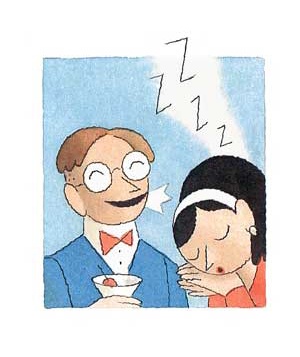
boringA writer should be a student of conversation. Paying close attention to a variety of verbal exchanges helps us compose quality dialog. A sparkling conversation educates not only writers but all who are involved. A dead conversation simply put its participants to sleep. You wouldn’t put boring lines in your book/movie/story/poem. It’s a good idea to leave them out of real life, too.

Here’s a sampling of topics that cause my head to sag, my shoulders to slump, and my eyes to glaze over.

  1. Pretty much anything about the weather is conversational poison, especially when it regards any forecast more than 24 hours into the future. You might as well discuss possible lottery outcomes. Even worse, talking about how often weather forecasts are wrong… which I think I just did.
  2. Any reference to the supposed fact that Saturday Night Live isn’t funny any more is so much fertilizer. It seems as if everyone has their favorite SNL era. Anything before or after that must be lousy. It’s just a matter of taste and timing.
  3. Please don’t tell me how expensive things are now compared to when you were young, unless you’re prepared to discuss said costs in conjunction with average salaries for the given time period.
  4. So they don’t make good, family movies anymore, right? Well, yes and no. There are actually plenty of family movies. It’s just that, for the most part, no one goes to see them. They’re out there, but they tend to get lost in the shuffle of remakes of reboots of sequels made about comic books or candy bars. When I hear this comment, I like to ask the gripers when the last time was that they went to the theater to support those family movies. That usually leads to a series of grunts and shrugs, mercifully ending a boring exchange. (On the other hand, you can have an interesting discussion about why so many R-rated movies have been made when PG and PG-13 movies have historically earned more at the box office.)
  5. Any description of one’s dreams should be banned by law. I’d prefer a root canal without any painkiller.
  6. The workplace is rife with dull comments, such as, “Working hard or hardly working?” The worst of all is when a person walks into an office and finds someone other than its usual occupant. The typical inane reaction is to say something in the vein of, “Wow, you’ve changed!” This is especially painful when the person in the office is of a different gender than its normal resident. Please refrain.

This next one happened to me recently. It’s probably the reason for the post. At a funeral or other such somber event, it’s almost required that we say to one another, “It’s so great to see you. Too bad it’s under such sad circumstances.”

You say it, I say it. The question is, do I mean it? If it’s that great to see you, why don’t I call you or visit you under better circumstances, such as, say, out of a desire to see you?

I guess that brings me to a meta-observation on bad conversational topics. Maybe anything that is insincere or untrue doesn’t belong in a conversation between people who are anything more than casual acquaintances. Save the subtext for the novels and screenplays.

Which reminds me of a dream I once had… scream

Distractions

block2Is there really such a beast as “writer’s block”? Some writers talk about the fear of the empty page, i.e. getting started. That’s never been much of a problem for me. One cure for writer’s block is to avoid self-editing and vomit up anything and everything onto the page. That’s pretty much how I write anyway. This post is a case in point.

I was struggling with what to write today. I might have blown it off completely, but having a designated day for my weekly post is beyond helpful; it’s crucial. As Charlie Brown sings in his portion of the song “Book Report“…

I work best under pressure,
And there’ll be lots of pressure
If I wait till tomorrow
I should start writing now.

I am, in fact, more likely to get down to work if I have a deadline. Whether I work best under that kind of pressure, I’ll leave to others to judge. Tuesday is my deadline for this post, thus here we are.

Where and when one chooses to write can also have a significant bearing on the amount and quality of work produced. When I’m home, the distractions are many and varied and all come with a misleading urgency because they’re in my face. When that happens, I head for a neutral place, a local coffee shop or restaurant (both of the independent variety, of course) that has free wi-fi and doesn’t mind me hanging around nursing a Coke or a muffin for three hours at a time. (I don’t drink coffee. Go figure.)

Even there, I’m distracted. I carry the number one distraction with me wherever I write: my laptop and, by inference, the Internet. The entire (virtual) world begs me to explore countless pages of inane videos, meaningless sports scores, and boundless trivia.

Sometimes, because I crave natural light, I settle in the front window of a terrific little bakery/cafe. Watching cars drive by becomes my own little reality show. Here’s what I’ve learned:

  • People text while driving… a lot.
  • If they aren’t texting, they’re generally talking on the phone, even if there is someone else in the car. However…
  • Somewhere around 90% of the cars, regardless of their size, have only one occupant. (Could there be a less efficient way to move people around?)
  • People like to stare at someone sitting in the window of a little bakery/cafe.

That’s a lot of distraction. Maybe I’m better off at home. I got this post off, didn’t I?

block

Of watermelons and books

watermelon&books

In the middle of his tea party, the Mad Hatter asks Alice a riddle:

Why is a raven like a writing-desk?

When Alice gives up trying to figure out the answer, she asks the Hatter, who says:

I haven’t the slightest idea.

I’ll do Mr. Carroll and his Hatter one better. Here’s a riddle, the answer to which I not only know, but will divulge (spoiler alert) in this post.

Why is a watermelon like a book?

First, confession time: This isn’t a true riddle, although what constitutes a true riddle (if that isn’t an oxymoron) isn’t 100% clear to me.

You see, I was cutting up and eating a watermelon today (I can never do the former without indulging in the latter) when it occurred to me that there are striking parallels between these two things that are, on the surface, quite different. Here’s my (probably partial) list of similarities:

  1. I love both of these items. I couldn’t imagine life without either one.
  2. Both are often consumed voraciously. I treat a book in the same way as I do the melon. At first I savor every bite/page, but as I approach the end, I down those chunks/pages as if they might disappear before I finish them.
  3. Both have seeds. In the case of the fruit, literal ones. (Yeah, even the “seedless” ones.) With books, they’re seeds of inspiration.
  4. Either one makes a great beach companion on a hot summer day.
  5. You can’t judge either by its cover. Believe me, in the case of watermelons, I’ve tried to figure out how to identify a quality melon by inspecting, tapping, or shaking it. I still end up with clunkers. Which brings me to the next thought:
  6. There are good ones and there are bad ones. Far fewer watermelons could be described as “bad” but I’ve had a few. Books, while I haven’t read them all, probably have more bad than good, especially in this day of self-publishing.
  7. You can grow your own. It’ll be a crap shoot quality-wise, but with time, effort, and enough fertilizer (make of that what you will) you can have yourself one sweet fruit of your labors.

Mind you, there are also major differences between watermelons and books which are hard to ignore.

  1. With few exception, watermelons are much bigger than books. They can be downright unwieldy.
  2. If watermelon juice drips, it becomes very sticky. I honestly can’t think of a book about which I could say the same thing.
  3. No one has yet been able to perfect the eMelon. I pray it never happens.

That’s about all I can think of at the moment. I’m open to your ideas.

Meanwhile, I’m going to grab a book and some watermelon.

Why Should I Care?

I’ve been told by more than one person that I have a song for everything. That is, for almost any situation, I can recall some obscure song lyric that captures that situation’s essence, or enhances the experience thereof. There’s probably at least one song that applies to any occasion. I just seem to know more than my fair share.

quadThus, when I was thinking about a title for this post, it shouldn’t surprise you that I settled on song lyrics. In fact, the lyrics of two songs from “Quadrophenia“, the classic album by The Who, came to mind. In two different songs from that outstanding concept album, there are lines that ask, “Why should I care?”

I’ve been asking myself that question lately regarding my reaction to fictional characters. As I alluded to in my previous post about “Peace Like a River”, some books have characters that are so real, so sympathetic, so readily identifiable, I simply buy into them as real people and I care about what happens to them. Further, I want to know what happens to them once the story (movie, book, play, short story, whatever) ends.

Why?

The short answer is that I have no idea. I would like to know, however, because those are the kinds of characters I want to write. A story populated with those kinds of characters is easier to write. They have a will of their own. They move the writer along rather that the other way around.

A collection of flat, one-dimensional characters have no place to go and no reason to go there. They have no motivation, no purpose for being. Who cares what they do? They’re deadly dull. They are dead. Who wants to read or write about them?

We could learn a lot by thinking about ourselves in those terms. If we have no depth, no purpose, no absolute motivator, we’re going to lead a pretty dull existence, more than likely swamped by our own self-interest.

Recently, someone who performed a test-read of my first (and, so far, only) novel said she couldn’t stop thinking about the protagonist, a young woman in Haiti. That’s about as high praise as I could want and more than I expect, yet I feel the same way about her and the rest of the characters.

Having rewritten the book in part or whole several times, I’ve probably read it a dozen or more times. Maybe it’s my familiarity with the characters, but I’ve come to (in some weird way) love and care for them. I’m so pathetic in fact, that I cry every time I read certain poignant passages.

It happens all over the place with me. In movies, for example:

  • I’d love to follow the relationship of Sam and Annie (and Jonah) after they finally meet at the top of the Empire State Building in “Sleepless in Seattle”. Will they be married? Where will they eventually live, Seattle or Baltimore? Will Becky,  Greg, and Suzy all hang out together? Sadly, Nora Ephron is gone so I’ll never know.
  • I want to watch as George and Nina Banks raise little Megan. (“Father of the Bride 2”)
  • Is there any hope of redemption for Harry Caul after trashing his apartment in “The Conversation”?
  • Where does that long road lead for the tramp and the gamin at the end of “Modern Times”?

And those are just movies. What of books like “The Rosie Project”, “Winter’s Tale”, “Gilead”, “Claire of the Sea Light”, and, of course, “Peace Like a River”?

(This phenomenon appears to be a “chick thing”. If you Google “fictional characters”, you’ll see what I mean. I’ll have to live with that, I guess.)

This is why I love movies with “follow-up” info before the credits roll. I get to find out what happened to all those fascinating players in “Remember the Titans”. Those are real human beings, so there’s some excuse for me in that case.

Strangely, it doesn’t matter if the characters are the creation of some writer’s imagination. I still wanna know what happens to them. That’s why I’m relieved to see where the lives of the members of The Wonders (not the One-ders) lead them in Tom Hanks’ vastly under-appreciated “That Thing You Do”.

That extra information can make a funny movie even funnier and more memorable. The roller coaster relationship of Robert and Mary is just as nuts after the movie ends in Albert Brooks’s hysterical “Modern Romance”, another hidden gem and one of the funniest movies I’ve ever seen.

starsI’m not alone in my mania. This pointless passion is one of the key elements in John Green’s wonderful book, “The Fault in Our Stars”. Without Hazel and Gus’s quest for the next events in Van Houten’s “An Imperial Affliction”, the story is left incomplete. But then, they are fictional characters, too. And I want to know what happens to Hazel! How long does she live? What happens to Isaac? Argh!! Nested frustration! I want to know what happens to fictional characters who are trying to figure out what happens to fictional characters.

I really care about these quasi-people. I just don’t know why.

fictional

Maybe I should stick with non-fiction.

Peace Like a River

PLARThis new blog being primarily concerned with writing, I thought I’d start with an homage to one of my favorite books, “Peace Like a River” by Leif Enger. As one reviewer put it, this book “serves as a reminder of why we read fiction to begin with.”

The reason it’s fresh on my mind is, a couple of weeks ago I finished reading it for the fourth time. It’s weird, isn’t it, to read a book more than once? When we do that, we’re doing more than searching for the end of a cracking good story. If you already know the butler did it, something else must be calling you back to a commitment as significant as reading a 300-page novel.

We read books multiple times is to drink in the prose, to spend time with old friends we know well and want to know better, whose fate (for some odd reason, which I’ll scribble about in a later post) we care about. The writing in PLaR is so vivid, so crisp, so beautifully crafted, I would regularly stop and reread a passage as if I were a sommelier tasting a fine wine; to roll it around as a delicious taste that I wanted to savor as long as possible. Or a song that never grows old.

A few such snippets of Mr. Enger’s prose, in all its glorious Midwestern resonance:

That night Swede and I lay somewhat breathless under a hill of quilts. For drafts, there was no place like August’s farmhouse; you could roast under such strata and your nose still cold as a glass knob.

There’s nothing like a good strong meter to make a poem mind its manners.

I succeeded in worrying about this escalation business for a good day and a half before worry died as usual, at the hand of routine.

Good advice is a wise man’s friend, of course; but sometimes it just flies on past, and all you can do is wave.

So thoughtlessly we sling our destinies.

Winter was a train crawling north.

I won’t pretend that reading those brief lines out of context and without knowing the narrator will drive you to the library to pick up this book. But really, if you haven’t, you ought.

The same reviewer I quoted above also said, “He’s the type of writer that other writers read, and die a little.” While I’m a writer, I can’t say I died reading it — I’m here, after all, after four passes through that would-be valley of death. — but I know (I feel) what he means: Compelling plot, musical prose, lifelike characters… Mr. Enger has them all in a way I could never attain. This is a near perfect book. Rather than depress me (OK, it does depress me a bit) it motivates me to write better. He’s set a standard I can’t even dream of achieving, but it’s best to aim high. For as Mr. Browning says, “Ah, but a man’s reach should exceed his grasp, or what’s a heaven for?”

Make of it what you will…

Welcome

Another novel lost to the sea?

Another novel lost to the sea?

Welcome to my scribblings in the virtual sand. Funny thing about writing in sand, it doesn’t last long. Neither does most of the scribbling anyone does on paper or in electrons. Except for a miniscule percentage of past writing — Homer, Moses, Confucius, Euripides, and Josephus have had a pretty good run — it gets washed out with the tides of time. Books tend to migrate to the back shelves, then to library sales, and finally become compost.

The fate of these words will be the same. I confess to fantasizing that, after some kind of environmental or military apocalypse, all writings of the current age will have been destroyed. Some archaeologist will stumble on something I wrote and judge our entire culture on those findings. Be afraid. Be very afraid.

All told, this is my fifth blog of one sort or another. You might think that’s somewhat self-indulgent, and you might be right. But I like writing, so there you are.

Of the other blogs, one I’ve passed on to others, one to which I regularly contributed has gone on hiatus, and one is quiescent. This nascent series and one other, Limping in the Light, are alive and, well, well.

If you are so inclined, please feel free to click on the little plus sign at the bottom right (you know, the one that says, “Follow”) to be notified of my mostly weekly posts.

God bless you…