Look closely

Whenever the subject of book tours is brought up in the company of writers, they all talk about how much they dread them. The travel, the repetitive questions, the crowds or the absence of them. I can’t imagine why they don’t enjoy the experience. If I had a book tour, believe me, I’d make the most of it. Easy to say since the prospect is slim for me. I can always dream.

If it’s any consolation to those jaded scribes, I enjoy hearing author presentations of any kind. The standard format is to have the authors read excerpts from their work then endure a line of dozens, perhaps hundreds, of autograph hounds. Serious RSI potential.

One of my favorite writers, Mark Helprin, did the signing thing but declined to read from his book, claiming that there were only a few great actors in the world and there was no way he could do his prose justice with his weak performance skills. There’s a lot of truth in what he said. What’s the point in hearing him read his own stuff anyway? Usually, I’ve already read it. If I’m there, I’m probably a fan so he doesn’t have to sell me on the book.

Instead of reading, Helprin described fascinating, often bizarre experiences he’d had. Not surprising, since his books are filled with such occurrences. He concluded his talk by urging his readers to follow his example by keeping our eyes open to the amazing things that happen around us all the time. (That’s heavily paraphrased. My addled memory can’t recall his exact words and my comparatively pathetic prose can’t come anywhere near his lofty standard.)

In the spirit of his admonition, and my unwillingness to devote too much time to this post in the face of deadlines and exhaustion, I present some photos of things I’ve observed in recent months. Since each is worth 1,000 words, this could be my longest post of all.

Enjoy, but then go out and have your own experiences.


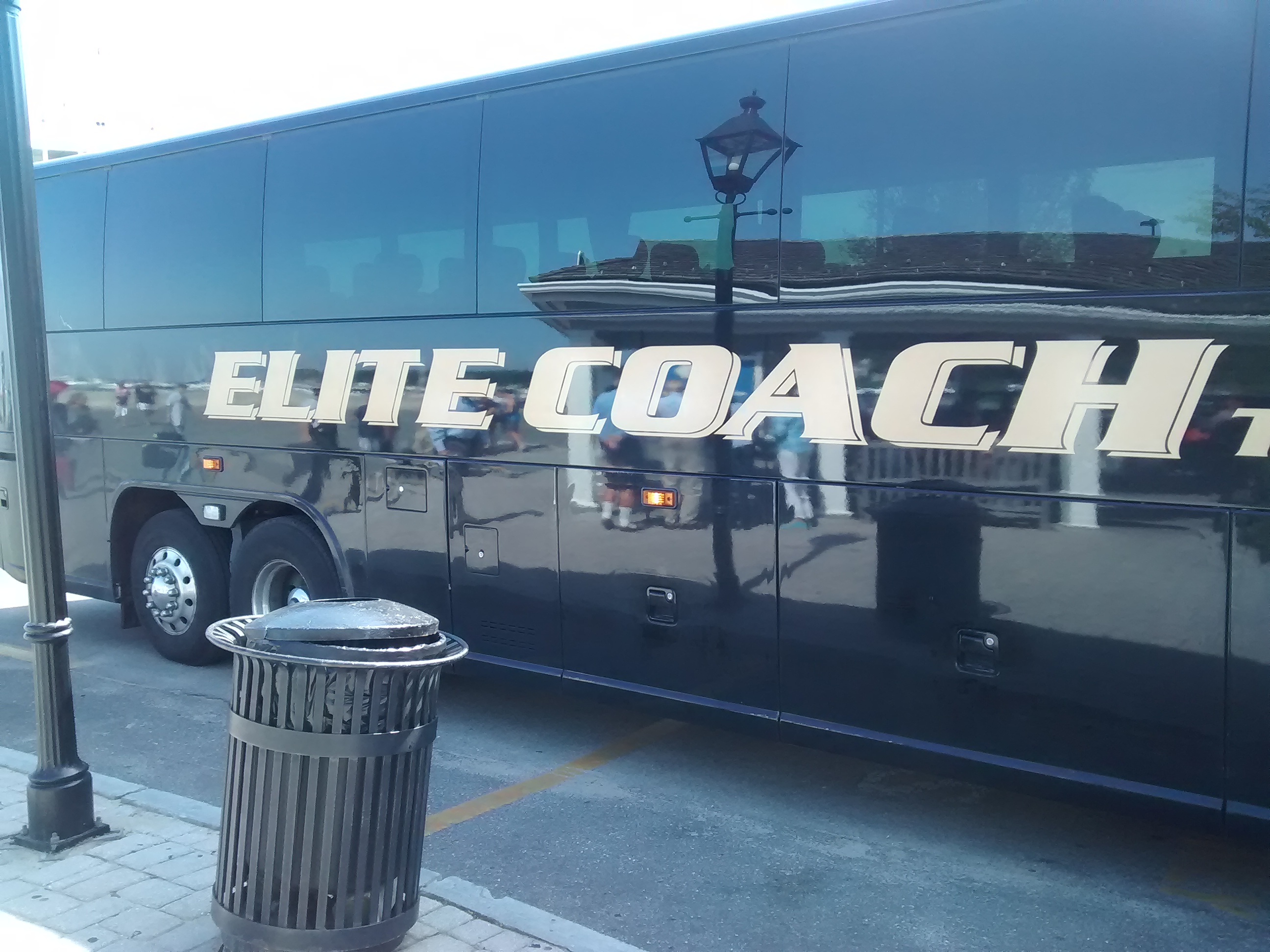
I saw these two buses drive off a ferry recently. Which one would you prefer to ride, “Elite” or “Lamers”?

IMG_20150917_112917463_HDR IMG_20150917_113050820


This is what’s called a “no-brainer”. Who’s the marketing wizard who came up with “Lamers” for a name? It’s almost certainly a person’s name – a person who put his (or her) ego before the company’s best interests.

This guy was giving away ice cream in downtown Boston. I love this town!

This guy was giving away ice cream in downtown Boston. I love this town!

A visitor on the bike path. Is it any wonder I spend as much time on it as possible?

A visitor on the bike path. Is it any wonder I spend as much time there as possible?

What's cooler than the front porch of a general store?

What’s cooler than hanging out on the front porch of a general store? Especially Alley’s. (Martha’s Vineyard)

There’s something inspiring about these two trees seeming to grow out of nothing but rock. (Acadia National Park)


Beating a dead horse

As much as I hate to revisit and flog a deceased equine, my time is limited by other projects and general life stress. Thus I’m back to a favorite topic of an unfavorite movie: Boyhood.

My original lambasting of the aforementioned over-hyped project was written several months ago. Recently, however, while stuck in a holding position over personal issues, the topic came back to mind. My primary critique of the film, held in common with others in the blogosphere, is that it was not a great movie, nor even a particularly good one. Its only claim to greatness rests in its gimmick of filming the same performers in the same roles over many years. The only problem is…

…it’s been done! Many times!

…albeit in a different format with more entertaining results. I’m talking about television programs. Many have successfully spanned a decade or more: Ozzie and Harriet, Lassie, My Three Sons, Bonanza, Happy Days, The Cosby Show, Seventh Heaven, Two and a Half Men, and so many more of varying degrees of quality. In each case, the same cast aged before our eyes over the span of the series.

That’s right, “Boyhood” is merely the logical (but dull) extension of any long-running TV series, although the ones with children bear the closest resemblance. If you take the 10-year run of “Happy Days” and edit it into a single three hour marathon, what exactly is the difference? Yeah, the HD movie would be much more entertaining and Boyhood has nobody that comes close to The Fonz in originality. Other than that and a slew of undeserved Oscar nominations, it’s the same deal.

See what happens when I have too much time on my hands to think and too little to write?

Seriously, which of these guys would you rather watch grow up? Mr. emo Boyhood kid or Ricky Nelson? Ricky’s life was way more interesting.

Seriously, which of these guys would you rather watch grow up? Mr. emo Boyhood kid or Ricky Nelson? Ricky’s life was way more interesting.

Devaluation

wordcloud1Lately everyone has been worried about the devaluation of the Chinese yuan against the US dollar. It must be important because it’s mentioned in every business report and the front page of the Wall Street Journal. For some reason, it also significantly devalued my IRA.

I don’t understand this. I’ve never spent a yuan. I’ve never held one in my hands. I couldn’t even tell you what one looks like. Yet it cost me all sorts of money because of its devaluation, whatever that is.

To be perfectly blunt, I don’t pay a lot of attention to money. While there are people whose lives revolve around the topic, I find it less interesting than Lithuanian zoning regulations. That’s bad, I know, in our mammon-obsessed culture where money somehow signifies credibility, even for the least credible presidential candidate.

Words are the currency I put the most stock in. The devaluation of words and, on a larger scale, the language is what keeps me up nights when others toss and turn over the latest price of pork bellies on the futures exchange. I’m here to tell you that the news is not good. Words appear to be at their lowest value in ages. The evidence is seen all around us as the meanings of words and phrases change faster than the Standard & Poor’s index.

I blame Facebook for a lot of this. “Friend” is a crucial word in my vocabulary and life. It once indicated a relationship of some intimacy. An old proverb says,

A man of many companions may come to ruin, but there is a friend who sticks closer than a brother.

Another translation puts it this way:

There are friends who pretend to be friends, but there is a friend who sticks closer than a brother.

These aptly sum up a real friend versus a “Facebook friend”. How can you be a friend with someone whose only connection to you is a photo and a few carefully laundered and embellished personal facts? I’ve said it before and I’ll say it again, the number of Facebook friends a person has is usually inversely proportional to the number of that one’s true friends.

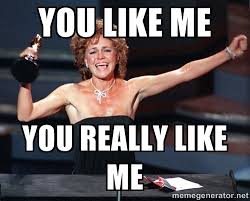
sallymemeFacebook has also turned us into a nation of Sally Fields. Everywhere I turn, people, organizations, and companies are begging me, yea, bribing me, to like them. “Like us and we’ll give you free stuff,” or, “Like me and you’ll be entered in a sweepstakes.” If we step back and acknowledge this for what it’s saying about our culture, it’s pretty pathetic. In truth, it all makes Ms. Field look downright dignified. At the very least, she was ahead of her time.

The most culpable culprit in this ongoing linguicide is corporate America. Look at the gifts they’ve bestowed on us:

  • going forward – “In the future”, “soon”, and “later” weren’t good enough. Everything happens “going forward.”
  • at the end of the day – Other than giving us a good song in Les Mis, this mal mot has added nothing to our lives.

And my personal favorite:

  • Reach out

No one calls, writes, texts, asks, visits, patronizes, drops by, contacts, or tells anymore. We all reach out. We could wipe out the national debt if we put a tax on the use of this banal phrase. It’s bad enough when businesses do it. It has invaded the realm of personal discourse. “Thanks for reaching out to me, Mom. I’ll finish my homework when I’m good and ready.”

Notice one thing about all those biz-speak words. They all increase ambiguity. Thus, an executive may truthfully say, “Bonuses will be distributed going forward,” but might not intend it to happen in your lifetime.

When we say we’re starving, we aren’t. What we say we need, we don’t. Most disasters aren’t. That which we call awesome rarely inspires awe; it barely gets our notice. Great usually isn’t. Important things aren’t. Very-special, can’t-miss episodes of television programs are nothing or less.

Word devaluation doesn’t necessarily hit our wallets, though it could over time. More immediately, it throws our communication – and consequently our relationships – into disarray. We don’t know what we mean anymore. Misunderstanding is on the rise as precision is lost.

Don’t take my word for it. You’ll hear it for yourself going forward.

Cutting back

bothendsAs some of my readers are aware, I have two blogs, this one (SITS) and Limping in the Light (LITL). Keeping up two separate blogs, even as minimalist as these two are, is a significant amount of work, especially if quality is an important consideration in their content, which it is to me anyway. I’ve written about time constraints and priorities in another post, so I won’t bore you with it (again) here.

Combine these blogs and the daily mundane activities of life with attempts to actually write stories to be sold, published, or otherwise used beyond the realm of the blogosphere and there’s a serious conflict. Something’s gotta give. Everything we do represents something we don’t do because that slice of time and energy has become unavailable.

The conflict is illustrated most tangibly blog-wise when I take shortcuts, such as using the same post in both blogs (q.v. here), write skimpy posts (q.v. here), and when I’m late with a post (q.v. what you’re reading now, one day late.) On the whole I’ve maintained an exemplary record, considering the longevity of the blogs. LITL spans over five years and 300 posts while its little brother SITS is comprised of about 70 entries spread over the last 14 months.

Not a bad run, but it’s going to slow to a walk after today.

In order to devote more time to my “job”, i.e. writing – and also to accommodate some other “opportunities” insinuating themselves into my life – I’m cutting back to one post a week total, that is, for both blogs. From today forward, I’ll write a single post per week, the intent being to alternate between the two platforms. The day of the week is TBD. Recommendations welcome.

This eases up the demands on my schedule, but it frees up your time, too.

You’re welcome.

Old words, bad words

Before I started this blog to concentrate on my writing, I was already writing another blog. It’s called “Limping in the Light” and it’s still limping along out there. Today it focuses on its primary role: dealing with chronic illness while trying to live a life of faith, plus whatever rant comes to mind that week. Until I started this newer blog, however, everything, including the kinds of literary and film stuff you find here, was dumped into that one catch-all.

One such post has come home to haunt me recently. This post on the power of words, especially negative words, would fit nicely into “Scribbling in the Sand”. If I’d read it myself a few weeks ago, I might not have later blurted out what I thought was a clever wisecrack, but was actually a cruel invective cleverly disguised in joke’s clothing.

For a while after I uttered it, I wondered if maybe it was more hurtful than I intended and how the recipient might have taken it. The incident soon faded from my fading memory.

I thought no more about it until a subsequent role reversal. This time someone else made a simple joke at my expense, the kind of quip we often hear and too often make. We babble our little bon mot, not realizing it’s received as a mal mot, containing a slim stiletto of truth that cuts to the heart.

It certainly did in my case. For the next week I was undone. Unbeknownst to the speaker, he’d hit on a simmering volcano in my life and it erupted with a vengeance.

The upside of my injury was that it reminded me of my previous verbal blunder. In trying to make amends, I learned that my idiotic witticism stepped on a personal land mine. Now there’s some serious relational repairs to be undertaken.

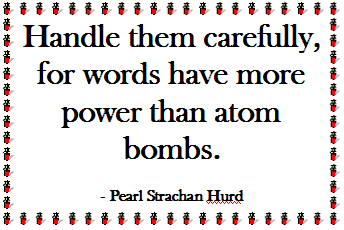
wordbombs2That’s a lot of collateral damage for a couple of silly statements meant to entertain or, more likely, meant to flaunt our extraordinary wit. We’d like it if those who deal in weapons of mass destruction would show some discretion in their use. (They don’t, but that’s another sad tale.)

As dealers in words, we writers should be careful how we wield our particular brand of explosive.

Now a message from our sponsors

I really hate television commercials.

That’s just one of the reasons I don’t watch much TV. Unfortunately, every now and then I’ll be watching a movie and one of those beasts will interrupt my viewing. Here are a few for which I hold particular disdain:

The Dunkin Donuts commercial where a guy announces he got a promotion. He and his friends decide the appropriate way to “celebrate” this achievement is to get a sandwich from DD. Really? That’s the best they can come up with?? I’m thinking either this wasn’t much of a promotion (“Hey, guys! After five years in my bathroom cleaning job, I’m finally getting a brush!”) or they aren’t really his friends.

Another is for some kind of automobile cleaning product. The tagline says it all:

“Restore your car, restore your pride.”

Wow. Maybe that’s the guy with the bathroom cleaning job.

It was a year or so ago but, in one BMW commercial, a purchaser of a used BMW declares the day of his purchase to be the “best day of my life.” His wife and child stand by in amazement. So do I. What odds do you give that marriage? That kid? There’s a reason the old joke comparing BMW’s and porcupines is so funny.

I learn a lot from watching commercials, though. For instance, if a classic movie shot appears in a commercial, it has officially left the realm of tired cliche and entered the Vapid Zone. It should never be touched again. Example: Some superhero or wannabe falls into a three point crouch, usually shattering the ground beneath. It was cool in “The Matrix”, still mildly fun in “Iron Man”, but commercials have been using it for a while now. Yet movies still lean on that hack. Retire the insipidity.

Here’s another lesson I learned: Remember Veruca Salt in the “Willy Wonka and the Chocolate Factory” movie? The diminutive actress who portrayed her performed one of the great musical numbers in film history: “I Want It Now”. In case it wasn’t obvious enough from the Oompa Loompa’s song (“Who is to blame when a child is a brat?”), she was a bad girl. She was selfish. The lesson was to not be like her.

So when did “I Want It Now” become a good thing? No less than two commercials – for beer and a cell service, there could be many more; I don’t get a very wide sampling – use the chant as exemplary. Yes, American marketing tells us, we should all strive to be little Verucas, sulking and screaming and throwing tantrums if we don’t get what we want NOW.

Encouraging lesson: My era’s music still rules the airwaves. As much as I hate to have my musical heroes sell out, it’s great to hear their tunes in surprising places, such as commercials for Lay’s (Bread), Stop & Shop (Three Dog Night), video games (The Turtles), as well as many others. Either those groups are timeless or all these commercials are made by geezers like me. I’m guessing the former.

Finally, it occurs to me that advertisers are consistently telling us that their customers, both current and prospective, are jerks with warped priorities, q.v. aforementioned Beemer drivel. Think about it next time you’re viewing advertising. It’s always wise to watch commercials with a discerning mind. One good practice is to think critically and ask yourself: “Do I wanna be lumped in with those creeps?”

I vote “no”.

YABD

Yet Another Brain Dump.

Since I don’t have much time to write this week and since I did an extra post last week and since I haven’t popped the idea stack for more than three months, I’m going to do it now. Here’s another brain dump of thoughts that have piled up lately. Nothing life-changing or earth-shaking. Maybe Head-shaking, though.

Here’s a little news item you might have missed:

The [Boston Red Sox] officially released minor league lefthander Cody Kukuk, who was arrested in November on a robbery charge in his native Kansas. Kukuk was given an $800,000 bonus after being selected in the seventh round of the 2011 draft.

The kid got an 800K signing bonus and was on his way to a big league career and he commits robbery. Huh? Reminds me of the even more amazing story a couple years ago, involving a football player making half a million bucks a year who was arrested for shoplifting a cologne sample and two pair of underwear worth a total of $123.50.

Wow.

I hope we hurry up development of the driverless car, cuz from what I’m seeing on the road, no one’s paying attention when they drive anyway.

From the “Who Invented This Language Anyway?” department:  The words overlook and oversee are opposites yet flammable and inflammable mean the same thing.

True confession: Wonder no longer. I wrote the book of love

Why do people record messages on their cell phones that say, “I can’t come to the phone right now”? Isn’t the whole point of a cell phone that you don’t have to come to the phone? What did I miss?

I thought it was a short-lived fad, but it seems books and movies about zombies and vampires simply refuse to die. I guess I shouldn’t be surprised.

Have you seen the movie about the guy who used to be a criminal who tried to go straight but was forced by some bad guys to do one last job? Which movie was that you ask? Just about all of them.

It’s about 10 degrees outside. I heat my house to 70. And I have a big box I store food in that cools down to below freezing. Am I the only one who sees a problem here?

??????????A business in Santa Barbara: Ye Olde Deli and Thai Food. That’s covering all your bases. Oh yeah, and as you can see in the photo to the right, you can also get Boba Bubbles in your Olde Thai Deli drink.

That’s all I have time for. I have to go to my cell phone.

What do you mean?

ambiguousWords are the tools of the writer as much as a hammer is for a carpenter, a brush is for a painter, or a combover is for a CEO. As such, I should be able to make myself understood. And I want others to express themselves clearly, unambiguously. It doesn’t always happen. We either shy away from saying something directly or we slip into vague expressions that can cause serious misunderstandings.

The most prominent example in my life, and the one that makes me most crazy, is the question that begins, “Do you want to…” then continues with an obvious command, such as, “wash the dishes?” How can I honestly answer yes? There’s no way I want to wash the dishes (or run to the store or pick up after myself or do anything for that matter). The person posing that pseudo-question is trying to tell me to do something without telling me to do it. It’s politely passive-aggressive.

Another useful one for the subtle-controller crowd: You’re on the phone with someone and the conversation has worn out its welcome; you’re ready to move on. The direct, “I don’t want to talk to you any longer”, is probably not going to win you any style points, etiquette-wise. The one I hear all the time is, “I’m gonna let you go.” Huh? What happened? Did I express a desire to be “let go”? The truth is, you wanted to go but didn’t want to hurt my feelings. That would work… if I was stupid.

What that statement really meant was, “Let me go.” If it was an appropriate way to express that sentiment, I figure Moses would have used it on Pharoah a few thousand years ago.

moses

I’m going to let you go!

Moses: Well, Pharoah, it’s been real, slaving under you for the last 400 years, with you making our lives bitter with harsh labor and all. But now I’m gonna let you go.

Pharoah: You’re gonna…? How did…? I thought…?

Moses: See you at the Red Sea. Bye now.

It could have been that simple. No plagues required.

(As an aside, the easiest way to end a protracted phone call is to hang up while you are speaking. Hanging up on the other party would be rude. No one expects you to hang up on yourself. This is purely hypothetical. I would never do this, of course.)

The problem with those approaches is all the room for misunderstanding.

Mother: Billy, do you want to take out the trash now?

Billy: Not really. Instead I think I’ll just blockade myself in my room and play video games until puberty’s over. But thanks for the offer, Mom!

Mother: I sincerely appreciate your honesty, Billy.

The above approaches should be avoided because ambiguity is an enemy to peace in relationships. That’s why it’s so important to be clear. A friend told me about an argument she had with her husband when he asked her where to find a certain item in the kitchen:

cabinetHusband: Honey, where’s a certain item in the kitchen?

Wife: In the cabinet next to the dishes.

(Rummage, rummage)

Husband (simmering with anger): It’s not there.

Wife: Yes, it is. Are you sure you looked in the cabinet next to the dishes?

Husband (smouldering with anger): Yes! I’m sure I looked in the cabinet next to the dishes!

Wife: Then you should have found it.

Husband (boiling over with anger): I’m looking there right now and it’s not there!

This went on for ten minutes or so before they realized what she said was not what he heard. She was referring to the dish cabinet, next to said dishes. He heard the cabinet next to the cabinet where the dishes were. I suppose verbal punctuation would have helped: “In the cabinet comma next to the dishes,” but that makes for pretty clumsy communication.

That’s my communication lesson for today: You can’t be too specific when you speak. (Figure out what that means.)

Looking in the mirror

mirrorFor some time, I’ve had this intriguing idea for a play. I’m convinced it would be entertaining because I lived through the events I’d be chronicling and they were surreal, hysterical, and more than a little profound. The main reason I’ve hesitated writing it is my fear that it would hurt the real people who were involved. The chances of them seeing or reading any version of the play would be relatively slim, but it’s not a chance I’m willing to take. Today, anyway. There might come a time.

Meanwhile, I wonder how many people out there have felt the sting of seeing themselves in a less than flattering light in the mirror of the media, whether intentional or not. Here are a couple of areas I’ve been contemplating recently where that could easily happen.

One of the most successful TV advertising campaigns of late has been the “alternate” Rob Lowe commercials. The awkward, hairy, paranoid, and other bizarro Rob Lowes are simply hysterical. Although they’re all over-the-top stereotypes, they are types, after all. The world is filled with creepy and painfully awkward people. Do they recognize themselves? At least one group does, according to this Time Magazine article. (Who knew there was a “shy bladder syndrome”, never mind an advocacy group thereof?)

meatheadThe one that really gets me with respect to recognizing oneself, though, is “meathead” Rob Lowe. I know this guy! If you’re honest, you probably do, too. These musclebound no-brain-no-pain dudes are everywhere, but sighted most often in fitness centers picking things up then putting them down. When this commercial plays at “Fitness World” or wherever, as it surely must, how could there not be a meathead revolt of Bolshevik proportions? Huh, Bro?

On a far more serious note, there are the neanderthal racists (excuse the slight at neanderthals – do they have an advocacy group I need to be wary of?) portrayed in disturbingly large numbers in excellent films such as “Selma”, “Glory Road”, “Mississippi Burning”, and “Remember the Titans”, to name just a small sample. Given that the actual events on which those films are based occurred only 50 years ago, give or take a decade, a lot of those bigots are still slithering around. How do they view those portrayals? I can think of a few possible reactions:

  1. People of such low IQ wouldn’t see quality movies. Or any movies.
  2. They wouldn’t understand what they saw, mistaking antagonists for “good guys” and vice versa.
  3. They have, since those dark days, recognized the error of their ways and look with deep regret at the characters who most resemble them.
  4. They grind their brown, crooked teeth as they yearn for the “good old days” when they could carry out their psychotic acts with impunity.

neverending1I get it. The whole point of a good movie is to hold up a mirror so we can see ourselves in a new and unexpected light. Not everyone is up to the task of seeing themselves as they really are. I’m reminded of the quest of Atreyu in “The Neverending Story”. At one point, the “mad scientist” Engywook has this exchange with Falcor, the Luck Dragon:

Engywook: Nonsense! You don’t understand anything! The worst [test] is coming up. Next is the Magic Mirror gate. Atreyu has to face his true self.

Falkor: So what? That won’t be too hard for him.

Engywook: Oh! That’s what everyone thinks. But kind people find that they are cruel, brave men discover that they are really cowards. Confronted with their true selves most men run away screaming!

I’ve run away screaming from many a  mirror – especially in the morning – but wonder how I’d react to seeing my “true self”, i.e. the person I could be under the worst possible circumstances. Having witnessed the depths to which people can sink, I can only hope I’d do better.

May I never find out.

Haiti, Five Years Later


DSC_0677

It was five years ago today that Haiti was hit by an earthquake. The tremors still shake the ground under their feet. Since that day, there has been a lot of hand-wringing and finger-pointing about the fate of Haiti. I’ve done my share.

Lest we forget, we’re talking about people. This special post is just a pointer to another post in my other blog. It’s mere tragic coincidence that I’ve done this twice in a few days.

January 12 will never pass without my remembering, writing, mourning, praying, and acting.