Life is long… and short

Is it possible for two seemingly opposite statements to both be true? On the face of it, the answer would be no, but not so fast. We deal with such incongruities all the time.

Absence makes the heart grow fonder. There’s plenty of anecdotal evidence supporting that as a true statement. Yet, we’ve all experienced the veracity of “out of sight, out of mind.”

Christian theology is filled with such contradictions. God is one but God is three. We have free will, but God is sovereign and predetermines our eternal fates.

When it comes to one particular adage, I can’t disagree with one of my favorite characters from another of my favorite under-appreciated movies: Lamarr from “That Thing You Do” says:

"Slow down, young squire. Life is long."
“Hey, hey, hey! Slow down there, young squire. Life is long.”

Lots of folks say life is fleeting and you have to squeeze as much into every moment as possible. But if Lamarr says life is long, who am I to disagree? He’s one of my heroes and he’s never steered me wrong. Think about the last time you were in the dentist chair. Did life go by fast? Or when you’re waiting for the results of a job application or medical test? Or for the writers out there, how about when you’re waiting for a response to a query letter?

In those cases, and in many others, life is indeed looooooooooooooooooong.

At the same time, life is way too short. If you have kids, you know exactly what I’m talking about. One day, they’re potty-training, seemingly the next, they’re finishing a doctoral thesis on string theory (or string cheese; I can never tell the difference). Life couldn’t go any faster than that.

I’m not the first and I won’t be the last to declare how life speeds up as you age. The more years behind you, the shorter the ones ahead. A classic example: When I was in school, summer lasted forever. Those two months, after all, were a significant percentage of my life. Now they represent a miniscule fraction of the whole and the season’s gone before I’ve had time to make vacation plans.

None of this is new; everyone pays lip service to it. But few behave any differently in the face of the increasing velocity of life. Ironically, Lamarr’s advice applies here as well, “Slow down, young squire.” Appreciate the fleeting moment. Get off the information superhighway.

Instead of giving more and creating more, we (myself included) bury ourselves, our gifts, and our talents in a jumble of iDevices, sports, lame TV and movies, innumerable tweets, and more added to the mess every day.

To once more quote the incomparable Lamarr, “Now where I come from, that just ain’t right.”

Special edition*: Grass roots

If you live anywhere in New England, you can’t help hearing about the Market Basket soap opera. In fact, you can’t help hearing about it no matter where you live. I’ve seen articles in Time and the Wall Street Journal, as well as newspapers as far away as New Zealand covering this tawdry debacle.

I’ll declare my sentiments up front. I’m a huge fan of the old MB. I shop there and have for the past thirty or so years. The DeMoulas family is clearly dysfunctional, but the ASD side of it (if you’ve been studying the cast of characters in your program) is delusional, stupid, and possibly even evil. (The distinction is subtle, one I plan to discuss in a future post.) The employees, the customers, and even local pols have made it clear by the proverbial overwhelming majority, that the current board of directors of the company needs to put the old CEO, ATD, back into power.

So what’s this all about? Money? Clearly not. MB is losing ten million dollars a day. That’s $10,000,000 US. Every day. Now I’ve lost money in my day. Quarters slip behind the couch cushions, dollars stick together, and that kind of thing. But $10,000,000? As forgetful as I am, I can’t even imagine that. (“Honey, have you seen my ten million bucks? I had it in my jacket pocket this morning.” This concept deserves its own post.)

newsiesThe more I hear about this grass roots movement of a bunch of employees, the more I think of what I consider the single most underrated movie of all time, “Newsies”. The critics trashed the movie mercilessly when it was released 22 years ago, but I’ve never met a viewer who didn’t like it. I’m among them. To remind myself of how terrific the movie is, and to capture the parallels with the MB fiasco, I watched it again tonight.

It’s still great.

The songs will bounce around my head for at least a week, so catchy are they. The live musical version of the movie went on to win 2012 Tony Awards® for Best Score and Best Choreography. So I guess it’s not just me. This is a case where the self-proclaimed “experts” are simply wrong.

The connection to MB is best summarized in the following (slightly abridged) exchange between two of the striking newsies (kids who sell papers on the street) and Joseph Pulitzer, publisher of the NY World.

PULITZER: Anyone who doesn’t act in their own self interest is a fool.

DAVID: Then what does that make you?

PULITZER: What?

DAVID: You talk about self interest, but since the strike, your circulation’s been down 70%. Every day you’re losing thousands of dollars just to beat us out of one lousy tenth of a cent. Why?

JACK: You see, it ain’t about the money, Dave. If Joe gives in to nobodies like us, it means we got the power. And he can’t do that, no matter what it costs. Am I right, Joe?

If the current Board of Directors (who, to replace ATD, appointed co-CEO’s – now there’s a formula for success – one of whom was named one of the five worst CEO’s in 2012) cared about money, they’d give in to the employee’s demands yesterday. But that’s not what the fight is about. It’s about bitterness, power, revenge, hatred, and all sorts of other petty nonsense. Are these really adults?

Give me back my Market Basket!

*This is five days before my next scheduled post, but I couldn’t resist. The whole situation could change any minute.

Lies we believe #5

[What? #5??? Where the heck did 1-4 go? I’ve had a running series of “Lies we believe” posts in my other blog, Limping in the Light. (This one, for example. You should read them all. Now.) It just seemed more appropriate to continue that series on this side of the blog wall.]

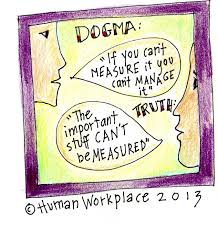
measureWe believe a lot of lies and, to paraphrase Cole from “The Sixth Sense”, we don’t even know we believe them. Yet they rule our lives in many ways. Does that make any sense (sixth or otherwise) at all? It’s not so much that we’re gullible as we fail to take the time to think about the assumptions on which we base our decisions. I’m very big on thinking. Some say I’m too big on it. I’ve already waxed eloquently on the topic a few times, including here.

Here’s one that drives me crazy:

If you can’t measure it, you can’t manage it.

This is the gospel according to bean counters. The truth is, if you can’t measure it… you can’t measure it. Nothing more can be inferred from the former conditional clause. Business lives and, more often, dies by this pseudo-maxim. Everything has to be measured, even if it can’t be. Some unmeasurables that come to mind:

  • Customer satisfaction
  • Employee satisfaction
  • Future results
  • Productivity (in some cases)

There are dozens more, but I have other stuff to do today.

So when business executives realize they can’t measure something, out of fear of not being able to control it – and control is everything to these posers – they make up a measurement and pretend it applies. My favorite example follows.

My last employer decided that customer satisfaction could be measured objectively and precisely by counting the number of unfixed (i.e. “open”) defects currently reported against a given product. Now this is blatant nonsense. I’m sure even IBM execs (oops! I mentioned the employer name) didn’t really believe the figure meant anything. They just winked at each other and agreed to the lie.

Since customer sat was bad at the time, they surmised that lowering the count of those defects would improve the situation. So they gave me the task of closing as many of those defects as possible. Not fixing them, mind you, just getting rid of them, usually by saying they had no plans to address the problems. After a few months, about half those defects had simply gone away and thus, magically, our customer sat numbers doubled.

The suits were happy, the bean counters were happy, and Wall Street was happy. The only people who weren’t happy were the ones this whole pointless exercise was intended for in the first place: the customers. It wasn’t just a lie, it was a counterproductive lie. Though there’s no way to know for sure (reread above), I’m willing to bet those customers were less satisfied than before.

By the way, Forbes agrees with me on this one.

So next time you hear an accepted truth, think about it. Take it from a child of the ’60’s: Question Authority.