Goodbye Instagram ⃰

I joined Instagram ten years ago this month, mainly to see pictures of family, promote my writing, and publicize philanthropic efforts I participated in. It was useful and fun.

The world has changed.

Most of my family has dropped out of the IG world, there’s no evidence it has helped sell any of my books, and its parent company, Meta/Facebook†, has become an enabler of the US kakistocracy and the miscreants in charge. I can no longer associate with a company someone accurately described as “a diabolical cult run by emotionally stunted men babies, institutionally enabled sexual harassers and hypocritical virtue-signalling narcissists” that is “able to swing elections, target body-shamed teens with beauty products and monetise millions of humans’ hitherto private data.”

I quit.

What effect will my quitting have on these deviants? None. So what’s the point? I’ll sleep better knowing I’m no longer supporting such malevolence. It’s the same reason you won’t find me at Walmart or any of the increasingly prevalent local casinos. I try my best not to support sociopathic behavior anywhere.

I’ll miss a lot of stuff I followed on IG:

The thing is, I can get at most of this stuff online in other ways, as evidenced by the links above. Besides, I survived the first 60 years of my life without IG. I should be able to get by the rest of the way without it. And I’ll have a lot more time, what with not getting sucked into the bottomless void of idiotic videos and photos of life hacks (often life-threatening hacks), people doing stupid things (I do enough on my own), ads for crap I couldn’t imagine ever wanting in a thousand lifetimes (items chosen specifically for me by specious AI algorithms), staged “candid” scenes (presumably made by shameless exhibitionists), AI-fabricated nonsense posing as reality (thus perverting our vision of actual reality), maudlin recollections of the way things used to be (but never truly were), and on and on and on (and on, ad nauseam). It seems as if it never ends. In a sense, it never does. I don’t know about you, but I don’t have that kind of time.

Enough. Goodbye and good riddance to it all.


After a long deliberation about taking this step, I was inspired to finally make the leap by an article by one of my heroes, musician, writer, and all-around Renaissance man, Charlie Peacock. You can read it here.

We have a Facebook account, but we rarely use it. Nevertheless, that’s going, too.
Devaluation

wordcloud1Lately everyone has been worried about the devaluation of the Chinese yuan against the US dollar. It must be important because it’s mentioned in every business report and the front page of the Wall Street Journal. For some reason, it also significantly devalued my IRA.

I don’t understand this. I’ve never spent a yuan. I’ve never held one in my hands. I couldn’t even tell you what one looks like. Yet it cost me all sorts of money because of its devaluation, whatever that is.

To be perfectly blunt, I don’t pay a lot of attention to money. While there are people whose lives revolve around the topic, I find it less interesting than Lithuanian zoning regulations. That’s bad, I know, in our mammon-obsessed culture where money somehow signifies credibility, even for the least credible presidential candidate.

Words are the currency I put the most stock in. The devaluation of words and, on a larger scale, the language is what keeps me up nights when others toss and turn over the latest price of pork bellies on the futures exchange. I’m here to tell you that the news is not good. Words appear to be at their lowest value in ages. The evidence is seen all around us as the meanings of words and phrases change faster than the Standard & Poor’s index.

I blame Facebook for a lot of this. “Friend” is a crucial word in my vocabulary and life. It once indicated a relationship of some intimacy. An old proverb says,

A man of many companions may come to ruin, but there is a friend who sticks closer than a brother.

Another translation puts it this way:

There are friends who pretend to be friends, but there is a friend who sticks closer than a brother.

These aptly sum up a real friend versus a “Facebook friend”. How can you be a friend with someone whose only connection to you is a photo and a few carefully laundered and embellished personal facts? I’ve said it before and I’ll say it again, the number of Facebook friends a person has is usually inversely proportional to the number of that one’s true friends.

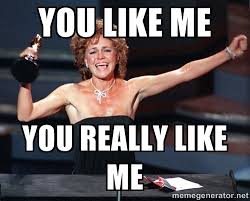
sallymemeFacebook has also turned us into a nation of Sally Fields. Everywhere I turn, people, organizations, and companies are begging me, yea, bribing me, to like them. “Like us and we’ll give you free stuff,” or, “Like me and you’ll be entered in a sweepstakes.” If we step back and acknowledge this for what it’s saying about our culture, it’s pretty pathetic. In truth, it all makes Ms. Field look downright dignified. At the very least, she was ahead of her time.

The most culpable culprit in this ongoing linguicide is corporate America. Look at the gifts they’ve bestowed on us:

  • going forward – “In the future”, “soon”, and “later” weren’t good enough. Everything happens “going forward.”
  • at the end of the day – Other than giving us a good song in Les Mis, this mal mot has added nothing to our lives.

And my personal favorite:

  • Reach out

No one calls, writes, texts, asks, visits, patronizes, drops by, contacts, or tells anymore. We all reach out. We could wipe out the national debt if we put a tax on the use of this banal phrase. It’s bad enough when businesses do it. It has invaded the realm of personal discourse. “Thanks for reaching out to me, Mom. I’ll finish my homework when I’m good and ready.”

Notice one thing about all those biz-speak words. They all increase ambiguity. Thus, an executive may truthfully say, “Bonuses will be distributed going forward,” but might not intend it to happen in your lifetime.

When we say we’re starving, we aren’t. What we say we need, we don’t. Most disasters aren’t. That which we call awesome rarely inspires awe; it barely gets our notice. Great usually isn’t. Important things aren’t. Very-special, can’t-miss episodes of television programs are nothing or less.

Word devaluation doesn’t necessarily hit our wallets, though it could over time. More immediately, it throws our communication – and consequently our relationships – into disarray. We don’t know what we mean anymore. Misunderstanding is on the rise as precision is lost.

Don’t take my word for it. You’ll hear it for yourself going forward.