Writing in Community: Somewhere Stories

It’s a tried and true cliché: Writing is a solitary affair. A writer and his or her computer, typewriter, pencil, tablet, pen, marker, crayon, or other writing implement of choice are isolated for hours, days, weeks, or months on end staring out a window, at a wall, or at the blank page. Locked away in an office, attic, basement, or studio with no people, no interactions, and no interruptions (hopefully). The writer alone with his/her thoughts. (And, when working on a computer, with the endless distractions of the Internet.)

I’m an extroverted, community-oriented, people-energized kind of guy. How did I end up in this world?

Well, there’s another cliché, just as true, that while writing is solitary, a book is a communal undertaking. I can scribble all day for my own entertainment and edification but unless I have others to assist in getting it from the page to an accessible form, it’s merely an exercise of the imagination. That has its own value, to be sure, but it’s generally not the writer’s ultimate aim. Furthermore, if no one reads what I scrawl, it’s vanity of vanities, as the Preacher tells us. The written word needs to be read to be complete.

Take my case, for example. Each of my 12 (so far) books lists me as sole author. (My picture book also has an illustrator.) That’s misleading because I hardly worked alone. There were editors, designers, consultants, inspire-ers, and (maybe most important of all) encouragers, to name a few. And, as I said above, the folks who read those books are as important as any contributor. To paraphrase the age-old question, “If a book is published and no one is there to read it, does it matter?”

Change is in the wind. For the first time, my writing is part of a group project. The local writers’ group I’m part of has published a collection of writings. I had the privilege of contributing three pieces: two short stories and an essay. “Somewhere Stories” can be found on Amazon by clicking on the image below.
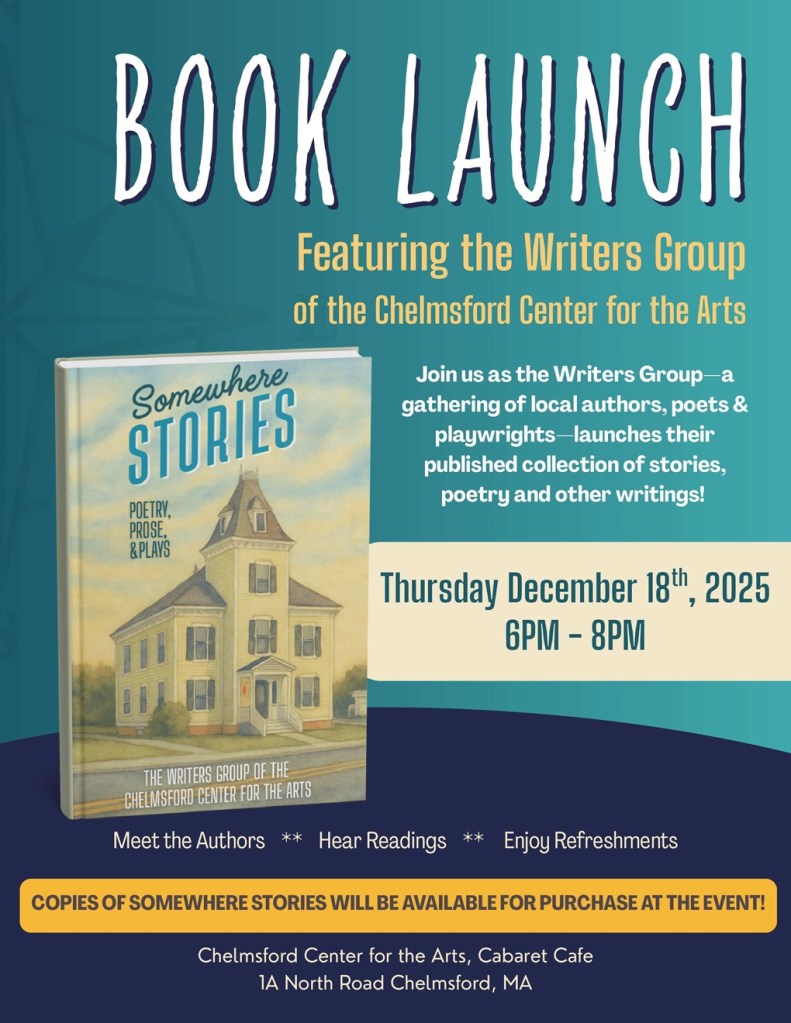
As the flyer above indicates, a book launch will be held next week, on Thursday 12/18/25 at the “somewhere” where we meet, the Chelmsford (MA) Center for the Arts. Feel free to drop by, have some cookies, and check it out.  


(In case you were worried that I’ve given up writing long form books on my own (admit it, you were worried, weren’t you), fret not! I have a new book in the works, a family-friendly comic tome based on another of my unproduced (as yet 🙂 ) screenplays. God willing, it will be out in plenty of time for better weather reading.)

Thank your for you support!

Typos are everywhere. I can’t think of a single book that didn’t have at least one. And I read a lot of books. In fact, a recent novel by one of my favorite authors had at least two. Heck, my books (You know, the ones listed here. 🙂 Ironically, a typo in one of those titles caused Amazon to list it twice! Can you find it?) barely have that many. One of my favorite examples is in the written word in the middle of a movie. You can read about that one in this post.

Sometimes, it’s not clear whether an error is a typo or whether it’s just ignorance of the English language. Here’s a prime example from an article about a local community, which bragged that it…

…is infamous for its support of our local artists, writers, and musicians.

In a world where literally and metaphorically have become synonyms, why not famous and infamous? (I know those two aren’t antonyms or even mutually exclusive, e.g. Trump, but hopefully you get the point. They’re way different.)

The most common typo, however, the grandaddy of them all (and as a grandaddy, I assure you I know what I’m talking about) is the substitution of “you” for “your”. This mistake is virtually (not literally) omnipresent in cyberspace. I swear I don’t read an email, blogpost or even legitimate article that doesn’t have this failure. The most recent I can remember is this comment I saw on an article I read not too long ago:

Thanks for writing you article.

I don’t recall if the article itself had the error. I hope so.

Constraint-induced writing therapy

A few years back (here, to be specific) I wrote about how the tyranny of the urgent, a way of living that keeps us always running but never getting anywhere, gums up the writing process big time. Writing will always take a back seat to mundane but sometimes artificially urgent tasks such as dealing with insurance or cleaning the bathroom or cutting down the pile in the inbox or grocery shopping or catching up with old friends or…

You get the point. Again. The list is seemingly endless. So when to sit down and perform the arduous but not always pressing task of writing? It’s the easiest thing to blow off because it isn’t breathing down my neck.

Except it is.

I’ve come upon a possible solution to this problem. In medical rehab circles, there’s a concept called “learned non-use”. (Stay with me here; there’s a connection.) When a stroke victim loses control of a hand, for example, the brain “learns” not to use it or, more accurately, unlearns how to use it because the patient gives up on that hand and relies on the other. That process can be reversed through a technique known as “constraint-induced movement therapy”. With CIMT, the brain is re-taught to use the formerly abandoned hand by restricting (i.e. constraining) the use of the good hand, thus forcing the use of the previously unused hand. Through a process known as neuroplasticity, the therapy rewires the brain such that the hand can be used again.

So, is there such a thing as constraint-induced writing therapy that I can use to get moving again? Can I constrain the rest of my schedule and to-do list to force me to write? Not likely. The “urgent” tasks will be with me always, yea, unto the end of the world.

Getting away on a personal writing retreat solves the problem temporarily, removing the temptation to give up writing to do the urgent but often less important items weighing heavily on my mind. (Note: If you don’t consider your writing to be important, you’re probably in the wrong field.)

If anyone’s checking (half of me hopes no one is, the other half wishes someone were), this is my first blog post in… too long. The blog serves as both a barometer of my commitment to writing and as a motivator. If I’m not writing in it, chances are I’m not writing at all. If I post something, it builds inertia to keep me going. I’m rewiring my brain to write.

Let’s see if it works.

Start moving now!

The lazy way out of writing this post would have been to simply make a link to the latest post in my other blog because this is little more than a reiteration of what was written there. But that little more (buttressed by my overdeveloped sense of responsibility) is enough to justify a few original words.

Until the new year hit, I hadn’t written anything in months except these posts, and these were dwindling down to a precious few. (Did anyone notice?) As for more substantial written efforts—novels, screenplays, even short stories—that wasn’t happening. I was giving serious consideration to chucking the whole thing. (Who do I think I am to call myself a writer?) Motivation was MIA, but there was no A to speak of.

Then the fortune cookie crumbled. (q.v.)

On top of that, I’m reading a book called “The Last Arrow: Save Nothing for the Next Life” by Erwin Raphael McManus. McManus, one of my favorite writers, has a way of getting under my skin and into my soul to inspire and challenge me like no one else. This book is no exception and the timing was perfect.

Bottom line (literally): I have to write something. In fact, a few things. Watch this space for updates.

Extraordinary praise of the Ordinary

I’ve seen movies that deliver more satisfaction in their first ten minutes than others do in their entirety. I’ll never forget my first viewing of “Raiders of the Lost Ark”. (Note placement of period and quote there.) When Jock flies that plane carrying Indy (and Jock’s pet snake Reggie) into the sunset, I was ready to get up and leave the theater. I’d already gotten my money’s worth. There was more action, excitement, and fun in that segment than most films carry in their first two hours and three sequels.

Pixar’s “Up” is another perfect example. The opening is a brilliant, poignant short film in its own right that outshines (IMHO) the rest of a good movie.

You probably have a list of such favorite openers. (Feel free to mention some in the comments.) In a few of those, the rest of the movie goes nowhere. You wish you actually had gotten up and left or turned off the DVD or stopped the streaming. More often, the beginning is just a foretaste of a great cinematic experience.

That’s a whole ‘nother post. This one isn’t about movies.

There are books like that, too. In fact, there are paragraphs buried in the middle some books that are so wonderful, you could read just those words, close the book, and savor the experience. I’m reading one of those books. To be more precise, I’m rereading one.

I’ve said before in various places (here is just one such instance) that Mark Helprin is my favorite writer. I have to reread some of his prose on a regular basis. (Unfortunately, he doesn’t write books often enough to satisfy my needs. The good news is that, in researching this post, I discovered he has a new novel!) There have been days when I picked up one of his books and read a page or even a paragraph or two to be reminded what great prose sounds like. The following excerpt from his 1995 novel, “Memoir from Antproof Case”, demonstrates well his ability to capture profound truths in prose that is both poetic and humorous.

So many people spend so much time protecting themselves from the ordinary and the worn that it seems as if half the world runs on a defensive principle that robs it of the tested and the true. But if the truth is common, must it be rejected? If the ordinary is beautiful, must it be scorned? They needn’t be, and are not, by those who are free enough to see anew. The human soul itself is quite ordinary, existing by the billion, and on a crowded street you pass souls a thousand times a minute. And yet within the soul is a graceful shining song more wonderful than the stunning cathedrals that stand over the countryside unique and alone. The simple songs are the best. They last into time as inviolably as the light.

I find that passage simply stunning. It’s only a single paragraph, but the truths expressed therein are worth hours or days of meditation.

For a variety of reasons, this kind of writing is comforting, challenging, thrilling, enlightening, and depressing.

And aren’t those the reasons we read—to think and to feel?

Of situations and grandmothers

People ask me what I’m up to. I tell them I’m working on my next book. (Check out my first book here.) The next obvious question is, “What’s it about?” That’s when I lower the boom and give them the most feared answer in all of writing:

It’s a story about my grandmother.

No one wants to hear this sentence because no one wants to hear about anyone else’s grandmother. (This is also true of grandfathers, but they tend to get the short shrift in this respect.) Chances are your grandmother’s story wasn’t even interesting to your grandfather. Yet it seems as if everyone who has ever written a story has written about something amazing that happened to their grandmothers.

A further problem is that “what happened to your grandmother” isn’t a story. It’s a situation. And there’s a big difference. A situation is fine for a news article but not for a novel. It’s a long journey from a situation, as interesting as it might be, to a story.

But it can be a good journey, a fascinating journey, even a fun journey. That’s the journey I’m on now. I’m turning an amazing you-can’t-make-this-stuff-up situation drawn from my grandmother’s life into a story that I hope is a journey my readers will want to take with me.

It’s a novel, so 99% of the content will be from my imagination. The other 1% is the situation – the grain of sand that I hope to build a pearl around. Or if you prefer a cooler metaphor on these sultry summer days, the speck of dust around which will grow an intricate and beautiful snowflake.

For that reason, I must go now. The journey awaits.

Save my little darlings!

An oft-heard recommendation for writers-in-training is some variation of the macabre maxim, “you must kill all your little darlings.” It’s not a mandate for infanticide but rather advice to remove from your work those passages whose purpose is more to build your ego or impress others than to drive your plot or build your characters.

This dictum, which has been attributed to everyone from Faulkner to Stephen King*, is hard to obey. First of all, we love our clever turns of phrase and our precious metaphors. Writers tend to be an egocentric bunch (actually, nearly all human beings fit that bill) who want others to appreciate their genius (or mediocrity, as the case may be). Otherwise, why try to publish our work instead of just scribbling it out and reading it to ourselves?

I have a worse problem. I don’t even want to hurt my darlings.

In this instance I’m talking not about my prose but my characters. They’re like my children or my friends. How could I stand to let them suffer needlessly? Sure, a character has to go through crises and conflicts or they end up in a totally tedious tome. (Now that’s a little darling if ever I wrote one!) No one wants to read:

They started out happy.
A bunch of happy things happened.
They lived happily ever after.

Hopefully, no one wants to write it either. It’s OK for my darlings to go through the fire – we all must – but I need to redeem their trials so the journey is worthwhile.

This afflicts my reading as well as my writing. I’m one of those people who gets ridiculously wrapped up in the characters in a story. (To read more about my obsession, check out this post.) I can’t stand it when characters I’ve grown to care about don’t wind up in some positive state by the end of the tale. Do whatever you want with the jerks in the story, but leave my buds alone.

I prescribe to the Golden Rule of Writing: “Do unto your characters as you would have done unto you.”

Does that make for a boring book/movie/play? By no means. There are lots of (most, I’d judge) stories that have what some would call a happy ending. For some reason, though, it limits the critical reception since critics fawn all over Humpty-Dumpty-esque characters that self-destruct never to be put together again.

It doesn’t have to be that way. Austen, Dickens, and Tolkien (to name just a few) pulled it off somehow. There are worse examples to follow.


*Evidence indicates it was actually coined by a Cambridge lecturer named Arthur Quiller-Couch back in the 1910’s.

Cutting back

bothendsAs some of my readers are aware, I have two blogs, this one (SITS) and Limping in the Light (LITL). Keeping up two separate blogs, even as minimalist as these two are, is a significant amount of work, especially if quality is an important consideration in their content, which it is to me anyway. I’ve written about time constraints and priorities in another post, so I won’t bore you with it (again) here.

Combine these blogs and the daily mundane activities of life with attempts to actually write stories to be sold, published, or otherwise used beyond the realm of the blogosphere and there’s a serious conflict. Something’s gotta give. Everything we do represents something we don’t do because that slice of time and energy has become unavailable.

The conflict is illustrated most tangibly blog-wise when I take shortcuts, such as using the same post in both blogs (q.v. here), write skimpy posts (q.v. here), and when I’m late with a post (q.v. what you’re reading now, one day late.) On the whole I’ve maintained an exemplary record, considering the longevity of the blogs. LITL spans over five years and 300 posts while its little brother SITS is comprised of about 70 entries spread over the last 14 months.

Not a bad run, but it’s going to slow to a walk after today.

In order to devote more time to my “job”, i.e. writing – and also to accommodate some other “opportunities” insinuating themselves into my life – I’m cutting back to one post a week total, that is, for both blogs. From today forward, I’ll write a single post per week, the intent being to alternate between the two platforms. The day of the week is TBD. Recommendations welcome.

This eases up the demands on my schedule, but it frees up your time, too.

You’re welcome.

The Day I Finished

The last three posts (“The Night I Woke Up“, parts 1-5) were more of an exercise for me than anything. If learning was the primary purpose – and I believe it was – then it was a successful foray into the unknown. A rewrite is definitely planned, given that I wanted to change things almost immediately after I published each post. That’s the way the process works, after all. Writing live is a treacherous pastime, one that I’ll probably be foolhardy enough try again, hopefully not repeating the same mistakes. I’ll create new mistakes if there’s a next time.

Some people might be disappointed by the ending. Nothing really happened, when all was said and done.

Or did it?

Certainly, one small corner of a boy’s brain was indelibly etched with an unexplained incident. That alone might justify the story. The telling of a story is the revealing of a life. This one revealed a lot about a kid on the cusp of puberty facing the unknown in more ways than a mysterious visitor in the night.

Maybe we’re all so conditioned to the carved-in-stone movie plot template that governs the storylines of virtually every movie showing at the cineplex. Where’s the reversal? The false ending? The save-the-cat moment? The denouement? Sorry. What you read is what you get. That’s why they call it “reality”, as opposed to, say, reality TV, a.k.a. nonsense. In this case, it’s not too far-fetched to say, it is what it is, or rather, it was what it was. I just call’em as I remember’em. Which brings me to…

Perhaps the whole thing is just the creation of an overactive and highly susceptible imagination, passing itself off as memory. Who knows? I honestly don’t. I believe that what I wrote is exactly what happened. If it isn’t, no harm done.

To quote… well, almost everybody: “That’s my story and I’m sticking with it.”

Read or write… or write?

Inspired by a discussion with a fellow writer earlier today, I’m trying to figure out how to do it all.

I’m told that great writers read a lot. Writers also have to write a lot. Whether this is true is, of course, a matter of conjecture.

What isn’t conjecture is that there are only so many hours in a day – 24, by most reckoning – as well as days in a lifetime. In other words, there are boundaries. If I’ve learned anything in my life, it’s that you can’t do everything. Believe me, I’ve tried. Now you don’t have to because I’ve told you and I wouldn’t lie.

Plus, I’m writing this blog.

On top of all that reading and writing (thankfully no ‘rithmetic), there’s life. Life takes up all my time. Even weekends. As one of my heroes wrote, we all have dots we’re committed to connect: pay bills, keep in touch with friends and family, exercise, go to the bathroom, feed ourselves, return calls, clean the house, buy Stuff, fix Stuff, store Stuff, throw away Stuff, pay taxes, fill the gas tank, balance the checkbook. You get it. Somewhere in there we need to pull back and recharge, too.

That list looks really important when it’s staring me down. Like most people, I generally submit to the Tyranny of the Urgent. Everything else – writing included – gets pushed down until it decomposes into compost, stinky and filthy but suitable for planting seeds, one would hope.

So when do I get the real Writing done?

Now.