YALMP

This is YALMP: Yet Another Lazy Man’s Post. Sometimes, you do what you must to meet deadlines, even self-imposed ones. Case in point, this post.

First, a funny email header I saw:

clown

Hard to believe there’s room for any more clowns in corporate America.


Second, this being a writing blog, here’s a short story I wrote several years ago. I already published it in my other blog, Limping in the Light, before this blog was begun. Rather than copy it into this space, here are three links, each to a part of the story.

6 Hours

Part one

Part two

Part three

Enjoy! And Merry Christmas!

“Idiocracy” and other reflections on the demise of America

Written Wednesday morning, 11/9.

I’m not a drinker, so I’ve never known the misery of “the morning after”. Until now. As penitence, purge, and catharsis, I offer up this series of reflections. Think of it as “literary ipecac”. (I’m also considering taking up binge drinking.)

For a long time I resisted recommending the movie “Idiocracy” (tag line: “In the future, intelligence is extinct.”) because, while it’s smart and funny, it’s incredibly profane. Now, in the aftermath of one of the most shameful days in American history, I feel comfortable doing so. In fact, I consider it mandatory viewing, especially the opening setup. Not only is it hysterically funny, it has proven to be prophetic, almost frighteningly accurate.

For reasons I can’t figure out myself, I’ve never written about my father here. He died one year ago this month. He was a stereotypical member of “the greatest generation”. He lived to make sure his children had better lives than he did. He worked for the same company for decades. He fought on a PT boat in the South Pacific in World War II. (You remember WWII – the last war that wasn’t fought purely to generate profit for American industry.) I was incredibly proud of him. As much as I miss my father, I’m glad he isn’t around to see this day. He used to say, “I didn’t fight in a war just to see this country sold to billionaires.” I can’t imagine what it would do to him to see it handed over for free.

Time to dust off my “Don’t blame me, I’m from Massachusetts” bumper sticker. It served me well when a previous sleaze-bag won an election. This pudgy-fingered, overgrown, adolescent sexual predator makes Nixon look like Mother Teresa. I’ve never been more proud to be a citizen of Massachusetts.

I’ve been ashamed of my country before. The war in Vietnam, Watergate, our silence in Rwanda, and the invasion of Iraq in my lifetime were embarrassing episodes. They remain taints on our history along with a lot of others that preceded me: slavery, Native American genocide, the internment of Japanese in WWII, the McCarthy hearings. This day can be counted among that infamous number because it could usher in new versions of any or all of those.

In addition to a lot of other negative lessons, this campaign and election have taught me that most American men, especially self-proclaimed “Christians”, hate women.

The term “bully pulpit” has taken on a whole new meaning.

My next vote: Lexapro or Zoloft.

“Make America Hate Again”

Before your president-elect did it, when was the last time you saw someone ridicule a disabled person? Right. Middle school. Most of us grew out of that phase. I have a lot of disabled friends. A lot. That image is burned into my mind forever.

We still haven’t learned that those who forget history (or, more commonly in this culture, were ignorant of it in the first place) are condemned to repeat it. Welcome to the Fourth Reich. Ask holocaust survivors. They’ve been there.

I have a few predictions:
1) The presidunce-elect will not serve out a full term.
2) His ignorance and arrogance will cause a major international tragedy.
3) Along with Nixon and McCarthy, he will be remembered as one of the darkest stains in American history.

To start, I’m going to place all stamps on envelopes upside down, an old protest trick from the Vietnam era. I know it’s just symbolic, but it makes me feel better. It takes on greater significance if there’s a flag on the stamp, as there often is. An American flag flown upside down is a sign of national distress.

There was a similar feeling among some people back in 1980 when the Reagan revolution helped Republicans sweep the presidency and both houses of Congress. That was different. People chose one philosophy and rejected another. It was an ideological victory. This was an idiot-illogical victory.

My previous post in my other blog, LITL, about the Christian community’s culpability in this fiasco is hereby re-emphasized.

Pray for mercy.

I’m going to build a wall around me. I’ll gladly pay for it.

Hurricane Matthew fundraising

This is a one-off emergency post to announce the following:

From 10/31/16 until 12/31/16, I will donate 50% of all gross sales (not just profits) of “A Slippery Land” to a reputable organization doing Hurricane Matthew relief efforts. (I can’t say which one, but you’ll get a clue on this page.) That’s $6.00 for every paperback and $2.00 for every Kindle sale through the end of 2016 or until the amount reaches $2,000.00, whichever comes first. (I’m betting on the former, though I’d be perfectly happy with the latter.)

New rating: BA

Previously, I wrote a post about new MPAA ratings that need to be introduced for the protection of the viewing public. There are plenty more where those came from. Today, I’d like to introduce one:

This one isn’t aimed at viewers but rather at the lazy and imagination-bankrupt producers of much of the dreck that passes for movie releases these days. (Thank goodness the “colorization” rage suffered a rapid demise.)

Fine. I get it. You want to produce sure money makers so you revive or piggyback on successful movies of the past. (We’ll ignore that fact that it doesn’t work.) It used to be that they at least had the decency to (1) wait a few decades to remake a movie and (2) stay away from classic films that have stood the test of time.

No more.

A popular movie stands a good chance of generating a reboot every ten years or so. (A remake of “Memento”, only 16 years old, is being developed.) And sequels? They flow like pee from a race horse. With much the same value. (There’s a sequel to “Mary Poppins” coming. Sacrilege.) No big deal. Crap is crap and we’ve come to expect it from Hollywood in large steaming heaps.

But “Ben Hur”?!?! Were they serious? It’s not enough that they put Morgan Freeman in dreadlocks. This is a movie that should never even have been considered for a remake or sequel. (If it had made money, the sequel would have been a lock.) Back in 1998, Gus Van Sant must have been psycho to remake Hitchcock’s classic. (From the “those who don’t know history are condemned to repeat it” department: Michael Bay, of all people, wants to remake “The Birds”. Make it go away!!!)

The good news is that both of those films were box office disasters. And rightly so. Those two films, along with a lot more, should have been rated Back Away, Off Limits, Don’t Touch, Hands Off. Anything to keep producers’ grubby and greedy little mitts off the Good Stuff.

Here’s a short list of a few films that beg for the BA rating:

  • Casablanca
  • Gone with the Wind
  • 2001: A Space Odyssey
  • Singing in the Rain
  • City Lights

…along with probably every film in the AFI’s top 100. There should be serious penalties for violating this rating, above and beyond the deserved scorn and likely financial loss.

There’s plenty of stuff in the can that are legitimate candidates for remakes. Here are a few I would like to see:

  • It Happens Every Spring – Fun baseball story rife for new humor and technology.
  • I’d Rather Be Rich – Wonderful 1964 screwball romcom, hysterical but badly dated. It’s actually a remake of 1941’s “It Started with Eve”. Time for a new one.
  • On the Town – Great Broadway musical hacked by censors into an uneven movie. Remake from the original stage version.

Do you have any candidates for either list?

The Shoeshine (Part 3)

[The conclusion of a Haitian shoeshine’s story, begun here and continued in the previous post. Based on a minor character introduced in my book, A Slippery Land.]

The long line of customers at the mission was a mixed blessing. He was running so late, he decided to skip his usual next stop, Toussaint L’Ouverture Airport. No one would miss him there, where mobs swarmed the arriving passengers, grabbing luggage and asking for payment in return, offering rides on tap-taps, or simply begging for American dollars from any blans emerging from the sweltering terminal. Having been at this most of their lives, they knew the blans were probably charity workers already in a giving spirit. The shoeshine usually had to battle those beggars for position. He didn’t hold them a grudge knowing he was only one shoeshine box away from joining them. He didn’t need the reminder.

Cité Soleil

Cité Soleil

Proceeding to his next stop, he made sure to cut a wide swath around his old neighborhood of Cité Soleil. Although he’d arrived at an uneasy peace in his own heart regarding his old life there, he knew of others in that slum who would not be inclined to extend the same grace to him. He wasn’t proud of the life he’d led there or the things he’d done, some of which would follow him to his grave. While he was embroiled in those transgressions, he’d rationalized away his misdeeds, telling himself that he only did what he needed to do to survive and get out of the slum. He did get out of the slum, to be sure, but Cité Soleil was never completely out of him.

His next stop was part of his penance. A home had been established for a group of elderly men and women who had somehow survived the ravages of life in Haiti—the storms, the violence, and the final insult: the earthquake. His own actions had prevented some young men from ever having the chance to reach that age. Any of the residents who brought shoes to him would have them shined at no charge.

The old men whose shoes he shined knew that what he did was not free. A price had already been paid. They sensed in him the same turmoil they recognized in themselves. They had been young, too. A few had served as enforcers for the Duvaliers. Some younger residents were former activists in Fanmi Lavalas. On the streets years ago, they might have battled one another to the death. Age had allayed the differences weapons could not. The ideals of youth died long before their own bodies did.

The shoeshine had no political affiliations or inclinations. With the disappearance of his family, he’d become a one-man party with no representation in government he was aware of. He’d seen enough elections to prevent him putting any faith in that process.

The last shoe buffed to a sheen rarely seen on any other object in Haiti, he bade ovwa to the old men.

His last hope for customers was outside the church. A few harried congregants always neglected to shine their shoes. Seeing the gleam of other’s footwear would drive them to the shoeshine in a desperate attempt to prepare their outfits for an appearance before God, even if their souls still harbored pain and guilt. Something could be done about the shoes, at least.

The man wasn’t comfortable around the church. He kept as great a distance from the building as possible without endangering his business. He still believed in God, but his regard for His servants crumbled when his wife fell under the seductive power of the pastor. Other than tending the shoes of the people entering the building, he’d had nothing to do with the church since then.

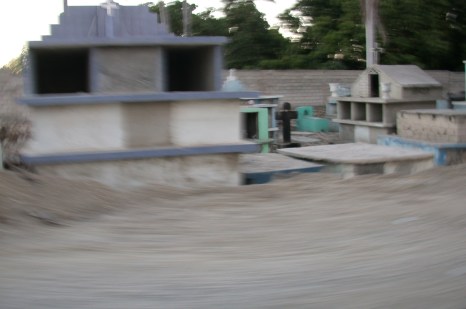
A cemetery in the Haitian countryside.

          A cemetery in the Haitian countryside.

A stop at the church was always emotionally draining for him. He needed to rest before he returned home. On the way was a cemetery where he knew he could find quiet. He settled on a stone, hoping it didn’t mark the finally resting place of some poor soul. In his box he found the little treats the kids at the mission house had left him. He took one out and examined it. The colors on the packaging alone mesmerized him. What kind of country had these colorful goods in such quantity that mere children were giving them away? America was a dream. He knew distant relatives who had moved there. He tried to imagine their lives in a place where food was so abundant and opportunity lurked everywhere. How much better his life might be in such an environment, he couldn’t even begin to imagine.

To distract himself from such dreams, which tended to induce more despair than hope, he scanned the area where he sat. Each time he encountered the large, impressive monuments in the cemetery, he was amazed. Ornate wrought iron designs adorned intricately poured concrete structures. Many dwarfed his own home. It made him laugh to himself to think he might have to die to improve his living conditions.

Nothing was new under the Haitian sun. After consuming half the gritty, bland American bar, he wrapped the rest up and stuffed it back into his box. He rose and turned his back on the cemetery, ready to make his way home. In his imagination, his wife and son awaited him.

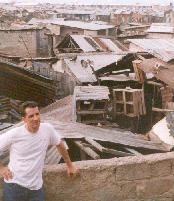
The author in Cité Soleil.

The author in Cité Soleil.

The Shoeshine (Part 2)

[A Haitian shoeshines story, continued from the previous post.]

shoes

His first stop after roaming along his own street was the orphanage, not because it was a likely spot to find customers, but simply because it was the nearest large building. Occasionally, the people who owned the orphanage would be there. Clean shoes lent them an air of credibility, or so they felt.

The shoeshine had come to know many of the children in the orphanage over the years. He’d even met some of their parents, whose inability to feed and house them had forced them to turn their little ones over to the care of this institution. The children were fed and housed, but whether they were truly cared for was another question, the answer to which saddened him.

He wondered how he would have handled the situation if his son had survived the quake but the boy’s mother had still perished. Could he have given up the only child he would ever have? Against his will, he had anyway. The memory of the little boy was so vivid, he swore he felt the child’s breath whenever a stealth breeze caught him by surprise. The man had never shed a tear for the boy since he died, although he remembered crying over him constantly while he was still with him. He cried as the boy slept, when he played, and when he sat on the roof of their home staring over the city, never knowing what thoughts passed through the child’s mind. Were they the same as his own? Where were those thoughts now?

No customers emerged from the orphanage so the shoeshine moved on.

His hopes for a good return from the mission house were high. He’d seen evidence of a team of young people from the US staying there. The Americans always carried plenty of cash. While he only charged his fellow Haitians a few gourdes, he could easily ask an American dollar for each pair of shoes from the blans. It was rare that their shoes actually needed cleaning, packed away as they had been in luggage few Haitians could afford. It was an unspoken agreement of a metaphysical transaction. They would give up what to them was worthless to clean not their footwear but their consciences.

His English was limited to the few expressions required to accomplish the deal. “One dollar.” “Two shoes.” “Thank you.” Few of the team members made an effort to expand communications, so he appreciated all that much more the ones who did. They would approach him with smiles and ask in their American accents, “Konben?” A few would actually try to bargain with him. While he went along with the game and didn’t begrudge them their amusement, it annoyed him all the same.

The teens had come to help build a school. He appreciated the Americans’ misguided attempts at assistance, but he’d known more than one construction worker who had lost their jobs to visiting American kids. Despite the fact that one Haitian worker could accomplish as much in an hour as a team of American youths could do in a day, they kept coming like some invading force, taking opportunity captive.

The house was alive with activity. Through the screened windows, the shoeshine saw the teens scurrying back and forth, exhibiting the same degree of purpose as that shown by the ants that crisscrossed the walls of the building with no apparent goal.

One white face glanced out from a hole in a wall and saw him. A young girl who couldn’t have been more than fifteen approached him. She held out a bag in her hand. With a shining smile, she told him, “Kado.” A conflict of fear and gratitude contorted his face as he took the gift. Looking inside, he saw a brand new tin of black polish. His smile of more gaps than teeth was sincere, but he couldn’t help thinking of the man he usually bought his polish from. This was one less bit of income his friend would receive. He felt bad, but wasn’t about to turn down this meager windfall.

Most of the kids just left their shoes on the steps with a dollar in one of them. A couple had bits of food, strange, colorfully wrapped bars of nuts and grains flecked with bits of chocolate. He would make the most of those scraps. One bar could be made to last for two meals if money or food were scarce, as they often were. There was no telling when the next team might arrive carrying more free goods.

To be continued…

The Shoeshine (Part 1)

[Two events brought about the timing and content of this week’s post. First, I missed last week’s deadline for this blog. This is a Limping in the Light week but the next LITL post will have to slip out a week. Second, someone (a fan?!?) was expressing an opinion about my book, A Slippery Land. She said she wanted to hear the stories behind some of the minor characters in the book. Luckily, I’ve already started one such story, so I present it here. I hope you enjoy this first part of the shoeshine’s story.]

shoeshine

The Shoeshine

Dawn announced its arrival on the concrete walls long before the shoeshine ever saw the sun. The light bounded between the decrepit structures that surrounded his decrepit house, crept up the alleys, and drew long vectors of light that gradually linked the tumbledown buildings as if his neighborhood were a giant connect-the-dots puzzle.

His eyes opened as slowly as the sun rose. Not even the slightest breeze had infiltrated the room all night. The air he woke up in was the same air in which he’d fallen asleep. The heavy, dust-filled air enveloped him like a vaporous cocoon. His face was drenched with sweat, as it always was, his eyes were bloodshot, and his nose runny. He reached over and picked up a shirt balled up on the floor at the side of his mattress and wiped his face clean. He had another shirt he could wear.

Instinctively, he swung his eyes around the room. It was unchanged from the day before and in fact unchanged from the day he moved in the week after the 2010 earthquake. The day after his home was destroyed by one of the many tremors following the initial shock, he’d found this abandoned tiny concrete box. He’d slept outside it for several days before he felt it was safe from collapse. He found a mattress, dragged it in, and his new house was furnished. After a year, he correctly assumed no one would return to it to claim ownership.

As quickly as his arthritic knees would allow—not quickly by any means—he gathered the tools of his trade along with his will. If he didn’t catch people before church, there would be few customers. Sunday was no day of rest for him. Most everything he needed was still in the mildewed wooden box sitting by the door where he’d left it the day before. He took stock of its contents: A brush, most of its bristles worn down to the wooden base. He’d need a new one soon, but had no idea where it would come from. Two rags, vestiges of shirts he’d picked up here and there, one still stained with the blood of the man he’d ripped it off after the quake. Black polish, a new can he’d bought with last Sunday’s earnings. White polish. He didn’t often use the white polish. White shoes, the style little girls only wore to weddings, became so scuffed up in the rugged streets of Port-au-Prince, shining them was a futile exercise. A couple of badly tarnished gourde coins rattled around at the bottom of the box.

An enormous dump truck, one that towered over most of the dwellings on the street, rumbled by carrying a load of charcoal, carcasses of felled trees that would never be replaced. As the truck shook the ground, his heart raced. He was immediately transported to the moment his life changed forever. The resilience that had carried him this far calmed him by the time the truck passed.

The outlook for breakfast was not good. Perhaps, he thought, a customer would offer him a piece of toast or a sample of Sunday’s squash soup. Hunger had long since ceased to be an impediment to his schedule. It was as much a part of his routine as breathing.

He picked up his little bell, the one that announced his presence with its feeble, tinny sound. He glanced around his home as if there were more to see. All that remained was a trip around the back to relieve himself before he began his rounds. The stain he made on the cement wall didn’t last long in the sun and heat, but the streaks of red drawn by the blood in his urine worried him. He had no idea what it portended but, having never seen it before last month, he assumed it was a bad sign.

To be continued…

All the news that’s fit to depress

Here’s a column I saw recently in a small-town Maine newspaper. Have you ever seen anything so depressing?

DivorceListEdit

I’ve never seen anything like this. It went on quite a bit longer. Each paragraph saddened me more deeply.

Sorry to ruin your day, but it ruined mine. I couldn’t resist sharing the pain.

On the positive side, each of those items is a story prompt. A sad story.

Of situations and grandmothers

People ask me what I’m up to. I tell them I’m working on my next book. (Check out my first book here.) The next obvious question is, “What’s it about?” That’s when I lower the boom and give them the most feared answer in all of writing:

It’s a story about my grandmother.

No one wants to hear this sentence because no one wants to hear about anyone else’s grandmother. (This is also true of grandfathers, but they tend to get the short shrift in this respect.) Chances are your grandmother’s story wasn’t even interesting to your grandfather. Yet it seems as if everyone who has ever written a story has written about something amazing that happened to their grandmothers.

A further problem is that “what happened to your grandmother” isn’t a story. It’s a situation. And there’s a big difference. A situation is fine for a news article but not for a novel. It’s a long journey from a situation, as interesting as it might be, to a story.

But it can be a good journey, a fascinating journey, even a fun journey. That’s the journey I’m on now. I’m turning an amazing you-can’t-make-this-stuff-up situation drawn from my grandmother’s life into a story that I hope is a journey my readers will want to take with me.

It’s a novel, so 99% of the content will be from my imagination. The other 1% is the situation – the grain of sand that I hope to build a pearl around. Or if you prefer a cooler metaphor on these sultry summer days, the speck of dust around which will grow an intricate and beautiful snowflake.

For that reason, I must go now. The journey awaits.