Bad movies of good stories

inspired by actual eventsRecently I watched what looked, from descriptions I’d read, like an interesting movie. It was a fabricated story “inspired by actual events”, as opposed to “based on a true story” or “inspired by a true story” or “based on actual events.”

According to the blurb on the DVD cover, the film was “Astonishing.” As it turns out, the only thing about the movie I found astonishing was that it got made at all. Surprisingly, the “actual events” that inspired the story were more horrific than the ones actually portrayed in the movie. More often than not, the opposite is true. Otherwise tepid events are typically sensationalized to titillate potential viewers. That should give you an idea of how grim these particular “actual events” were.

There are a number of questions and concerns that films like this raise in my mind:

First, when is a true story not a true story? Is it fair to sell fiction as fact? The Academy Award winning best picture of 2012, “Argo”, brought this question to the fore. It was publicized as, “Based on the declassified true story”, but it was more fiction than history. How discerning is the average moviegoer? From my perspective, not very. Therefore, in a very real way, we’re rewriting history.

Then, is it fair to review a movie’s content versus its quality? I’ve seen plenty of weak movies that tell amazing stories ripped from headlines or history books. Great story, mostly because it was great in real life. The movie, not so much. Still, these are worth watching. One good example was a biopic (probably heavily fictionalized) about Cesar Chavez, a man whose story should be more widely known. The film was marginal, but it was important to see because I regularly need to be inspired by great – and real – men.

That also brings up the question of whether the moral content of a film should be included as part of its review. In today’s political climate, a siskel-and-ebertracist film would almost certainly be trashed, as it should be. Yet misogynistic films and TV shows seem to be proliferating without much resistance. One could legitimately say that the moral judgment of a story is dependent on the morality of the reviewer. But doesn’t the reviewer’s bias come into play in any review? If every reviewer agreed on every movie, we could eliminate personal prejudices as a factor. But then we would never have had Siskel and Ebert arguing about the direction of thumbs. What fun would that be?

So then, of what value are critics’ opinions? Probably none at all, except in those rare cases where all the critics seem to agree. But even then, if I’d listened to that unanimity, I’d have missed out on some films I consider terrific. (Call me weird.) Worse are the films I’ve seen because the cognoscenti decreed them great and they’ve left me feeling like I needed a good scrubbing afterward.

Unless you have a particular reviewer whose opinions always align with yours – Ebert was one who came closest for me – you’re pretty much on your own.

Like me, be your own best critic.

What’s *your* story?

storyI love Jesus. Not just because He loves me and died for me, although that’s pretty cool and would be enough. I also love the fact that He’s a master storyteller. When people ask Him profound theological questions, He usually tells a story. It’s almost as if He’s trying to evade the question. Rather, I think, He’s getting to the heart of it.

Ask a theologian to tell you what the Kingdom of God is and you’re bound to get a tedious multi-volume treatise on the ins and outs of Jewish culture, a summary of a couple millennia of church history, and a detailed exegesis of Greek New Testament passages. Ask Jesus and you get a story about one of the following:

  • Some sad old woman who spends the whole night looking for her spare change in the sofa.
  • A farmer who’s having mixed success with his crops.
  • A sleazy middle manager who makes good by cheating his old boss.

legoparableThe parables (fancy theological word for stories) of the Prodigal Son and the Good Samaritan are more than tales that have become part of the nerve fiber of our culture. They’re great stories.

Why does He tell stories? Because people listen to stories. Sermons? Not so much. Even those of us who listen to sermons don’t always listen. If you know someone who’s heard a sermon recently, ask her what it was about. You’re more likely to hear about the joke the preacher told or the simple family anecdote that illustrated a forgotten moral lesson.

We’re wired to listen to stories. No matter what the era or the dominant philosophy thereof, people love and crave stories. They used to be told around campfires and now they’re seen on a phone or in a cineplex. No difference. It’s the story, the people, the ups and downs of fortune, the clawing after the goal, the battle of good vs. evil, the boy-meets-girl, the life-and-death struggle.

cleaversOne reason I believe stories resonate so well with us all is that we somehow, without even thinking about it, realize we’re in our own story. You might not be a writer, but you’re writing your life story. You’re the lead, the hero. That doesn’t mean you have to be Indiana Jones or Aragorn. It might be enough to be June or Ward Cleaver.

Most of our stories are pretty boring. They’d make lousy movies. Hitchcock was quoted as saying, “Movies are real life with the boring parts cut out.” By that criteria, most lives would make brief movies indeed, more like music videos or even commercials.

It doesn’t have to be that way.

What if your life was interesting enough to be made into a miniseries? Or a sitcom that runs 20 (or more) seasons? What’s to stop it? You’re the writer. You might have no pen, pencil, laptop, or vintage Underwood, but every day you’re writing the story of your life with your words, your loves, your priorities. Some day this volume of that story will end. (Lord willing, there will be a sequel.) Meanwhile, make it interesting, something worth telling. Something people want to hear.

Including you.

Random late summer thoughts

random3My favorite writer, Mark Helprin, once adjured an audience, of which I had the privilege of being a part, to pay attention to the world around us. This is critical for writers. The topic was touched on with respect to dialog in a previous post.

Paying even a modicum of attention to what’s happening in your family, town, or on the news will supply fodder for countless stories. Market Basket, a lowly supermarket chain, has in recent weeks given us enough storylines, characters, and sub-plots to fill several books, a few movies, and at least one mini-series. Just watch; they’re coming.

What to do? asks the humble scribe of blog posts. With so much to comment on, there isn’t time to do justice to every one. My solution to the problem is to do an occasional dump of thoughts rattling around in this mostly empty skull. This is the first in this blog, although it tends to be a regular ploy in my other blog, Limping in the Light, e.g. here.

Here are a few things backed up in my mental septic system:

Here’s a fun question for you literati: When you go to a bookstore, what section do you go to first? Your answers should lead to a lot of fascinating follow-up discussion.

I recently read a best-selling novel with a couple of egregious problems. This wasn’t mass market pop lit such as “Twilight” or some transcribed TV-show passing itself off as literature. This was a highly regarded, serious novel. Two things stood out to me. One was the author’s obsession with using the word “impossibly” to modify an adjective (e.g. “impossibly large”). I have no problem with that in principle. The aforementioned Helprin will use it occasionally. But this author used it five times in the one book! (Don’t ask me how I noticed this. It’s a curse.)

Another sentence read: “…each <whatever> was more perfect than last.” Some things can be more perfect than others? How does that work?

Although the book received mixed reviews, it won awards and was on the NY Times best-seller list for several weeks. Yet I can’t get anyone to even read my book. It must not be as perfect as that one. ((sigh))

parking-lot1Off the book topic: What’s with people endlessly circling parking lots looking for the closest space? In spite of sky-high gas prices and rampant obesity and the supposed busy-ness of everyone, they waste what’s in scarcity – time and fuel – to avoid what they desperately need: exercise. Just park the stinkin’ car!

Have you noticed that owning chickens is hot?

100_0403CVSIn CVS (a firm already infamous for its extravagant waste of receipt paper, q.v. photo) yesterday, I bought one item that came in a bag. The clerk at the counter put it in one of their plastic CVS bags. I asked her why I needed a bag to put the bag in. She had no answer, perhaps because there is none. Punch in folks, it’s time to bag the bags. We don’t need a bag to carry one item… unless you’re hiding something.

I usually ask for no bag, but the checkout people, who must be on the payroll of the bag manufacturer, sometimes beat me to it. When I ask them (kindly) to keep their bag, more often than not, they stuff it in the trash. Someone’s missing the point.

Living on a busy street, my front lawn serves as de facto trash dump for passing cars. We can learn a lot about the kind of person who has no regard for other people’s property or the cleanliness of the town they live in or drive through. The following items make up 90% of the trash strewn across my lawn:trash

  • losing lottery tickets
  • beer cans
  • fast food containers
  • cigarettes

Who are the slobs who trash our neighborhoods? The list speaks for itself. It makes me think of the old Disney cartoon. It’s cute, but painful.

bob&rayA word to the wise: Today’s phones, whether cell or landline, have the annoying trait of inserting a brief delay between the time the phone is answered and when it will register your voice. Thus, you call someone and they generally respond, “…lo!” My advice: answer the call and count to 2-1000 before speaking.

Reminds me of the old Bob and Ray routine with the fictional reporter Wally Ballou starting his on-the-spot reports by saying, “…ly Ballou here.”

When I was a kid and when my kids were kids, punishment usually meant being sent to your room. A more appropriate form of discipline today would be, “That’s it, I’ve had it with you. Come out of your room and stay out all afternoon!” Much more effective.

 That was an impossibly easy post…

Life is long… and short

Is it possible for two seemingly opposite statements to both be true? On the face of it, the answer would be no, but not so fast. We deal with such incongruities all the time.

Absence makes the heart grow fonder. There’s plenty of anecdotal evidence supporting that as a true statement. Yet, we’ve all experienced the veracity of “out of sight, out of mind.”

Christian theology is filled with such contradictions. God is one but God is three. We have free will, but God is sovereign and predetermines our eternal fates.

When it comes to one particular adage, I can’t disagree with one of my favorite characters from another of my favorite under-appreciated movies: Lamarr from “That Thing You Do” says:

"Slow down, young squire. Life is long."
“Hey, hey, hey! Slow down there, young squire. Life is long.”

Lots of folks say life is fleeting and you have to squeeze as much into every moment as possible. But if Lamarr says life is long, who am I to disagree? He’s one of my heroes and he’s never steered me wrong. Think about the last time you were in the dentist chair. Did life go by fast? Or when you’re waiting for the results of a job application or medical test? Or for the writers out there, how about when you’re waiting for a response to a query letter?

In those cases, and in many others, life is indeed looooooooooooooooooong.

At the same time, life is way too short. If you have kids, you know exactly what I’m talking about. One day, they’re potty-training, seemingly the next, they’re finishing a doctoral thesis on string theory (or string cheese; I can never tell the difference). Life couldn’t go any faster than that.

I’m not the first and I won’t be the last to declare how life speeds up as you age. The more years behind you, the shorter the ones ahead. A classic example: When I was in school, summer lasted forever. Those two months, after all, were a significant percentage of my life. Now they represent a miniscule fraction of the whole and the season’s gone before I’ve had time to make vacation plans.

None of this is new; everyone pays lip service to it. But few behave any differently in the face of the increasing velocity of life. Ironically, Lamarr’s advice applies here as well, “Slow down, young squire.” Appreciate the fleeting moment. Get off the information superhighway.

Instead of giving more and creating more, we (myself included) bury ourselves, our gifts, and our talents in a jumble of iDevices, sports, lame TV and movies, innumerable tweets, and more added to the mess every day.

To once more quote the incomparable Lamarr, “Now where I come from, that just ain’t right.”

Yanks to Fete Steinbrenner Next

[This important sports item has just been released.]

The venerable New York Yankees, after the ultra-successful whirlwind retirement tours of Mariano Rivera and Derek Jeter, have decided to follow up with a round-the-horn circuit by “The Boss”, the late George Steinbrenner.

We want to maintain the momentum established in 2013 and 2014,” explained Yankee Director of Chutzpah, Steuben Lowe. “When we looked at our roster, however, we found a serious dearth in expected retirements for the next few years.” Mr. Steinbrenner, who passed away in 2010, was the next logical choice.

He’s a legend,” claimed Lowe. “He singlehandedly transformed baseball from an athletic competition to a virtual meat market. To top off his regime, he transformed ‘The House that Ruth Built’ into ‘The House that George Demolished’. No other owner in baseball history can claim achievements of that significance.”

As the Yankees visit each ballpark during the 2015 season, honorary local volunteer pall-bearers will carry Steinbrenner’s coffin to home plate where he will receive the accolades due his reputation as fierce competitor and ruthless executive.

Of course, he’ll have no use for the vehicles, artwork, and memorabilia of the type showered on Mariano and Derek,” Lowe told reporters. “But all those goods can be converted into cash to sign future retirees.” eBay has been contracted and is already gearing up to handle the expected bonanza. Donations to Mr. Steinbrenner’s favorite cause, the Yankee Free Agent Fund, will be accepted and welcome.

Being honored in all those ballparks would have brought a genuine thrill to Mr. Steinbrenner, especially Fenway Park, which held a special place in his heart. I only wish Shea Stadium was still around for The Boss to occupy. It will be a bittersweet time, that’s for sure,” the Yankee executive said with a well-placed tear in his eye.

Lowe further explained that, what with the Yankees recently losing such stars as Robinson Cano and Andy Pettitte, the pipeline for “quality retirees” is dry. “The storied history of the Yankees demands higher profile pensioners than those currently available. Gone are the days when we could have filled an entire decade with Hall of Fame caliber players to drain the pockets of kowtowing competitors. Lou Gehrig in particular was a missed opportunity of exceptional proportions.” Lowe later added that the level of available plundering has not always been as rich as it is today. “With the advent of interleague play, the stakes are much higher. The amount we could have extorted before the interleague era pales in comparison to today’s potential take.

Depending on the outcome of his suspension and various appeals, Alex Rodriguez is generally regarded as the next viable tour candidate. Unfortunately, his availability will be in doubt for some time. A traveling Congressional inquiry with Rodriguez as the key witness has been discussed but the legalities involved could make such a tour prohibitive.

If A-Rod falls through, rumor has it that Jacoby Ellsbury, speedster centerfielder signed away from the rival Red Sox, will be asked to take early retirement after the 2016 season to fill the gap. “We signed Ellsbury not only for his baseball skills but for his estimable marketing potential,” declared the Yankee’s General Manager, the ironically named Brian Cashman. “He has nothing to lose taking early retirement. The Yankees’ severance package is, as you might imagine, generous to a fault. Additionally, Jacoby will be allowed to keep the cars, shoes, bling, and other offerings that are de rigueur for these tributes.”

Reaction to the announcement from around the league was mixed.

This is not only good for the Yankees and for baseball, frankly, it’s good for the Tampa Bay Rays,” declared Rays Senior Vice President of Overachievement. Merry Chase. “We don’t draw flies here at the Trop unless one of the big money teams comes to town. These tributes boost our attendance tremendously as retired New Yorkers flock to the stadium to pay their respects to their returning heroes. That’s fine with us, as long as they put out for the proverbial peanuts and Cracker Jacks.”

Orioles brass were less enthusiastic. A source who wished to remain anonymous summed up their feelings, saying, “What a bunch of greedy bastards.”

Where, oh where did my money go?

[As threatened, er, mentioned in my last post, the idea of losing ten mill a day is too funny to pass up without elaborating on. So, here I go, elaborating. It’s a lot like writing, but easier.]

losemoneyThe first day it happened, I thought, “What the heck, it’s only $10,000,000.” The second day, I was a little more concerned, but didn’t lose any sleep over it. After all, Stephen Drew makes $10M a year and he’s batting 21 points under the Mendoza line. How much can it be worth?

After a week of losing ten million bucks a day, though, I was beginning to think maybe I should give this issue some thought. You know, ten million here and ten million there and pretty soon your talking about real money. This was a situation to be taken seriously before it became a real problem.

After looking in all the obvious places – my pants’ pockets, those little car storage compartments, the washer and dryer, under the bed – I was still several tens of millions in the hole. I know what you’re thinking: “No big deal.” But it’s the principle of the thing. Besides, you never know when you might need a hundred million or so. It would be embarrassing to pull up to a toll booth and come up a few million short. After all, I don’t have E-ZPass.

Still, it’s only money. Did you ever balance your checkbook and it was off by a few million? Yeah, me too. It happens all the time, but I never pay it any mind. I figure it’ll all straighten out in the next statement or two. Then there was the time I tipped the waitress at Applebee’s and accidentally put an extra seven zeros after the amount. I could have kicked myself, but these things happen. Besides, the service was very good.

I’m not one of those crazy OCD types who has to know where every million bucks goes. Come on! My time is worth more than that. If I worried about every million dollars that passed through my hands, I’d never get anything else done.

Some people tried to convince me that members of my family were bilking me of my money. The thought never received even a moment’s consideration. Can you imagine suspecting my own family of trying to cheat me? Accusing them would irrevocably sever our ties. Money comes and goes, but family is one nonnegotiable constant in my life. I’d never imperil my relationship with my family for money, no matter what the amount.

No sane person would.

Special edition*: Grass roots

If you live anywhere in New England, you can’t help hearing about the Market Basket soap opera. In fact, you can’t help hearing about it no matter where you live. I’ve seen articles in Time and the Wall Street Journal, as well as newspapers as far away as New Zealand covering this tawdry debacle.

I’ll declare my sentiments up front. I’m a huge fan of the old MB. I shop there and have for the past thirty or so years. The DeMoulas family is clearly dysfunctional, but the ASD side of it (if you’ve been studying the cast of characters in your program) is delusional, stupid, and possibly even evil. (The distinction is subtle, one I plan to discuss in a future post.) The employees, the customers, and even local pols have made it clear by the proverbial overwhelming majority, that the current board of directors of the company needs to put the old CEO, ATD, back into power.

So what’s this all about? Money? Clearly not. MB is losing ten million dollars a day. That’s $10,000,000 US. Every day. Now I’ve lost money in my day. Quarters slip behind the couch cushions, dollars stick together, and that kind of thing. But $10,000,000? As forgetful as I am, I can’t even imagine that. (“Honey, have you seen my ten million bucks? I had it in my jacket pocket this morning.” This concept deserves its own post.)

newsiesThe more I hear about this grass roots movement of a bunch of employees, the more I think of what I consider the single most underrated movie of all time, “Newsies”. The critics trashed the movie mercilessly when it was released 22 years ago, but I’ve never met a viewer who didn’t like it. I’m among them. To remind myself of how terrific the movie is, and to capture the parallels with the MB fiasco, I watched it again tonight.

It’s still great.

The songs will bounce around my head for at least a week, so catchy are they. The live musical version of the movie went on to win 2012 Tony Awards® for Best Score and Best Choreography. So I guess it’s not just me. This is a case where the self-proclaimed “experts” are simply wrong.

The connection to MB is best summarized in the following (slightly abridged) exchange between two of the striking newsies (kids who sell papers on the street) and Joseph Pulitzer, publisher of the NY World.

PULITZER: Anyone who doesn’t act in their own self interest is a fool.

DAVID: Then what does that make you?

PULITZER: What?

DAVID: You talk about self interest, but since the strike, your circulation’s been down 70%. Every day you’re losing thousands of dollars just to beat us out of one lousy tenth of a cent. Why?

JACK: You see, it ain’t about the money, Dave. If Joe gives in to nobodies like us, it means we got the power. And he can’t do that, no matter what it costs. Am I right, Joe?

If the current Board of Directors (who, to replace ATD, appointed co-CEO’s – now there’s a formula for success – one of whom was named one of the five worst CEO’s in 2012) cared about money, they’d give in to the employee’s demands yesterday. But that’s not what the fight is about. It’s about bitterness, power, revenge, hatred, and all sorts of other petty nonsense. Are these really adults?

Give me back my Market Basket!

*This is five days before my next scheduled post, but I couldn’t resist. The whole situation could change any minute.

Lies we believe #5

[What? #5??? Where the heck did 1-4 go? I’ve had a running series of “Lies we believe” posts in my other blog, Limping in the Light. (This one, for example. You should read them all. Now.) It just seemed more appropriate to continue that series on this side of the blog wall.]

measureWe believe a lot of lies and, to paraphrase Cole from “The Sixth Sense”, we don’t even know we believe them. Yet they rule our lives in many ways. Does that make any sense (sixth or otherwise) at all? It’s not so much that we’re gullible as we fail to take the time to think about the assumptions on which we base our decisions. I’m very big on thinking. Some say I’m too big on it. I’ve already waxed eloquently on the topic a few times, including here.

Here’s one that drives me crazy:

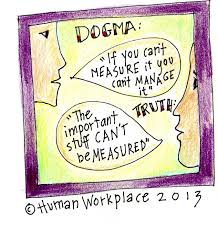
If you can’t measure it, you can’t manage it.

This is the gospel according to bean counters. The truth is, if you can’t measure it… you can’t measure it. Nothing more can be inferred from the former conditional clause. Business lives and, more often, dies by this pseudo-maxim. Everything has to be measured, even if it can’t be. Some unmeasurables that come to mind:

  • Customer satisfaction
  • Employee satisfaction
  • Future results
  • Productivity (in some cases)

There are dozens more, but I have other stuff to do today.

So when business executives realize they can’t measure something, out of fear of not being able to control it – and control is everything to these posers – they make up a measurement and pretend it applies. My favorite example follows.

My last employer decided that customer satisfaction could be measured objectively and precisely by counting the number of unfixed (i.e. “open”) defects currently reported against a given product. Now this is blatant nonsense. I’m sure even IBM execs (oops! I mentioned the employer name) didn’t really believe the figure meant anything. They just winked at each other and agreed to the lie.

Since customer sat was bad at the time, they surmised that lowering the count of those defects would improve the situation. So they gave me the task of closing as many of those defects as possible. Not fixing them, mind you, just getting rid of them, usually by saying they had no plans to address the problems. After a few months, about half those defects had simply gone away and thus, magically, our customer sat numbers doubled.

The suits were happy, the bean counters were happy, and Wall Street was happy. The only people who weren’t happy were the ones this whole pointless exercise was intended for in the first place: the customers. It wasn’t just a lie, it was a counterproductive lie. Though there’s no way to know for sure (reread above), I’m willing to bet those customers were less satisfied than before.

By the way, Forbes agrees with me on this one.

So next time you hear an accepted truth, think about it. Take it from a child of the ’60’s: Question Authority.

Title, heading, name, label, legend, banner, headline

badjailThis is a short [story, tale, saga, history, report, narrative] about an [event, happening, occurrence, incident] that never was. It’s just an [excuse, reason, pretext] for using a lot of synonyms of the type I’ve come to call “slangonyms”. Over the years, some words in the English language have spawned so many slang terms to refer to the same concepts, it seems there’s no [end, ceasing, hard stop, finality, culmination, last word].

One [night, evening, after hours] I was at a [party, bash, soiree, affair, shebang, blowout, gala, shindig] with some [friends, buds, pals, mains, BFFs, amigos, homeys, chums, bro’s]. To be [honest, forthright, on the up-an-up, straight arrow, tell it like it is] I was feeling a bit [drunk, tipsy, faced, zonked, merked, high, wasted, totaled, three sheets to the wind, blitzed, corked, tanked, plastered, potted, sloshed, juiced, feeling no pain].

Suddenly the [police, cops, fuzz, flatfoot, pigs, heat, badge, copper, law] showed up and they hauled my [rear end, butt, tail, glutes, tush, fanny, keister, bottom, backside, derriere] off to court. I didn’t have any [money, cash, loot, bucks, lettuce, scrilla, greenbacks, bread, clams, simoleons, scratch, moola, coin, dough], so they slapped me in the [prison, jail, hoosegow, slammer, pen, joint, graybar hotel, up the river, big house, clink, pokey, cooler].

I was so mad, I could just [swear, cuss, curse, spew, be foul-mouthed, flame]. But there was nothing I could do, so I just [went to sleep, passed out, hit the hay, copped some Z’s, got some shut-eye, sawed some logs, crashed].

Other than that, the party was [great, awesome, wicked, fabuloso, slammin’, far out, boss, all that, groovy, hip, epic, cool, stellar, the bee’s knees, fierce].

The end, fini, ball game, end of the line, exuent, finito, done, no mas.

(Don’t you just love the English language? There’s no excuse to be boring!)

Boring conversational topics

boringA writer should be a student of conversation. Paying close attention to a variety of verbal exchanges helps us compose quality dialog. A sparkling conversation educates not only writers but all who are involved. A dead conversation simply put its participants to sleep. You wouldn’t put boring lines in your book/movie/story/poem. It’s a good idea to leave them out of real life, too.

Here’s a sampling of topics that cause my head to sag, my shoulders to slump, and my eyes to glaze over.

  1. Pretty much anything about the weather is conversational poison, especially when it regards any forecast more than 24 hours into the future. You might as well discuss possible lottery outcomes. Even worse, talking about how often weather forecasts are wrong… which I think I just did.
  2. Any reference to the supposed fact that Saturday Night Live isn’t funny any more is so much fertilizer. It seems as if everyone has their favorite SNL era. Anything before or after that must be lousy. It’s just a matter of taste and timing.
  3. Please don’t tell me how expensive things are now compared to when you were young, unless you’re prepared to discuss said costs in conjunction with average salaries for the given time period.
  4. So they don’t make good, family movies anymore, right? Well, yes and no. There are actually plenty of family movies. It’s just that, for the most part, no one goes to see them. They’re out there, but they tend to get lost in the shuffle of remakes of reboots of sequels made about comic books or candy bars. When I hear this comment, I like to ask the gripers when the last time was that they went to the theater to support those family movies. That usually leads to a series of grunts and shrugs, mercifully ending a boring exchange. (On the other hand, you can have an interesting discussion about why so many R-rated movies have been made when PG and PG-13 movies have historically earned more at the box office.)
  5. Any description of one’s dreams should be banned by law. I’d prefer a root canal without any painkiller.
  6. The workplace is rife with dull comments, such as, “Working hard or hardly working?” The worst of all is when a person walks into an office and finds someone other than its usual occupant. The typical inane reaction is to say something in the vein of, “Wow, you’ve changed!” This is especially painful when the person in the office is of a different gender than its normal resident. Please refrain.

This next one happened to me recently. It’s probably the reason for the post. At a funeral or other such somber event, it’s almost required that we say to one another, “It’s so great to see you. Too bad it’s under such sad circumstances.”

You say it, I say it. The question is, do I mean it? If it’s that great to see you, why don’t I call you or visit you under better circumstances, such as, say, out of a desire to see you?

I guess that brings me to a meta-observation on bad conversational topics. Maybe anything that is insincere or untrue doesn’t belong in a conversation between people who are anything more than casual acquaintances. Save the subtext for the novels and screenplays.

Which reminds me of a dream I once had… scream